

In 2026, an e-commerce product video costs between €80 and €2,000. That gap of 1 to 25 does not reflect an unstable market: four different units of purchase hide behind the same word. Allow €80 to €250 per SKU for a batch product video packshot, €350 to €900 per ad creative delivered with its hook variants, €1,500 to €4,000 a month for regular studio output, and €29 to €300 a month for an AI generator. The useful benchmark is not the price of the video: it is the cost per SKU activated on your catalogue. That catalogue to put on video sits in a heavyweight market: according to the Fevad 2025 annual review, French e-commerce (products and services) reached €196.4 billion in 2025, up 7% year on year.
Why does the price of a product video range from €80 to €2,000 for the same SKU?
Because the pages that publish these prices are not selling the same thing. Apresta quotes €80 to €200 per SKU for a simple video. LittleBox Films, in its rate card published on 10 September 2025, places the e-commerce product video between €600 and €2,000. Both are right. The first bills a catalogue line processed on a production line; the second bills a dedicated shoot with a script, lighting rigged for a single product and bespoke editing. Between the two there is a 1-to-25 ratio and not a single contradiction.
The problem is the unit. When an e-merchant asks “how much does a product video cost”, they are generally thinking about their catalogue: 40, 120, 600 SKUs to bring to life. The provider answers with the price of a film. Nobody is lying; everybody is talking at cross purposes. These catalogues weigh heavily in retail: according to EcommerceMag (February 2026), which draws on the Fevad review, e-commerce accounts for 12% of retail and nearly 30% of the main non-food categories.
A benchmark to place the subject: according to La Fabrique du Net (17 June 2026), the median across all the corporate video projects analysed is €6,500, with half of videos costing less and half more. E-commerce product video sits well below that median. It is a short, fast-paced, repeatable format, the opposite of the corporate film. Quoting “the price of a video” without specifying the format therefore means nothing.
Four units of purchase coexist in this market: the price per SKU (catalogue video packshot), the price per ad creative (one master plus its variants), the price per monthly output (X videos a month), and the price per software seat (AI generator by subscription). Until you have chosen your unit, no quote is comparable to any other.
| Unit of purchase | 2026 range | What the price covers | What is billed on top | Best for |
|---|---|---|---|---|
| Video packshot per SKU (catalogue batch) | €80 to €250 / SKU | Paced shoot, 1 master, 1 ratio, 5 to 15 s edit | Extra ratios, voice-over, re-shoot | Catalogues of 20 SKUs or more, product pages |
| Demo video (dedicated shoot) | €600 to €2,000 (LittleBox Films, 2025) | Script, half-day shoot, 30 to 60 s edit | Variants, advertising rights beyond 12 months | Technical, hands-on products that need demonstrating |
| Product UGC creative | €350 to €900 per batch | Creator (€75 to €400 according to Takema Studio, 2026), post-production, 3 to 5 hooks | Ad rights, whitelisting, extensions | Paid acquisition on TikTok and Meta |
| Studio output subscription | €1,500 to €4,000 / month | Defined monthly volume, creative strategy, iterations | Volume overruns, shoots outside the studio | Brands that publish and test every week |
| Freelance marketplace | from about €20 (ComeUp, 2026), prices shown in euros, highly variable by seller | One video, one ratio, one round of revisions | Revisions, poorly framed rights, in-house rework | One-off test, an isolated SKU |
| Self-service AI generator | from about $10 / month (Digen, 2026) | Generation, variants, import from a product URL | Internal time for validation and re-generation | Volume of variants on products already shot |
| AI production supervised by a studio | €1,000 to €10,000 (Obeevi, 2026) | Art direction, generation, compliance checks | Iterations when the packaging changes | Worlds, sets and scenarios impossible to shoot |
How much does a video packshot cost per SKU, and from what volume does the price start to fall?
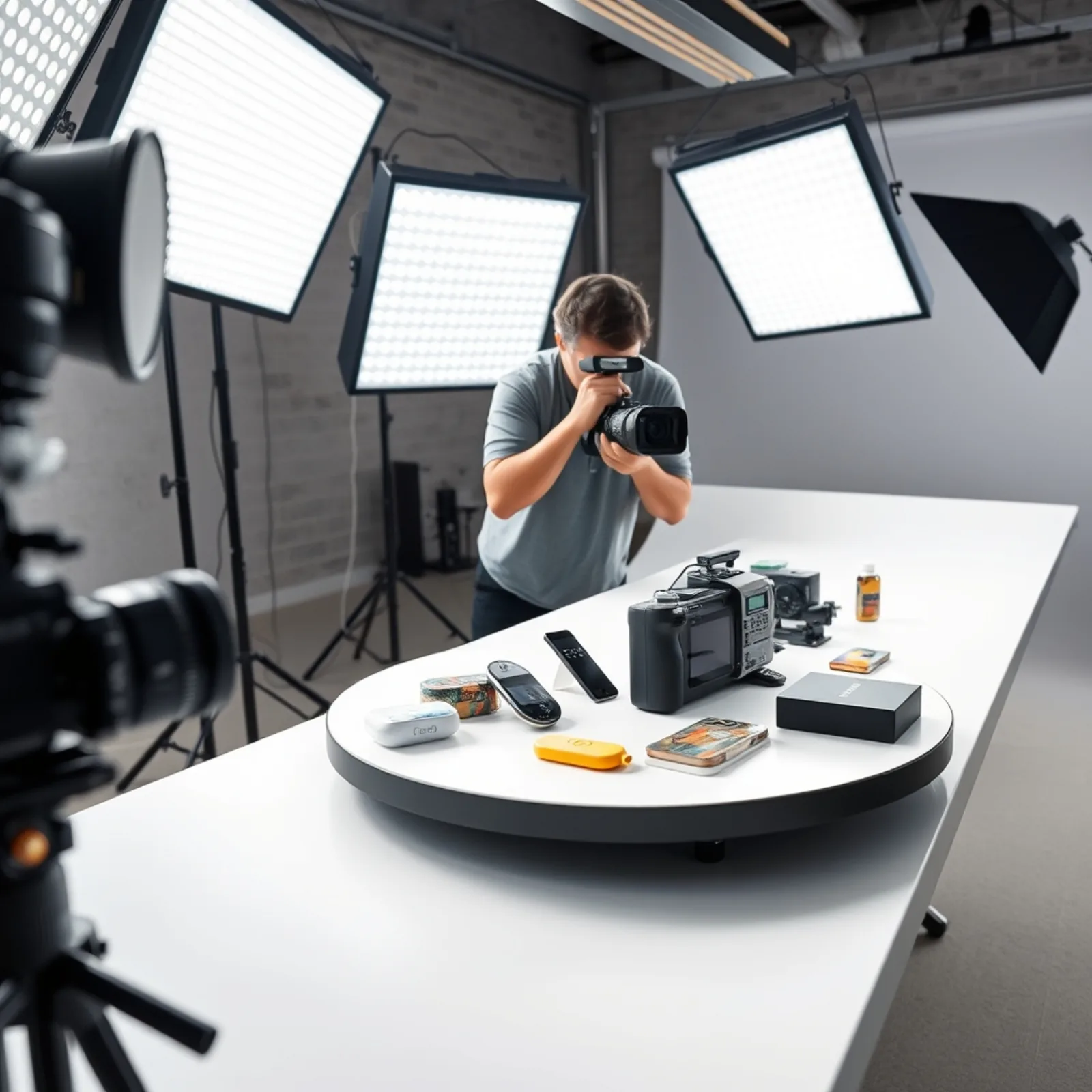
The price of a video packshot depends first on the number of SKUs shot on the same day, not on image quality. It is the dominant variable, and the one public rate cards say least about. On a set, the lighting, the backdrop, the motorised tripod and the colour calibration are set up once. After that, each extra SKU costs the time to place it, shoot it and export it.
The economics are the same as in product photography, where the mechanism has long been documented. Photographe-produit.fr applies sliding-scale rates from 10 images, with a daily rate on quotation for collections. Utopix, in its rate card of 29 May 2024, indicated that a packshot can drop from €150 to €20 depending on the volume ordered. The data is dated, and video pricing is not photo pricing, but the principle holds: it is the setup divided by the number of SKUs that sets the unit price.
| Volume ordered | Observed unit price | What happens on set |
|---|---|---|
| 1 to 5 SKUs | €250 to €450 / SKU | Nobody amortises the setup; a half-day is billed |
| 6 to 20 SKUs | €150 to €250 / SKU | A full day, pace of 2 to 3 SKUs per hour |
| 21 to 50 SKUs | €110 to €170 / SKU | Two to three days, editing industrialised on a template |
| 51 to 200 SKUs | €80 to €130 / SKU | Full production line, one assistant dedicated to handling the product |
These ranges are the ones we charge and the ones we see in competitors' quotes when we are asked to arbitrate. They come from no published study: treat them as a negotiating benchmark, not a price scale.
Two categories break the sliding scale. Textiles, because they need pressing, pinning, sometimes a model: allow 30 to 50% more time per SKU. And fresh food, because the product degrades under the lights and you need duplicates. In these two families, a quote of “€90 per SKU” signals either an underestimate or a very poor deliverable.
How much does a demo or UGC video for advertising cost?
An ad creative is not bought by the video: it is bought by the batch, meaning one master plus three to five hook variants and two ratios. Paying €400 for a single video meant for acquisition is buying a lottery ticket. Platforms consume creatives in bundles, and a single version produces no usable information.
Hence the right calculation. A product UGC batch sits between €350 and €900 depending on the number of variants and the scope of rights. The creator's share ranges from €75 to €400 according to Takema Studio (2026); the rest is the brief, shipping the product, review, editing the variants, subtitling and exporting to the right formats. For the detail of creator prices and rights durations, we have covered it separately in our article on the cost of a UGC video in France.
The studio demo video follows a different logic. A set-up is built for one product: hands, gestures, before/after, cutting, texture. Weplus (2026 rate card) places a half-day shoot with a 1 to 2 minute edit between €900 and €2,700 excl. VAT. For an e-commerce product, LittleBox Films' range of €600 to €2,000 covers the same reality: a short shoot, a single deliverable.
What we stopped selling: the single demo delivered on its own. We now always deliver it with its variants, because the client would come back three weeks later asking for “the same one in 9:16 and with a different hook”, and without properly sorted rushes or a budget set aside, that becomes a second quote. The batch avoids that conversation.
What really makes a quote vary: the shoot, the rights or the variants?
The shoot rarely accounts for more than 40% of a product video quote; pre-production and variants often weigh just as much. It is the item buyers look at least, and the one that best explains price gaps between two apparently identical quotes.
Topo Vidéo, in its rate card of 27 December 2025, prices pre-production separately: a briefing session free or billed at €200 to €500, script or scenario writing between €300 and €800, storyboard with technical breakdown between €400 and €1,000. On a catalogue packshot, these lines fall to almost zero, which is exactly why a SKU costs €120. On a product demo, they can account for a third of the budget.
The items, in the order they appear on a serious quote:
- Brief and script: €0 on a catalogue batch, €300 to €800 for an argued demo.
- Product logistics: receiving, checking, storage, return. Underestimated everywhere. On 50 SKUs, it is half a day's work.
- Shoot: €900 to €2,700 excl. VAT per half-day for a dedicated set-up (Weplus, 2026), or a studio day amortised across the batch.
- Master edit: the first edit is always the most expensive; the following ones are template work.
- Variants: ratios, lengths, subtitled versions, text-free versions for international use. €15 to €40 per variant in a batch.
- Broadcast rights: free on product images with nobody on screen, billed as soon as a face, a voice or registered music enters the frame.
- Re-shoot: the ghost line. It never appears on the quote and is always settled at the end of the project.
A belief to put away: the Paris premium. La Fabrique du Net counted in June 2026 nearly 200 studios and agencies claiming audiovisual production expertise with an office in France, the typical studio established since 2019, with a concentration in Paris but hubs in Lyon, Toulouse, Lille, Nantes, Nice, Marseille, Bordeaux and Rennes. Their reading: this regional presence explains the absence of a Paris premium on budgets. Paying more because the studio is in Paris has no structural justification; paying more because it shoots 80 SKUs a day does.
The same breakdown exercise, applied this time to the social format, is detailed in our line-by-line quote for an Instagram Reels production.
Does an AI video generator replace catalogue video production in 2026?
AI has collapsed the cost of generating a product video, not the cost of validating it, and on a catalogue it is validation that is expensive. Digen offers dollar subscriptions from about $10 a month, with a quota expressed in credits and a resolution cap of 1080p. Revid AI generates product videos directly from an e-commerce URL, the system extracting the key information from the product page, with a freemium model in 2026 (Campioni, 16 February 2026). Technically, it works.
The snag comes afterwards. A generation from a product photo distorts the packaging typography, misses the texture of a fabric, invents a hand holding the item at an odd angle, shifts a mandatory legal notice. For an e-commerce account with 200 SKUs, every output has to be reviewed by someone who knows the product. That is internal time, at a loaded hourly cost that appears in no tool comparison.
Our position, plainly: AI is excellent for multiplying the variants of an already validated asset, changing a background, producing six visual hooks, testing twelve opening seconds. It is poor at creating the reference asset for a physical product the customer will receive at home. The gap between the video and the parcel is a product return.
And “AI” does not mean “cheap”: Obeevi places supervised AI video production in 2026 between €1,000 and €10,000 depending on the project. As soon as there is art direction, brand consistency and compliance control, the budget catches up with a conventional production. That control also has a legal framework: according to the European Commission FAQ, Article 50 of the EU AI Act has applied since 2 August 2026, and both providers and deployers of AI systems have had to comply with its transparency obligations since that date.
What we cannot yet measure properly: the review rejection rate for generated product videos, by category. We see it as very high on cosmetics (texture, shine, bottle transparency) and rather low on matte-surface products with simple shapes. We do not have enough volume to publish an honest figure.
Where should you place product video, and how do you know whether a SKU has paid for itself?
A product video is not judged by the same metric depending on whether it lives on a product page, in an ad feed or in a shoppable format. Three placements, three ways of counting, three budgets not to mix up.
On the product page
The metric is the page conversion rate and the product return rate. A packshot video that shows the real scale, the material and the opening mechanism lowers returns for “does not match the description”. Trusted Shops reminded readers in 2026 that social proof, reviews, photos and usage videos, remains a direct lever for reassurance and conversion. Measure over 30 days, with a control group of SKUs not equipped. These returns have a legal framework: as the Bpifrance Création fact sheet on the right of withdrawal recalls, the consumer has 14 days to withdraw from a purchase made at a distance.
In the ad feed
The metric is cost per acquisition and the lifespan of the creative before fatigue. A pure packshot works poorly there on its own: it lacks a human hook in the first two seconds. That is why we almost always pair it with a UGC creative or a hands-on demo.
In shoppable and live formats
Videopop described in March 2026 the rise of shoppable videos, where each element becomes clickable with price and add-to-cart without interrupting playback, of live shopping arriving from Asia and of shoppable stories in native vertical. These formats consume a lot of assets and cope poorly with a library of three videos. Before going there, check that your catalogue is already covered in video packshots, otherwise you are setting up an empty shop window.
What budget should you plan for a catalogue of 10, 50 or 200 SKUs?
The cost per activated SKU goes from about €290 on a 10-SKU catalogue to about €115 on 200 SKUs, for an identical deliverable. That is the only figure that lets you decide, because it includes pre-production, variants and volume, not just the headline price of a video.
| Scenario | Pre-production | Production | Variants | Total excl. VAT | Cost / SKU |
|---|---|---|---|---|---|
| 10 SKUs, video packshot only | 400 € | 2 200 € | 300 € | 2 900 € | 290 € |
| 10 SKUs + 2 ad demos | 900 € | 3 800 € | 700 € | 5 400 € | 540 € |
| 50 SKUs, video packshot only | 800 € | 6 500 € | 1 200 € | 8 500 € | 170 € |
| 50 SKUs + 5 ad creatives | 1 400 € | 9 800 € | 2 300 € | 13 500 € | 270 € |
| 200 SKUs, video packshot only | 1 500 € | 18 000 € | 3 500 € | 23 000 € | 115 € |
| 200 SKUs + 10 ad creatives | 2 600 € | 24 500 € | 5 400 € | 32 500 € | 162 € |
Associated lead times: 2 to 3 weeks for 10 SKUs, 4 to 6 weeks for 50, 8 to 12 weeks for 200 with delivery in waves. These amounts correspond to our production batches, excluding product shipping costs and creator rights.
The “variants” line deserves a pause, because that is where budgets slip. Multiplying ratios on principle is expensive and pointless: the number of formats to produce follows from the placements you actually buy, as we explain in our comparison of 9:16 and 4:5 by placement. On a Shopify product page, a single ratio is often enough.
How we decide with our e-commerce clients: we never shoot the entire catalogue at once. We take the 20% of SKUs that make 80% of the revenue, equip them, measure over 45 days, then decide whether the rest is worth it. A 200-SKU catalogue where 140 sell fewer than three units a month does not need 200 videos; it needs 40 videos and better merchandising.
If your need looks more like a continuous flow than a one-off project, the unit of purchase shifts to the monthly subscription: Emeric Visuals placed, on 1st April 2026, support with regular social content from a versatile videographer at between €1,000 and €2,500 excl. VAT a month. Our analysis of the monthly video content creation budget details this model.
How do you read a product video quote and spot the 6 lines that cost you later?
Six formulations, always the same ones, turn a product video quote into an open-ended bill. They are not dishonest: they are vague, and vagueness is always paid for on the buyer's side. We have published the general comparison mechanics in our 4-step method for comparing two video production quotes; here, we stick to the lines specific to a product catalogue.
| Quote line | Wording to refuse | Wording to demand | Extra cost avoided |
|---|---|---|---|
| Broadcast rights | “Web use” | “Paid social worldwide, 12 months, renewable at €X” | €300 to €900 per creative |
| Format variants | “Multi-format exports” | “9:16 and 4:5, unit price beyond that: €X” | €15 to €40 per export |
| Re-shoot | Absent from the quote | “5% of SKUs redone at no charge” | 1 studio half-day |
| SKU added mid-project | “On quotation” | “Unit price guaranteed for 6 months: €X / SKU” | €50 to €150 per SKU |
| Product logistics | Not mentioned | “Receipt, 30-day storage, return at our cost” | €150 to €400 per batch |
| Source files | “Delivery of the final videos” | “Rushes and edit project files handed over, archived for 12 months” | A complete reshoot |
The source-files line is the one we defend most often in meetings. An e-merchant who changes agency without getting their rushes back starts again from zero on their catalogue. It happened with a client who arrived in 2025 with 90 SKUs already shot elsewhere: without the sources, we had to re-shoot everything. Seven thousand euros for a missing clause.
Where should you start if you have no product video yet?
A first commitment of ten packshot SKUs plus two ad creatives comes to around €5,000 to €5,500 excl. VAT, according to our grid above. It is enough to measure something and small enough to get it wrong without pain.
The sequencing that works: choose ten high-turnover SKUs, shoot, go live, and keep ten comparable SKUs without video for six weeks. On the ad creatives, launch the variants together and let the algorithm sort them. Only then decide on the rest of the catalogue.
Something rarely said when you sell production: some catalogues do not need product video. A spare-parts site listed by part number, where the buyer is looking for compatibility and nothing else, gets far more value from a clear technical sheet than from an animated packshot. Product video is useful when the doubt concerns material, size, gesture or use. When the doubt concerns a technical reference, it is useless.
The day you ask for a quote, do not start with “how much does a product video cost”. Ask: how much does my SKU cost, delivered in two ratios, usable in advertising for twelve months, with the sources. The answer to that question is comparable from one studio to the next. The other is not.
Frequently asked questions
- What is the average price of an e-commerce product video in France in 2026?
- There is no usable average price, because the units of purchase differ. Published benchmarks range from €80 to €200 per SKU at Apresta to €600–2,000 per video at LittleBox Films (2025). For a catalogue packshot, allow €80 to €250 per SKU depending on volume; for an ad creative delivered with its variants, €350 to €900 per batch.
- What is the price difference between a video packshot and a demo video?
- A video packshot is shot in series on a set that is already configured: €80 to €250 per SKU. A demonstration requires a script, a dedicated set-up and a half-day shoot, billed at €900 to €2,700 excl. VAT according to Weplus (2026). The gap comes not from image quality but from pre-production and set time that cannot be shared.
- Should you pay for a product video per SKU or on a monthly retainer?
- Per SKU when the need is a catalogue to equip once: the price is degressive with volume and the deliverable is finished. On a monthly retainer when you publish and test every week; Emeric Visuals places this type of support between €1,000 and €2,500 excl. VAT a month in 2026. Many brands do both: a catalogue batch at the start, then a monthly output.
- How much does a product video cost on a freelance marketplace?
- ComeUp lists product video ads from $62.59 with an observed average budget of $149.99. That suits an isolated test on one SKU. The limits: broadcast rights rarely framed, no guarantee of rework, no handling of the physical product's logistics and a single deliverable with no variants, therefore unusable for a serious ad test.
- How many product videos do you need to find a winning creative?
- Think in batches, not units: a usable ad test needs one master and three to five hook variants run simultaneously. The number of batches needed depends on your offer and your audience. We detail the full calculation in our article on the cost per winning creative of an e-commerce UGC agency.
- Are advertising broadcast rights included in the price?
- On a video packshot with nobody on screen, yes most of the time: there is neither image right nor creator fee. As soon as a face, a voice or registered music appears, rights are billed separately, by territory and by duration. Demand the exact wording in the quote: medium, geographic area, duration and renewal price.
Let's price your catalogue per SKU
You now know that the price of a product video means nothing until the unit of purchase is fixed. Esekai is a vertical-video studio: creative ads, UGC and organic content for TikTok, Reels and Shorts, with a dedicated Creative Strategist, in-house shooting and editing, and fast iterations on variants. A thirty-minute meeting: we talk about your SKUs, your formats, your budget and the plan. No agency pitch deck.
Book a call →30 minutes to talk formats, budget and action plan.