

An e-commerce video agency designs and produces vertical videos at volume for online selling: product videos, UGC and creative ads for TikTok, Instagram Reels and YouTube Shorts. It differs from a traditional video agency, which bills per project (median €6,500 for a corporate video in France according to the La Fabrique du Net barometer, data as of June 2026, more than 170 real projects), through billing by monthly volume of assets and iteration driven by ad performance. Two economies, two price grids. Comparing one with the other’s calculator means choosing the wrong provider. According to the Fevad annual review relayed by Ecommerce Mag in February 2026, online commerce generated €196.4 billion in revenue in France in 2025, up 7% year on year.
What is an e-commerce video agency, and how does it differ from a video agency in general?
A traditional video agency sells a one-off piece; an e-commerce video agency sells throughput. That is the whole difference, and you can read it in the structure of the quote before you can read it in the results.
An audiovisual production studio is organised to deliver a film. A brief, a moodboard, a recce, a crew for two or three days, a 16:9 master, a few cut-downs. The craft is real, the quality is often excellent, and for a brand film or a manifesto, it is exactly what you need. Look at the pages of the studios positioning themselves on “e-commerce video agency”: they advertise corporate films, interviews, motion design, reportage. Nothing untrue about that. It is simply a different trade.
An online retailer pushing €15,000 of media a month on Meta and TikTok does not need a film. They need 25 to 40 vertical videos a month, across three or four different creative angles, with interchangeable hooks, and the capacity to pull what isn’t working after nine days. That is not a production order. It is a production line.
The nuance few agencies will own up to: technically, any studio can produce a 20-second vertical video. The problem isn’t skill, it’s economics. A studio whose model rests on €6,500 projects cannot turn out 30 assets at €250 apiece without destroying its margin. So it will offer you 4 beautifully crafted videos for the same budget. You will have lovely videos and not enough material to run an ad account.
The media market explains why this subject is becoming central. According to IAB Europe (data published in July 2026), European digital advertising reached €131.1bn in 2025, up 10.5%, including €34.0bn in video and €35.5bn in social advertising. The money is there. For our e-commerce clients, the bottleneck is never the available media budget; it is the number of fresh creatives you can put into it each week. In France, the 35th SRI e-advertising Observatory (February 2026) puts the digital advertising market at €12.4bn in 2025, up 11%, driven in particular by Social and Video.
For the strictly format-related side — ratios, durations, safe zones, platform-specific adaptations — we have already covered everything in our guide to e-commerce vertical video formats. Here, we are talking about money and model.
Two trades, two price grids
| Criterion | Production studio | E-commerce video agency | What it changes for your P&L |
|---|---|---|---|
| Billing unit | The film | The asset or the monthly batch | Fixed cost vs. manageable variable cost |
| Typical deliverable | 1 16:9 master + reformats | 20 to 60 vertical 9:16 videos | Ability to keep ad sets fed continuously |
| 2026 reference price | Median €6,500 per project (La Fabrique du Net, June 2026) | Price per asset + monthly fee | No direct comparison possible without converting |
| Cost of a variant | Re-billed at almost full price | Low marginal cost | Testing becomes affordable |
| Brief-to-delivery turnaround | Several weeks | A few days | Responsiveness to peaks and stock-outs |
| Who writes the concept | Director / art director | Creative strategist fed by ad data | The brief comes from the numbers, not from taste |
| Casting | Actors, extras | UGC talent, real customers, staff | A very different cost line |
| Usage rights | Often included, long duration | To be negotiated per talent and per duration | The forgotten line that balloons at renewal |
| Success metric | Client approval | Hook rate, CTR, cost per winning creative | A measurable result, or not |
| Main risk | A beautiful film that doesn’t convert | Volume without creative direction | Two different ways of burning cash |
What does an hour of video editing cost, and why is that question costing you money?
An hour of video editing is billed at €40 to €60 excl. VAT from a junior freelancer, €60 to €90 excl. VAT from an experienced editor, and €90 to €150 excl. VAT at a studio or agency, but on a vertical e-commerce asset, editing rarely accounts for more than 15% of the total cost.
These ranges are the ones we see circulating on French quotes in 2026, from the providers we come across and on our own outgoing tenders. As a public benchmark: FlashBiz advertises, in 2026, around €500 excl. VAT for four hours of filming in Paris including a three-minute edit. In other words, the hourly labour rate, shooting and editing combined, comes out at around €60 to €80. Nothing exotic.
Now, why the question is a trap.
When a buyer negotiates the editing hourly rate, they are negotiating the least decisive item in the chain. On our vertical productions, the typical cost breakdown of an asset looks like this: concept and creative strategy 20 to 25%, casting and talent fees 25 to 35%, shoot 20 to 25%, editing and post 12 to 18%, usage rights 5 to 15% depending on the negotiated duration. The ranges shift depending on whether you shoot in a studio or at a creator’s place, but the order of magnitude holds. Saving 20% on editing means saving 3% on the asset. Saving 20% on the number of variants coming out of a single shoot means saving 20% on everything.
What is expensive in e-commerce video isn’t editing. It’s deciding what to shoot. A concept with nothing to say, edited by the best editor in France, is still a concept with nothing to say, and it will cost you the same CPM as everyone else’s.
So the right question to ask a provider is not “how much per editing hour”. It is: how many assets delivered per month, how many alternative hooks per concept, and at what price the marginal variation. Three questions, three numbers. A provider who can’t answer all three works per project, not at volume.
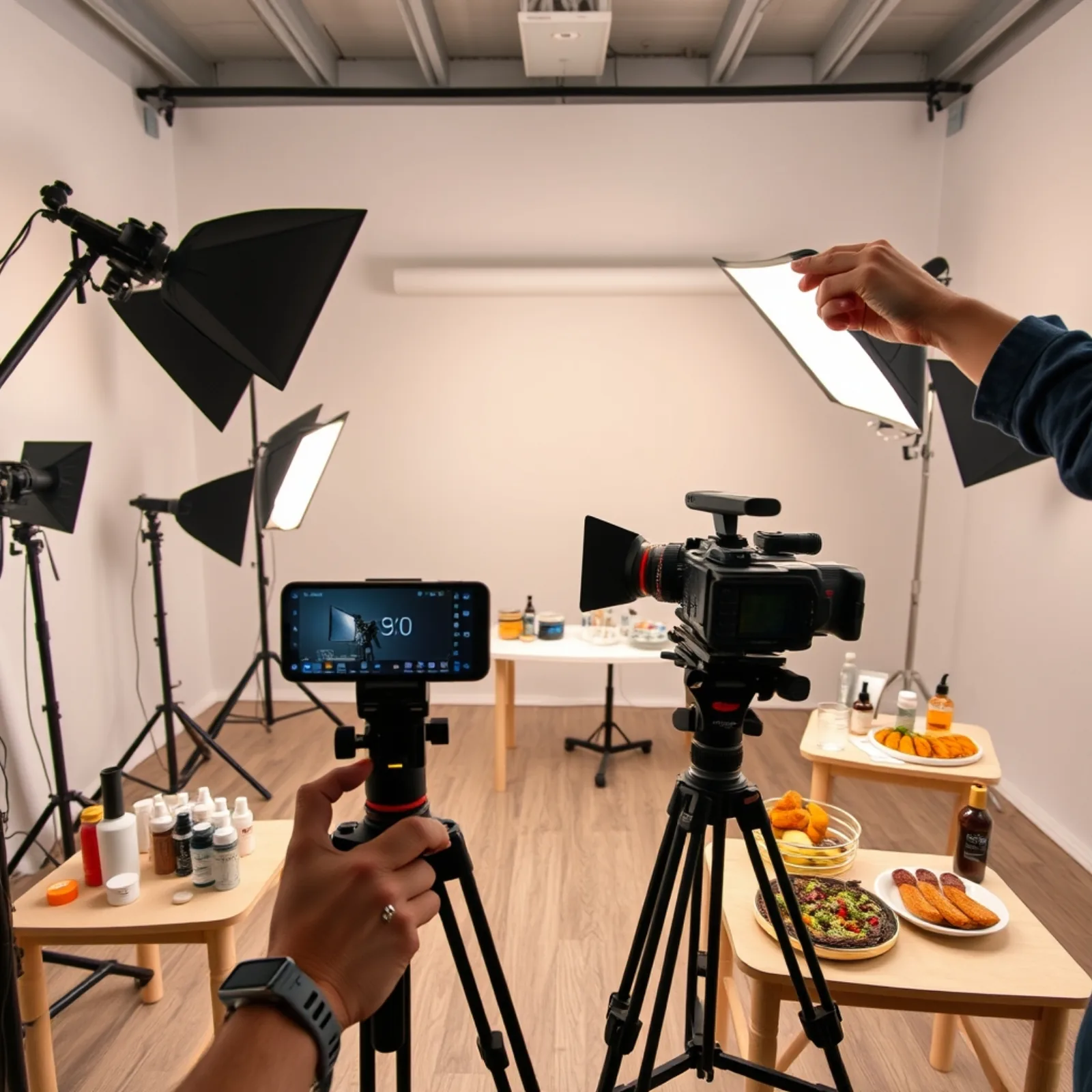
What does an e-commerce video really cost in 2026: per asset, per batch, per month?
Budget €150 to €600 excl. VAT per vertical asset in batch production, i.e. €4,000 to €12,000 excl. VAT per month for a flow of 25 to 40 videos, whereas a single corporate video is billed at a median €6,500 excl. VAT according to the La Fabrique du Net barometer (June 2026, more than 170 real projects).
Let’s start with the public price grids, sourced and dated, because that is the only solid ground.
- La Fabrique du Net, June 2026median €6,500 for a corporate video, from around €5,250 for an edit only to €12,500 for an advertising spot, across more than 170 real projects. Observed range: from under €2,000 for a simple edit to more than €50,000 for a full audiovisual campaign.
- Topo Video, 27 December 2025between €1,500 and €15,000 excl. VAT for a corporate video, depending on the type, the shooting days, the size of the crew and post-production.
- WePlus, 2026from €1,200 to €5,000 excl. VAT in Paris for a 1-to-3-minute corporate video: one shooting day, dynamic editing, a few graphic touches, delivery in optimised formats.
- Lowup, 20 February 2026from €1,500 to €10,000 excl. VAT in a regional studio, packages starting at €1,505 excl. VAT.
These figures are accurate. They are also unusable as they stand for an online retailer. At €6,500 a unit, a flow of 30 videos a month would cost €195,000 a month. Nobody does that. So either the figure doesn’t apply, or the need isn’t the same. It is the second hypothesis.
The conversion table: from price per project to price per asset
The shift from one economy to the other rests on a single mechanism: the batch shoot. You don’t shoot a video, you shoot a day. On our productions, a well-prepared batch shooting day yields 20 to 30 deliverable assetsmultiple framings, hook variants, isolated product shots, 9:16 and 4:5 formats. The number depends a lot on the product: an object that can be handled (cosmetics, food, accessories) goes towards the top of the range, a technical product or a B2B service drops back noticeably.
Once this mechanism is in place, fixed costs get diluted. The recce, the lighting setup, the brief, the product logistics, the talent’s attendance: all of it is paid once for 25 deliverables instead of once for one deliverable.
| Production model | Observed cost | Usable assets | Cost per vertical asset |
|---|---|---|---|
| Per-project corporate video (LFDN median, June 2026) | €6,500 excl. VAT | 1 master + 2 to 4 reformats | 1 300 à 2 200 € |
| Corporate Paris 1-3 min (WePlus, 2026) | €1,200 to €5,000 excl. VAT | 1 à 3 | 400 à 2 500 € |
| UGC creator, per unit | €150 to €500 excl. VAT / video | 1 (+ rights separate) | 150 à 500 € |
| Studio batch shoot, 1 day | €4,500 to €9,000 excl. VAT | 20 à 30 | 180 à 400 € |
| Variation on existing rushes | Marginal cost | Unlimited in theory | 15 to 30% of a new concept |
That last line is the one that decides your average cost. A variation — a new hook on the same rushes, new subtitling, a 15-second version cut from a 30-second one, language adaptation — costs us between 15 and 30% of a new concept in production. That is why a monthly flow isn’t 30 times the price of one video: it is 6 to 8 new concepts and 20 to 25 variations.
The breakdown by industry, with the gaps between food, fashion, beauty and B2B, is in the detailed pricing grids by industrywe won’t replay it here.
Our internal benchmark, to be discussed at the first meeting: an online retailer spending less than €300 of media per asset produced is overproducing. One spending more than €1,500 per asset is underproducing and paying for creative fatigue in CPM.
What does a digital marketing agency charge, and how do you read the “creation” line in its quote?
A digital marketing agency generally charges €1,500 to €8,000 excl. VAT a month on retainer for an e-commerce SME in France, fees excluding media, and in most of the quotes we see, the “content creation” line specifies neither the volume, nor the format, nor who produces.
A marketing manager at an e-commerce SME summed it up for us like this: the quote mixed consulting, creation and media; since then, he demands one line per item.
This mixing is not always dishonesty. A 360 agency sells steering: strategy, media buying, tracking, reporting. Creation is a means there, not the product. The problem appears when you discover, in month three, that the “content included” package amounted to 4 monthly videos subcontracted to a freelancer you will never meet.
The three questions that expose the truth in ten minutes
- How many assets, exactly, in the package? Not “regular content”. A number. And the definition of an asset: does a 30-second video and a 6-second variation count as one or as two?
- Who shoots and who edits? In-house, freelance, offshore platform? Ask for the editor’s name. An agency that genuinely produces answers without hesitation.
- What happens if a creative works? Is the variation included, re-billed, capped? That is where the models part ways. An agency structured for e-commerce has a price for variations. An agency structured for projects will give you a new quote.
A telling detail from the La Fabrique du Net barometer, June 2026: more than half of the requests submitted state no budget, and those are systematically the ones that receive the worst-calibrated proposals. Hiding your budget to “see what they offer” is the worst buying tactic in video production. The agency doesn’t know whether you want 4 films or 40 assets, so it proposes what it sells best.
If you have a quote on the table right now, run it through the filter: we have listed the 11 red flags on a video quote, from the “unlimited” package to missing usage rights.
How many videos do you need to produce each month for an e-commerce campaign to hold up?
Budget 1 new creative concept per €2,000 to €3,000 of monthly media budget, and 3 to 5 variations per concept: an online retailer spending €20,000 a month on media needs 7 to 10 concepts and 25 to 40 assets a month to avoid suffering creative fatigue.
This ratio comes from our campaigns, not from a published study. We present it as such. It varies with the size of the audience addressed: on a narrow French audience, frequency climbs quickly and you refresh more often; on a broad multi-country audience, a concept can last six weeks.
The calculation logic, in order:
- Start from the monthly media budget. According to the Gartner CMO Spend Survey, the average marketing budget weighs around 7.7% of revenue and paid media around 30% of that budget, check the edition cited. For an online retailer with €5M revenue, that gives around €122,000 of paid a year, i.e. ~€10,000 a month.
- Divide by €2,500: about 4 new concepts a month.
- Multiply by 4 variations: 16 assets a month.
- Set your target cost: a creation budget at 15-20% of media gives €1,500 to €2,000, i.e. €95 to €125 per asset. Too low for a studio batch, consistent for a mix of UGC creators + in-house editing.
That fourth point is the awkward one. Many online retailers want studio quality at creator prices. At €10,000 of monthly media, the realistic model is not the full-service agency in batch shoot: it is a tightly managed pool of creators, plus an agency stepping in on the quarterly concepts. We tell prospects this every month, including when it costs us the deal.
The other variable is the survival rate. On our e-commerce productions, you should count on average 5 to 8 variants tested for one creative that passes the scale threshold and stays in delivery for more than three weeks. Some months it’s 1 in 3, some months 1 in 12. It is this dispersion that makes the unit price secondary: the only figure that matters is the cumulative cost per winning creative. We detail the full calculation of cost per winning creative in a dedicated article, with the formula and two worked cases.
A concrete example of what real volume produces, a scale up: the Ciao Energy campaign, launched in 2026 by Squeezie with Léna Situations and Inoxtag (after Ciao Kombucha in May 2025), was fed by a near-daily vertical flow, without a classic advertising brand film. We dissected it format by format in our analysis of the Ciao Energie launch. The budget is not an SME’s; the cadence mechanics, however, can be copied.

What is the best content creation agency in France, and why is the question badly framed?
There is no best video or content creation agency in France: “top 10 agencies”-type rankings are built on seniority, the volume of requests handled and the reviews posted on the platform publishing them, never on the fit between a production model and your monthly volume.
This isn’t a stance. It’s arithmetic. According to La Fabrique du Net (June 2026), nearly 200 studios and agencies claim audiovisual production expertise with an office in France, the typical studio has been established since 2019 as a median, and the market is heavily concentrated in Paris with hubs in Lyon, Toulouse, Lille, Nantes, Nice, Marseille, Bordeaux and Rennes. A 10-line ranking therefore covers 5% of the market, selected on criteria that have nothing to do with your need.
The same mechanics apply to “the 10 best web agencies in France”: these league tables are directory pages, not assessments. The provider at the top often has the best sales profile on the platform, which is a piece of information, but not the one you are looking for.
Six qualification criteria, three of them verifiable in twenty minutes
Verifiable right away, without a meeting:
- 1. The portfolio format. Open the client cases. If they are 16:9 films with licensed music and voice-over, you have a corporate studio. If there is only subtitled 9:16, shot in natural light or in a tight studio, you have a vertical operator. The TikTok advertising help centre also lists, among the basics of a high-performing creative, 9:16 vertical orientation and a resolution of at least 720P.
- 2. The presence of public figures. An agency producing at volume knows its cost per asset, its median lead time and its survival rate. An agency that publishes no figures probably doesn’t measure them.
- 3. The vocabulary of the site. “Hook rate”, “thumbstop”, “variation”, “ad set”, “iteration” on one side. “Emotion”, “brand storytelling”, “visual signature” on the other. Words give away the production chain.
The other three require a call:
- 4. Who writes the briefs, and from what? Ask to see an anonymised brief. If it contains no campaign data, the creative strategist is an art director in disguise.
- 5. The brief → live asset lead time. With us, the median is around 8 to 12 working days on a new concept, 3 to 5 days on a variation from existing rushes. A provider who announces three weeks minimum won’t be able to keep up with an active ad account.
- 6. What they refuse to do. An agency that accepts everything — vertical video, website, SEO, print, events — cannot be structured for vertical throughput. Our own answer: we don’t make brand films, or long-form 16:9 production. It costs us tenders.
To formalise all this, rather than a top 10, use the 100-point audit grid: it turns these criteria into a score you can compare between two providers.
Agency, freelancer, UGC creators or in-house studio: how do you decide based on your volume?
The tipping point towards a specialist e-commerce video agency sits around €15,000 of monthly media budget: below that, a UGC creator pool managed in-house costs less and is enough; above €60,000, the hybrid in-house team + agency model becomes the most profitable.
These thresholds are the ones we observe across our portfolio of French e-commerce clients. They shift according to two factors: the number of product references to cover (a 200-SKU catalogue consumes content far faster than a single-product brand) and whether or not you have an in-house creative profile able to brief.
| Monthly media budget | Assets / month | Recommended model | Creation budget | Signal that it’s time to change |
|---|---|---|---|---|
| < €5,000 | 4 à 8 | Direct UGC creators + freelance editing | 800 à 2 000 € | You spend your evenings briefing |
| 5 000 à 15 000 € | 10 à 20 | Managed UGC pool + quarterly concepts from an agency | 1 500 à 4 000 € | Your hooks are repeating, CTR is dropping |
| 15 000 à 60 000 € | 25 à 45 | Specialist e-commerce video agency, monthly batch | 4 000 à 12 000 € | You wait for deliverables before launching |
| > €60,000 | 50 and above | In-house (strategist + editor) + agency on concepts | €12,000 and above | Cost per asset no longer drops with volume |
The case we see most often badly arbitrated is the third tier with a strong in-house profile. Some brands gain by bringing editing in-house and keeping the agency only for the shoot and creative strategy. Others don’t, because a lone in-house editor becomes a bottleneck as soon as they go on holiday. It is worked out case by case; we have set out the method for choosing between an agency and an in-house team.
The cases where you should not hire an e-commerce video agency
- You haven’t validated your product-market fit yet. No volume of creatives makes up for an offer that doesn’t sell. We would have you spend €6,000 to learn that.
- Your tracking is broken. Without reliable conversion data, creative iteration runs blind and you pay for volume without a feedback loop.
- You are looking for a brand film for a trade show, a website or a fundraise. Hire a production studio. It’s their trade, and they will do it better than we would.
- Your average basket is below €25 with no subscription or repurchase. Unit economics rarely forgive the creative cost of a sustained vertical flow. To put this threshold in context, the Fevad 2025 e-commerce review indicates that the average online basket in France fell 3% to €62.
The last point deserves a nuance: we have seen small-basket brands hold up thanks to a high repurchase rate and a solid 12-month LTV. That is the only calculation that counts, and it is done with your numbers, not with a general rule.
What we still can’t measure properly
Two grey areas, we may as well say so. The first: the brand effect of vertical. We know how to attribute a ROAS to a creative, we don’t know how to isolate what a flow of 40 videos a month does to a brand’s awareness over twelve months. Incrementality models are expensive and need volume. The second: the real contribution of organic content to sales when it runs alongside paid. The two feed each other, and measurement remains approximate. Anyone selling you a clear-cut answer on these two points is selling you a conviction, not data.
One last figure to finish, because it sums up the trade-off: at a constant creation budget, going from 8 to 30 monthly assets does not divide your performance by four. For our clients, it multiplies it, because the probability of finding a creative that scales follows the number of draws. E-commerce video production is a business of statistics, not masterpieces. It is less flattering to tell in a meeting. It is what sells.
Frequently asked questions
- What are the 10 best web agencies in France?
- No list of 10 honestly represents the market: La Fabrique du Net counted, in June 2026, nearly 200 studios claiming audiovisual production expertise in France. These rankings rest on seniority and the reviews posted on the platform publishing them. Instead, qualify 3 providers against your real need: delivered format, monthly volume, brief-to-delivery lead time.
- What does an hour of video editing cost?
- Between €40 and €60 excl. VAT from a junior freelancer, €60 to €90 excl. VAT from an experienced editor, €90 to €150 excl. VAT at a studio or agency, according to the French quotes we see circulating in 2026. On a vertical e-commerce asset, editing represents 12 to 18% of the total cost: negotiating that line changes almost nothing to your overall budget.
- What does a digital marketing agency charge?
- Budget €1,500 to €8,000 excl. VAT a month on retainer for an e-commerce SME, fees excluding media buying. Demand one line per item: consulting, creation, media, reporting. According to La Fabrique du Net (June 2026), more than half of the requests submitted state no budget, and those are the ones that receive the worst-calibrated proposals.
- What is the best content creation agency in France?
- The best agency is the one whose production model matches your monthly volume. For 4 videos a year and a brand film, a generalist production studio. For 25 to 40 vertical videos a month driven by ad performance, a specialist e-commerce video agency. Both exist; they are not interchangeable.
- Do you need a video agency in Paris to sell online?
- No. The French audiovisual production market is concentrated in Paris, with hubs in Lyon, Toulouse, Lille, Nantes, Nice, Marseille, Bordeaux and Rennes (La Fabrique du Net, June 2026). In vertical video, geography matters mainly for the product shoot: if your products travel by carrier, the studio’s location becomes secondary.
- How long between the brief and a creative going live?
- On our productions, the median is 8 to 12 working days for a new concept, shoot included, and 3 to 5 working days for a variation made from existing rushes. A provider who announces three weeks minimum on every deliverable won’t be able to keep up with the pace of an active ad account.
Let’s convert your media budget into asset volume
You have two incomparable quotes on the table: a studio that bills per project, an agency that bills by volume. Esekai produces vertical content as a flow, creative ads, UGC and organic content for TikTok, Reels and Shorts, with a dedicated Creative Strategist, in-house shooting and editing, and iterations within days. Thirty minutes on the phone: we talk formats, monthly volume, budget and action plan. No agency presentation.
Book a call →30 minutes to talk formats, budget and action plan.