

The choice between a freelancer and an agency for TikTok content comes down to volume, not unit price: below roughly 8 videos a month, a freelancer (€284 to €541 a day according to the 2026 Malt barometer) remains the most cost-effective option; beyond that, the agency becomes cheaper per winning creative, because only 1 to 3 creatives in 10 perform and TikTok ads need refreshing every week. The freelancer sells videos. The agency sells throughput. The whole trade-off lies in that difference, and this article gives you the formula to work it out on your own budget. According to Comarketing-News (September 2025), TikTok has 27.8 million monthly users in France, making it the platform's largest European market.
“TikTok agency”, “TikTok freelancer”: what exactly are we talking about?
In French, the term “TikTok agency” covers three different businesses that have neither the same client, nor the same business model, nor the same deliverable, and this is the main cause of pricing chaos in the market. When one page advertises “€300 a month” and another “€30,000”, they are not describing the same thing. They are not even describing the same sector.
So, three families. The production agency (or vertical studio) makes the video files: it is paid by the brand, per deliverable or on a monthly throughput basis. The creative ads or media agency buys and manages distribution: it is paid by fees or a percentage of spend, and production is sometimes just one line among others. The third family, MCNs, LIVE agencies and TikTok Shop agencies, represents creators, not brands, and earns its money from their revenue.
This third category pollutes search results massively. TikTok LIVE France states officially that a creator joining a partner LIVE agency is free and that the creator keeps 100% of their broadcast revenue. In other words, no money flows between a brand and this type of agency. If you are looking to buy content, these businesses are not for you.
| Type | Who pays | How it earns money | What it delivers | Relevant to a brand? |
|---|---|---|---|---|
| Production agency / vertical studio | The brand | Monthly retainer or per deliverable | Video files + variants | Yes |
| Creative ads / media agency | The brand | Fees or % of spend | Campaign management, sometimes the creative | Yes |
| MCN / LIVE agency / TikTok Shop | No one (on the brand side) | Commission on creator revenue | Creator support | No |
On the freelance side, the same blur. “TikTok freelancer” can mean an editor (who assembles the rushes you supply), a UGC creator (who films at home, with their own face and phone) or a media buyer (who produces nothing, they buy). Three distinct skill sets, three distinct day rates, and a permanent source of misunderstanding when the quote arrives. We have broken down the five trades behind the term TikTok agency in a dedicated article.
The first thing to do before any tender: write down, in black and white, what you want to find in your Drive at the end of the month. Files? A report? Sales? The answer completely changes the type of supplier you should contact.
How much does a TikTok agency cost, and a freelancer, for the same scope?
A video freelancer in France charges between €284 and €541 a day depending on seniority (Malt rates barometer, relayed by lefreelance.fr, June 2026), whereas a TikTok Ads agency engagement comes in at a median of around €30,000 excluding media budget (La Fabrique du Net, 22 June 2026). These two figures cannot be compared. The first is a day cost, the second a project cost over several months that includes media management.
The detail of the Malt barometer: €284 a day for a director with 0 to 2 years of experience, €375 for 3 to 7 years, €470 for 8 to 15 years, €541 beyond 15 years. Outside Paris, a versatile video profile hovers around €400 a day. These amounts are self-reported platform averages: they describe what freelancers advertise, not necessarily what they take home after negotiation.
On the agency figure, a caveat nobody bothers to write down: La Fabrique du Net itself states that its €30,000 median rests on 11 listed projects. Eleven. It is an order of magnitude, not a statistic. We cite it because it exists and is sourced, not because it is authoritative.
That leaves the third figure, the one that circulates most and distorts everything: a job ad published on infreelancing.com in 2026 offers €300 to €600 a month for a “freelance UGC / TikTok content creator” role. Set that amount against the €375 a day in the barometer. Six hundred euros a month is a day and a half of work for an experienced profile. Not a month. That ad does not describe a market price: it describes a hope.
| What you are buying | Direct freelancer | Gig platform | Vertical studio | Creative ads agency |
|---|---|---|---|---|
| Real purchase unit | The day | The gig (1 video) | The monthly throughput | The management + the spend |
| 2026 range | €284–541 a day (Malt) | ~$198 per UGC video (Billo) | $1,500–5,000 a month (Billo) | ~€30,000 median per project |
| Realistic monthly throughput | 6 to 10 videos | Unlimited but uneven | 20 to 60 variants | Variable (often subcontracted) |
| Backup if unavailable | None | Different seller, different style | Interchangeable team | Yes, on the management side |
| Who writes the angles | The brand, most often | No one | Creative strategist | Planner or media buyer |
| Typical breaking point | Capacity bottleneck | Brand inconsistency | Under-used fixed cost | Dilution across junior profiles |
| Best for | Low volume, solid brief | One-off test, low stakes | Weekly cadence on Ads | Large spend to manage |
We will not rework here the line-by-line breakdown of a quote: that has been done, with the line-by-line detail of four real invoices.
From how many videos a month does a freelancer cost more than an agency?
The tipping point sits at around 18 videos a month according to our model: below that, the freelancer remains cheaper per winning creative; beyond it, the studio pulls ahead, and this has nothing to do with the freelancer's talent, but with the fact that one person working alone produces no redundancy. Beyond that threshold, each extra video costs proportionally the same with a freelancer, whereas it costs less and less with a studio that amortises one shoot across several variants.
Let us run the numbers. An experienced freelancer at €375 a day. Based on our observations of production schedules, allow one shoot day for two to three finished videos, plus half a day of editing per batch of three. That gives a floor cost of €150 to €200 per delivered video, excluding the brief, excluding back-and-forth, excluding image rights if a face appears. As long as you order four a month, it is unbeatable.
The problem starts at twelve.
Because a freelancer working flat out on your account means three days a week at most if they have other clients, and they do, that is the definition of the job. On the accounts we have taken over, the real throughput of a solo creator tops out between 6 and 10 videos a month before deadlines start to slip. We mean distinct videos, not reframes. The notion of monthly throughput, detailed here, is the only unit that lets you compare two vertical video offers honestly.
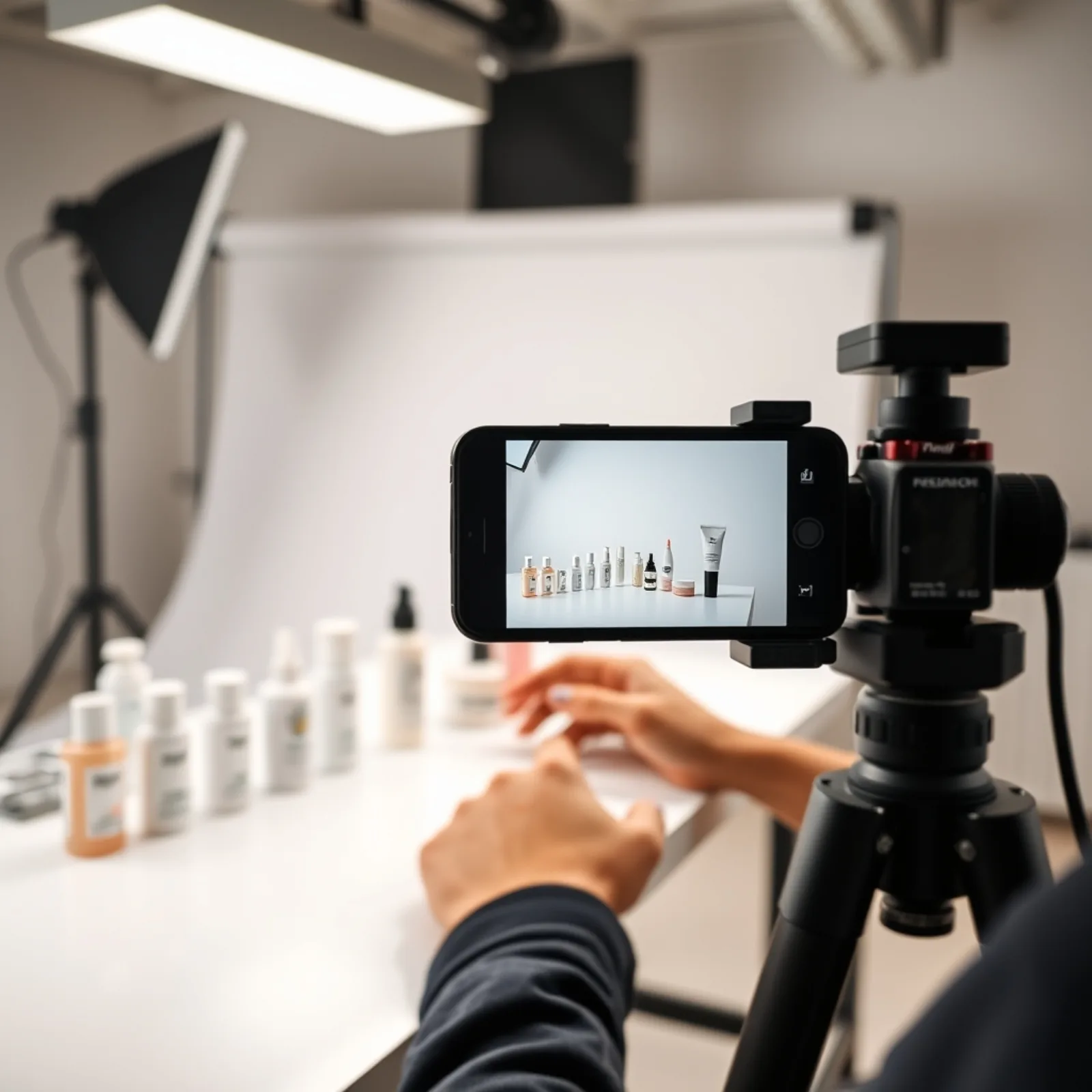
On the studio side, the cost structure is reversed. There is a fixed cost, the creative strategist, the setup, the editing process, which is absurd to pay for four videos and becomes very profitable at twenty. The lever is called the reuse ratio: on a one-day shoot, we routinely produce 6 to 10 source sequences, from which we pull 25 to 40 usable variants by playing with opening hooks, durations, subtitles, ratios and endings. This is not filler. It is exactly what the TikTok algorithm needs in order to make its choices.
A freelancer working alone cannot hold that ratio. Not for lack of skill, but for lack of hours. Producing forty variants cleanly, with a file naming system and tracking, is three days of pure editing. Three days that they either bill for or do not do.
Who absorbs the creative risk: the calculation that neither Fiverr nor Malt shows you?
Of ten creatives tested, fewer than one becomes a winner, so you are not buying videos, you are buying attempts, and the real question is who pays for the ones that fail. Motion (Creative Benchmarks 2026) puts the share of winners at around 5 to 8% of ads launched (more than 550,000 ads analysed, 6,000 advertisers, $1.3 billion in spend), an order of magnitude supported by AppsFlyer's State of Creative Optimization 2025 (1.1 million variations).
Two further data points from the same sources complete the picture: about 6% of ads capture the majority of spend, and nearly half receive almost no delivery at all. The distribution is brutally uneven. You are funding videos half of which will never be seen.
The freelancer bills you for ten videos and delivers them. A serious studio commits to something else: finding, within a given timeframe, the one that holds up. These are two different contracts, and you have to choose which one you sign.
The formula fits on one line: cost per winning creative = total monthly cost ÷ (number of deliverables × winner rate). With a cautious winner rate of 20%, here is what it gives across four volume scenarios. We apply a freelancer cost of €180 per video all-in and a studio cost of €3,200 a month for a weekly-cadence setup.
| Monthly scenario | 4 videos | 8 videos | 20 videos | 40 videos |
|---|---|---|---|---|
| Freelancer cost | 720 € | 1 440 € | €3,600 (2 freelancers) | €7,200 (4 freelancers) |
| Studio cost | 3 200 € | 3 200 € | 3 200 € | 4 500 € |
| Expected winners (20%) | 0,8 | 1,6 | 4 | 8 |
| Cost per winner, freelancer | 900 € | 900 € | 900 € | 900 € |
| Cost per winner, studio | 4 000 € | 2 000 € | 800 € | 563 € |
| Length of a test cycle | 5 to 7 weeks | 3 to 4 weeks | 1 to 2 weeks | Weekly |
Look at the “cost per winner, studio” row. It drops from €2,000 to €800 between the 8-video column and the 20-video column. That is exactly where the tipping point occurs, and it is also why the freelancer row stays flat: a freelancer produces no economies of scale, because their capacity is linear. Going from 20 to 40 videos forces them to duplicate themselves, and four freelancers on one account means four styles to reconcile. We have set out the full method for calculating the cost per winning creative elsewhere on this blog.
These amounts are our own, drawn from our rate cards and our schedules. They are not published by any institute. Replace them with your own figures: the shape of the curve will not change.
Creative fatigue, the accelerator everyone underestimates
TikTok calls for creatives to be renewed weekly, compared with every two to four weeks on Meta (Billo, 21 May 2026). During BFCM, that refresh rate doubles or even triples. In November 2025, Creatify put the average lifespan of a TikTok creative at 2 to 3 weeks before fatigue, and estimated that you need to test 10 to 20 variations to get one winner.
The signs of wear are easy to read: a 20 to 30% drop in CTR from the peak, a frequency above 3 or 4. In May 2026, Addict Mobile described the perverse mechanism: the better a creative performs, the more the algorithm concentrates impressions on it, and the faster it wears out. Your best video is the one that dies fastest.
Ask yourself honestly whether your freelancer can deliver a fresh batch every Monday, 48 weeks a year. The answer is almost always no, and that is no criticism.
What is a TikTok agent's salary, and why does this question not concern you?
A “TikTok agent” is a talent manager paid by commission on the revenue of the creators they represent, generally 10 to 30% depending on market contracts, and they never appear in the budget of a brand buying content. This question shows up on the same results page as yours because of the ambiguity of the word “agency”, nothing more.
The agent works for the creator. They negotiate partnerships, structure LIVE and TikTok Shop revenue, and sometimes manage the posting calendar. Their pay is based on what the creator earns. If you are an advertiser, you do not pay them: you may pay the creator, who then passes on their share. Cerfrance points out that a decree that came into force on 1 January 2026 requires a written contract with certain mandatory clauses between an influencer and their agent or an advertiser, from €1,000 excluding VAT.
Why devote a paragraph to this? Because we have seen brands contact a LIVE agency thinking they were ordering ads. They lose two weeks. The signal that settles it in thirty seconds: if the company talks to you about commission on creator revenue, it is not selling production. If it talks to you about deliverables and usage rights, it is.
What you should search for instead: “vertical video production studio”, “UGC agency”, “creative ads TikTok”. Three queries that lead to suppliers for whom you are the client.
What does 1,000 views on TikTok cost, and why is it the wrong KPI?
For a creator, a thousand qualified views earn between €0.40 and €1.20 through the Creator Rewards programme in France (TikTrends Online, 5 May 2026), but for a brand, a thousand views are an expense, not income, and advertising content is not eligible anyway. These two worlds have no financial point of contact, and confusing them is the first symptom of a supplier who does not master the subject.
On the creator side, the 2026 benchmarks: an RPM between $0.40 and $1.00 on average, with peaks above $1.20 in premium niches such as finance or B2B tech (VU Magazine, 17 May 2026). A million views earn €800 to €1,200 according to brand-advocacy.fr (25 September 2025). Compare that with the former Creator Fund and its $0.02 to $0.04 per thousand views: the current programme has multiplied pay by twenty to thirty.
One rule eliminates everything else. Videos under 60 seconds generate no direct revenue, regardless of the number of views (VU Magazine, 17 May 2026). Your creative ad is 6, 15 or 30 seconds long. It will never earn a cent in monetisation. Never. The payout threshold for the creator balance is set by TikTok at a low amount (around $10), to be checked in the app before making any estimate, which finishes off any relevance the topic might have for a brand budget.
On the brand side, the relevant unit is CPM, that is, what you pay TikTok for a thousand impressions bought. We do not publish a rate card here; our TikTok France CPM, CPC and ROAS benchmarks are kept up to date in a dedicated article. Remember the logic: RPM is what the creator earns. CPM is what you spend. A supplier who mixes the two in the same sentence will cost you money.
One more nuance, which works against easy reporting: in November 2025, Creatify estimated that last-click attribution undervalues TikTok by up to 10.7 times according to Marketing Mix Modeling models. We are not able to verify that multiple on our own accounts; we have no MMM among our clients. We cite it for what it is: a published order of magnitude, to be taken with caution, which above all invites you not to judge TikTok on the attribution dashboard alone.
In which situations does the freelancer win, and in which does the agency win?
The freelancer wins when volume is low, the brief is already written and the schedule is flexible; the agency wins when the cadence is weekly, the catalogue is large or the legal constraints are heavy. Six clear-cut cases, no “it depends”.
- Test launch, fewer than 6 videos: freelancer, without hesitation. Paying for a studio setup for five videos is like buying a lorry to carry a box.
- E-commerce catalogue with a high cadence: agency. Thirty products to cover is a production line, not a one-off job. The per-product quoting logic changes the whole calculation.
- Multi-market: agency. Three languages, three versions of subtitles, three sets of local compliance: a freelancer working alone becomes a bottleneck at the first client revision.
- Seasonal peak: agency, for the simple reason that refreshes are 2 to 3 times faster and nobody sustains that pace alone for six weeks.
- Brand with an existing in-house team: freelancer, almost always. If you already have a creative strategist in-house, you are buying hands, not a brain. Paying an agency to redo what your team does is the most common waste we see.
- Regulated sector: agency. Health, finance, alcohol, gambling: mandatory mentions, legal sign-offs and written rights assignments require a contractual framework that a standard freelance service contract does not cover. For gambling, Bpifrance Création points out that the influencer law of 9 June 2023 requires a clause in promotion contracts in which the creator confirms they know the applicable laws and regulations.
That leaves a seventh option, widely practised in the market and one that nobody writes about: the hybrid model. The freelancer or UGC creator shoots. The studio runs the system, the creative angles, the breakdown into variants, the tracking, the naming system, the rights. It is the set-up we most often recommend to brands producing between 8 and 15 videos a month, because it buys variable human capacity without paying a full fixed production cost.
What we have seen when taking over accounts
We regularly take over accounts after a freelancer and after another agency. The failure modes are not the same.
After a freelancer, the reason is almost always a capacity bottleneck: the brand has increased its spend, production has not kept up, the same three creatives have been running for six weeks and CTR has collapsed. Quality is not the issue. Throughput is. After an agency, the reason is different: the account was handed to a junior profile, the deliverables are clean but interchangeable, and no one knows any more which angle was tested in month 2.
There is also a cost that nobody invoices and everybody pays: the re-briefing. Every change of supplier restarts a brand learning curve. On our accounts, month 1 consistently produces fewer usable variants than month 3: the supplier is discovering the product, the tone, the legal constraints, what the client rejects. Changing freelancer every quarter amounts to paying for that month 1 four times a year.
Is a freelancer really 30 to 40% cheaper than an agency?
Yes on unit cost, no on cost per winning creative once volume exceeds around ten videos a month, and the “−30 to 40%” claim circulating in search results compares a management cost, not a production cost. It is lifted as is from the page of a social ads freelancer, lesliegrowth.fr, who sells media buying. Judge and party, on a scope that is not content production.
The reasoning is not wrong. It is incomplete. A freelancer has no premises, no sales team, no creative direction, no structural margin, so their day rate is mechanically lower. Nobody disputes that. What the calculation leaves out is what the structure absorbs: redundancy when someone is ill, the ability to produce forty variants from a single shoot, the account's memory when someone leaves.
Let us be clear on one point: the French freelance market is solid and professional. The Malt–BCG 2026 barometer, cited by La Gazette du Marketing on 30 June 2026, indicates that 84% of French freelancers do not wish to go back to salaried employment. These are established professionals, not stopgaps. Our point is not “freelancers are worse”. It is: a freelancer is a purchase of individual capacity, an agency is a purchase of a system. Confusing the two is what produces contract breakdowns in the third month.
And there are cases where we say no. A brand that calls us for six videos a year, we advise to use a freelancer and give them two names. That is not generosity, it is arithmetic: a badly sized client leaves after four months thinking vertical video does not work.
How do you test a freelancer and an agency over 60 days without committing?
Send the same pilot batch to both, with the same angles and the same constraints, and judge on just three metrics: actual delivery time, rate of usable variants, 3-second hook rate. Sixty days is enough, provided you do not change the brief along the way.
Days 1 to 10, the pilot batch
Write three creative angles. Not three video ideas: three angles, meaning three different promises addressed to three distinct purchase motivations. Send the identical document to the freelancer and the agency, with the same deadline and the same scope of rights requested (assignment period, territories, paid usage). Do not tell either of them that they are in competition. You want to observe their natural pace, not their show pace.
Days 11 to 30, delivery and measurement of actual lead time
Note the promised delivery date and the actual one. The gap is your most predictive indicator. A supplier who slips by four days on a pilot batch, when they are making the most effort, will slip by ten in month four. Then count the number of videos that can actually go live out of the total delivered: correct formats, legible subtitles, no botched shots, legal mentions present. The ratio is rarely the one announced. According to the ARPP's Observatoire de l'Influence Responsable 2025, small creators showed 23% of breaches in 2023, against 8% for large accounts, then 15% against 5% in 2024.
Days 31 to 55, delivery under identical conditions
Same budget, same targeting, same duration, one campaign per supplier. Record the 3-second hook rate and the CTR. Resist the urge to optimise mid-test: you are measuring the creative, not your media buying.
Days 56 to 60, the decision
Three simple rules. If the freelancer meets the deadline and your target volume stays under 8 videos a month, sign with them and add nothing. If the freelancer's rate of usable variants is more than 20 points below the agency's, your problem is the creative system, not the person. If both deliver well but you plan to double spend next quarter, take the agency: you are buying future capacity, not past performance. Before signing, run through the twelve questions to ask before signing.
One last piece of advice, counter-intuitive: repeat this test after eighteen months. Not because your supplier will have got worse, but because your volume will have changed, and the tipping point can be crossed in both directions. We have seen brands move from a studio setup back to a freelancer after bringing their creative strategist in-house. It was the right decision, and they made it without asking our opinion.
Frequently asked questions
- How much does a single TikTok video cost in 2026?
- Billo put the average cost of a UGC video at $198 in May 2026. In France, with a freelancer at €375 a day (Malt barometer, June 2026), allow €150 to €200 per delivered video if the shoot yields two to three formats. Excluding image rights, excluding approval back-and-forth, excluding variants.
- Can you use Fiverr or ComeUp for an established brand?
- For a one-off, low-stakes test, yes. For an ongoing account, no: each seller has their own style, file naming and rights terms, which produces an inconsistent catalogue after three months. The main risk is not the quality of a single video, it is the impossibility of building on one batch after another.
- Who owns the rights to the videos: the freelancer, the agency or the creator?
- By default under French law, the author retains their economic rights as long as no written assignment exists. A paid quote is not an assignment. Require a clause specifying media, territories, duration and paid usage. If a face appears, you also need a separate authorisation to use the image, distinct from the assignment of copyright.
- How many videos a month do you need for TikTok Ads to work?
- In November 2025 Creatify estimated that you need to test 10 to 20 variations to get one winner, and Darkroom recommended a minimum of 20 variants per production cycle in 2026. With weekly creative renewal on TikTok, a growing account needs 15 to 30 variants a month to avoid running on empty.
- Can a TikTok agency guarantee results?
- No, and be wary of those that promise it. With 1 to 3 winning creatives in 10 tested (Motion Creative Benchmarks 2026), no supplier controls the outcome. What can honestly be put in a contract: a delivery throughput, a lead time, a number of usable variants. An obligation of means and throughput, not of ROAS.
- Do you need a rights assignment contract with a freelancer found on a platform?
- Yes. The terms and conditions of gig platforms often provide for a usage licence, not an exclusive assignment, and sometimes exclude paid advertising or unlimited duration. Have a separate document signed before the shoot. Renegotiating it afterwards, once the video is performing, costs far more.
Let us work out your tipping point together
You now know that the freelancer-or-agency trade-off is decided on monthly throughput and cost per winning creative, not on unit price. Esekai is a vertical video studio: creative ads, UGC and organic content for TikTok, Reels and Shorts, with a dedicated Creative Strategist, in-house shooting and editing, and weekly iterations. Thirty minutes to talk: we look at your volumes, your budget and the action plan. No agency pitch deck.
Book a call →30 minutes to talk formats, budget and action plan.