

In France in 2026, an in-house UGC studio costs between €5,500 and €9,000 a month all-in (the loaded salary of a videographer-editor, amortised equipment, licences, payment for on-screen faces, premises), against €3,000 to €8,000 for an agency retainer. The break-even point is read not in budget but in volume: below 25 to 30 videos put live per month, in-house costs more per creative than an agency. Here is the full equation, line by line, with the utilisation-rate calculation nobody publishes and a cross-over table at 10, 20, 30 and 50 videos. According to the 35th Observatoire de l'e-pub from the SRI and UDECAM, published in February 2026, Social grew by 15% in France in 2025 to reach €4.18 billion, or 34% of the digital advertising market, driven by the rise of video.
The key points at a glance
- An in-house UGC studio does not cost a salary. It costs a utilisation rate: in the set-ups we see among our e-commerce clients, only 45 to 70% of theoretical capacity is actually converted into videos put live in the first year.
- Full cost of a 1-FTE in-house studio: €5,500 to €9,000 a month, including payroll charges, amortised equipment, licences, faces and premises.
- The only comparable unit between in-house and agency is the cost per creative put live in paid, not the monthly cost nor the cost per video delivered.
- Observed break-even point: 25 to 30 videos put live per month. Below that, the agency is cheaper per unit. Above it, the in-house fixed structure starts to pay off.
- The ceiling nobody talks about: an in-house studio means 1 to 3 recurring faces, and therefore angle saturation within 6 to 10 weeks on a single ad account.
What exactly is an “in-house UGC studio”, and what are you buying from an agency?
An in-house UGC studio is salaried production capacity: at minimum one person who shoots, edits and publishes vertical video, a place to shoot and faces who are available. An agency sells neither a person nor a place: it sells a monthly output, a pool of faces, limited usage rights and an iteration cadence. Two different things, billed on two different logics.
In practice, “bringing UGC in-house” covers four very uneven levels that comparisons happily lump together:
- Level 1, the opportunist. A work-study student films on a smartphone between two other tasks. No dedicated budget line, no guaranteed output. This is the level at which 80% of brands think they have gone in-house.
- Level 2, the light in-house set-up. A dedicated junior or work-study profile, decent equipment and an external freelancer for editing during peaks.
- Level 3, the dedicated FTE. A versatile videographer-editor on a permanent contract, a corner of the office turned into a set, faces recruited internally or paid by the day.
- Level 4, the permanent studio. 2 to 3 FTEs (shooting, editing, creative strategy), a dedicated space, a batch schedule. You only see this level at brands spending more than €150,000 a month on media.
What an agency bills breaks down into four things: a volume of deliverables, a casting (the number of distinct faces that can be mobilised in the month), a rights assignment for paid distribution, and a pace of iteration on the winning variants. A retainer that does not put a figure on these four elements is selling nothing measurable.
This article deals only with money. If your question is about organisation, who steers, which skills to recruit, how to govern production, the answer is in our decision grid for a video agency or an in-house team. Here, we calculate.
How much does an in-house UGC studio really cost in 2026, line by line?
Between €5,500 and €9,000 a month for a 1-FTE studio, roughly double the advertised gross salary. Payroll simulators put employer charges at around 42 to 48% of gross for a non-executive and up to ~55% for an executive, before reliefs; Dougs and L'Expert-Comptable put employer charges between 25 and 42% of gross depending on reliefs (the 22% figure corresponds to employee contributions). The salary is only half of the equation.
The 11 lines to put in the budget, in the order in which they get forgotten:
- 1. Gross salary. Glassdoor France records an average salary of €35,300 a year for a videographer in 2026 (range €29,000 to €39,000); Indeed puts a video editor at around €2,141 gross a month.
- 2. Employer charges. A coefficient of 1.25 to 1.45 depending on status and pay level (Jump, 2026). On an executive salary of €38,000 gross, that takes you to ~€54,000 employer cost.
- 3. Amortised recruitment cost. Eurecia puts a French hire at between €3,000 and €10,000; the École du recrutement, cited by Factorial, uses €5,000 to €8,000.
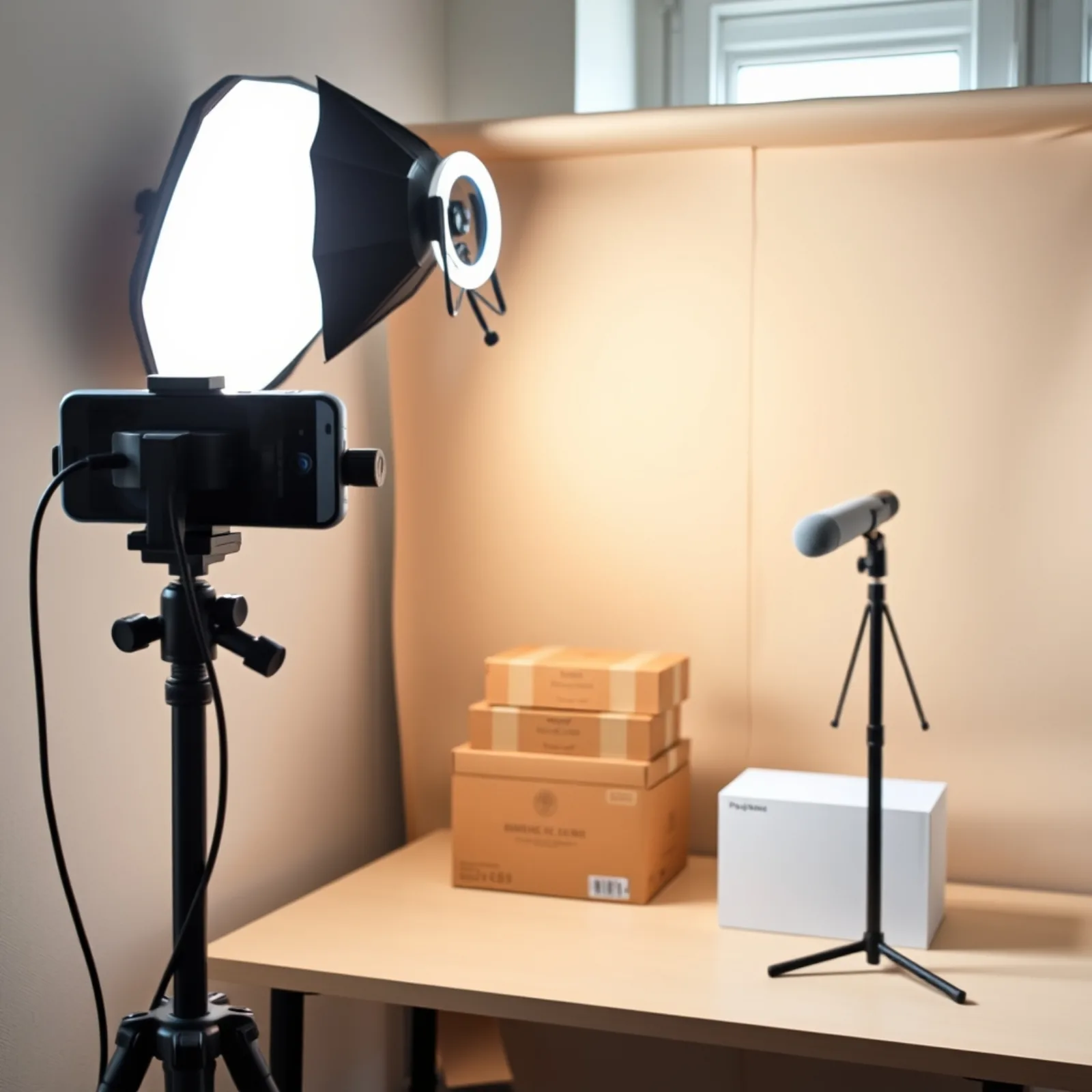
- 4. Equipment. A camera body or pro smartphone, two light sources, lavalier mics, tripods, cards, drives: €6,000 to €12,000 up front, amortised over 24 to 36 months.
- 5. Licences and storage. Editing suite, royalty-free music library, automatic subtitling, cloud: €120 to €250 a month. Music is the line that creates the most disputes in paid. The TikTok for Business help centre (updated July 2025) states that businesses are not allowed to use the general music library for commercial purposes and must go through the Commercial Music Library for all their commercial activity on TikTok.
- 6. Shooting space. 15 to 25 m² tied up, set, backdrops, basic acoustic treatment: €400 to €900 a month in imputed rent.
- 7. Payment for faces. Employees with an image bonus, external models paid per half-day, filmed customers: €600 to €1,800 a month to keep three faces. GERESO points out in 2023 that it is possible to pay an employee to shoot a promotional video or appear in an advertisement, and that any such payment is one of the points to be set out in the image-rights authorisation.
- 8. Products and logistics. Samples used up, props, shipping, shoot packaging. Between €150 and €600 depending on the category.
- 9. Management. The time of the acquisition manager or creative strategist who briefs, approves and analyses. 0.2 to 0.4 FTE, or €900 to €2,000 a month. Never invoiced, always real.
- 10. Upskilling. Training, format monitoring, tests. Three to five days per quarter.
- 11. Non-productivity. Holidays, sick leave, casting, reshoots, legal sign-off, meetings. This is the heaviest line and the only one that appears on no quote.
Added together, these lines give a 1-FTE studio at around €7,500 to €8,000 a month in a standard configuration. International comparisons for 2026 put an in-house US studio at several tens of thousands of dollars a month against roughly $2,000 to $10,000 for an agency retainer, with 2 to 3 American FTEs, salaries and charges bearing no relation to the French market. The hierarchy, however, holds: in-house is structurally heavier in fixed costs.
Does hiring a videographer on a permanent contract really save money?
Not before the fifth or seventh month. Between recruitment (€5,000 to €8,000 according to the École du recrutement), the equipment purchase (€6,000 to €12,000) and the ramp-up on your products and brand codes, a brand spends €12,000 to €20,000 before the first creative goes live. This entry ticket never appears in “salary versus retainer” comparisons.
The classic reasoning, an employee costs less than a service provider, comes from the worlds of design and print. It transposes badly. A logo produced in-house lasts three years. A vertical video creative has a useful life of two to four weeks on an active ad account, sometimes less when repetition climbs. The need is therefore not a stock, it is a flow. And a flow is measured in output, not in headcount.
The asymmetric risk is also worth stating: Eurecia estimates that a failed hire can cost up to 150% of the gross annual salary. On a videographer post at €38,000, that is €57,000 of dead loss for a single hiring mistake. An agency retainer can be terminated with one to three months' notice.
What we cannot honestly measure, and we would rather say so: internal management time. We have never managed to obtain a reliable record, among our clients, of the hours the acquisition manager spends briefing and approving for an in-house studio. The estimates we are given range from 4 to 14 hours a week for the same production volume. The gap is too wide to treat as data. Take 0.3 FTE as a working hypothesis and test the sensitivity of your model.
How much does a UGC video cost per unit: in-house, agency, freelance creator or AI?
Between €150 and €500 with a French freelance creator, €230 to €400 at an agency on a fixed fee, €250 to €800 in-house depending on the utilisation rate, and a few euros with AI, a figure that cannot be compared. Plateya puts the day rate of a French UGC creator in 2026 at between €280 and €900, or €150 to €500 per 15 to 30-second vertical deliverable. Creatorschool confirms: €150 to €200 for a beginner, around €350 for an experienced creator, over €800 with extended rights assignment.
We are not redoing the creator rate card here: it is detailed, hidden costs included, in our article UGC creator rates 2026. Keep the three lines that matter for the calculation: the displayed price almost never includes paid rights, iterations are billed on top (Plateya notes that going from two rounds to one lowers the bill by 8 to 12%), and the casting time on the brand side is at your expense.
The trap is the AI column. Obeevi puts an AI-generated UGC campaign in 2026 at between $60 and $150 a month for an SME producing 10 to 15 videos, specifying “before human time”. That clarification cancels the comparison. Human time is 80 to 85% of the cost of an in-house studio: brief, writing, direction, selection, editing, compliance. AI shifts the shooting line, it removes neither the strategy line nor the editing line. In our 2025-2026 tests, an AI creative needs as many back-and-forths as a real shoot to reach a level fit for paid on an account with a serious budget.
A useful market benchmark: Influence4You points out that a UGC video costs markedly less than a traditional production, with no published ratio, whichever structure produces it. The in-house versus agency trade-off is therefore played out within an already low range. We are talking hundreds of euros, not thousands.
Why does an agency retainer of €2,500–6,000 a month mean nothing without volume?
Because a monthly amount with no deliverables attached is not a price, it is an instalment. The rate cards published by French social media agencies in 2026 run from €800 to €6,000 a month without ever stating how many videos are produced. The same €4,000 retainer can cover 6 videos or 25: a ratio of 1 to 4 on the unit price.
Four questions convert any retainer into a comparable unit price:
- How many master deliverables per month, and how many versions are counted as deliverables? A hook variant on the same rushes is not a video.
- How many distinct faces appear in the month? This is the variable that determines how fast you saturate.
- Which rights, for how long, in which territories? A 12-month worldwide paid assignment cannot be compared with 3 months in France.
- How many iterations are included on the creatives that stand out? This is where performance is made, and it is where cheap retainers stop.
Divide the retainer by the number of guaranteed master deliverables. If the result exceeds €450 a unit with no extended rights or iterations, you are paying for consulting disguised as production. If it falls below €150, ask where the creative direction went. The healthy range, from what we see in France in 2026, is between €200 and €380 per usable deliverable, with 6 to 12 months of paid rights included.
A retainer that is not expressed in usable videos per month is not comparable to a salary. Convert everything into a unit price before opening the in-house versus agency debate.
From how many videos a month does going in-house become profitable?
Around 25 to 30 creatives put live per month, in steady state. Below that, the in-house fixed structure is under-used and the unit cost explodes. Above it, the marginal cost of an extra video in-house tends towards zero while the agency keeps billing per unit. The cross-over moves according to a single parameter, the rejection rate.
The unit of calculation is not the video delivered. It is the creative actually put into paid distribution, the notion we detail in creative iteration: definition and the real unit of purchase. A video that is delivered but never pushed into paid costs exactly the same as a winning video, and earns zero.
The formula fits on one line:
Cost per creative put live = full monthly cost ÷ (theoretical capacity × utilisation rate × (1 − rejection rate))
Our observations of the in-house studios we support or take over afterwards, in 2025-2026: real utilisation rate of 45 to 70% in the first year, rejection rate of 25 to 40% in-house against 10 to 20% at a performance-driven agency, and a realistic capacity for one versatile videographer-editor FTE of 18 to 25 usable videos a month, not 40, despite what hiring plans promise.
The cross-over, in figures
Explicit assumptions: an in-house studio at €7,900 a month all-in for 1 FTE, €9,200 with a junior reinforcement, €12,500 at 2 FTEs; an agency billing a sliding retainer from €420 down to €265 per creative put live depending on volume, 12 months of paid rights included. In-house rejection 30%, agency rejection 15%.
| Volume put live / month | 10 | 20 | 30 | 50 |
|---|---|---|---|---|
| In-house structure required | 1 FTE | 1 FTE | 1 FTE + junior | 2 FTEs |
| Full in-house cost | 7 900 € | 7 900 € | 9 200 € | 12 500 € |
| In-house cost / creative put live | 790 € | 395 € | 307 € | 250 € |
| Agency cost / creative put live | 420 € | 340 € | 300 € | 265 € |
| Cheapest model | Agency | Agency | Tie | In-house |
The cross-over falls between 25 and 30. One detail changes everything: if your in-house rejection rate stays at 35-40% in the first year, which is the norm, not the exception, the real threshold rises to 38-42 creatives put live per month. That is why in-house studios that “were supposed to” save 30% cost more after ten months. The rejection rate was not in the business plan.
This threshold is part of a continuum. The move from the isolated freelance creator to the agency happens at around 8 videos a month. The move from agency to in-house sits three to four times higher, because you have to absorb a fixed cost instead of a variable one.
The five models compared at equal volume
Common assumption: 30 creatives put live per month, 12 months of paid rights, French market, excluding media budget.
| Criterion | 100% in-house | Light in-house | Direct freelancers | Agency retainer | Hybrid |
|---|---|---|---|---|---|
| Upfront CAPEX | 12–20 k€ | 5–8 k€ | ~1,5 k€ | 0 € | 6–9 k€ |
| Full monthly cost | 9 200 € | 4 000 €* | 10 500 € | 9 000 € | 8 500 € |
| Usable / month | 30 | 10–13 | 30 | 30 | 30 |
| Distinct faces | 1–3 | 1–2 | 8–15 | 6–12 | 5–10 |
| € / creative put live | 307 € | ~350 € | 350 € | 300 € | 283 € |
| Time to first live | 10–14 wks | 6–8 wks | 3–5 wks | 2–4 wks | 4–6 wks |
| Cost of a month at zero volume | 9 200 € | 2 500 € | ~0 € | 1–3 months' notice | 5 000 € |
| Saturation at 3 months | High | Very high | Low | Moderate | Low |
* The light in-house model cannot sustain 30 creatives a month. It is shown here at its real capacity, 10 to 13, which makes its unit cost deceptively close to the others even though its output is three times lower. This is the most common misreading of this table.
CAPEX or OPEX: which cost model best protects a brand that is scaling?
In-house turns a variable cost into a fixed cost, and that fixed cost never goes down when the media budget goes down. A studio at €9,200 a month costs €9,200 in January as in August, whether you put 30 creatives live or 4. An agency retainer can be renegotiated, paused, resized. For a seasonal e-commerce business, this gap in elasticity weighs more than the gap in unit price.
Take a classic e-commerce calendar: a peak from September to December, a trough from January to March, a soft recovery in spring. Over twelve months, the real need for creatives swings between 8 and 45 a month. An in-house studio sized for the peak is under-used eight months out of twelve, your utilisation rate collapses to 45%, and your cost per creative put live mechanically doubles. A studio sized for the trough leaves you short in November, at the very moment the CPM climbs and you need to multiply angles.
The upfront CAPEX should also be seen for what it is: cash tied up in equipment that loses value quickly. Crepal puts the initial equipment of an in-house studio at over $8,000 against zero in a retainer. In France, between a hybrid camera body, three light sources, sound and storage, you land on the same order of magnitude. This equipment is worth 40% of its value at 24 months.
The upstream framing, how much to put in total into video content creation each month, excluding media, is covered in our article on the monthly video content creation budget. Do that calculation before choosing the structure. Many brands choose their production model before fixing their envelope, then discover they have internalised 60% of a budget that was meant to stay flexible.
Which signals show that you should go in-house, or on the contrary outsource again?
Six signals point towards going in-house, five signal that you should reverse. The most reliable of the six is not financial: it is the stability of the need. A brand that has put more than 25 creatives live per month for six consecutive months with no gap can absorb a fixed cost. A brand that did 40, then 9, then 31, cannot, whatever its revenue.
The six signals for going in-house
- More than 25 creatives put live per month over a rolling six months, with no trough month below 15.
- A fast-moving catalogue: weekly new arrivals, product seasonality, a need to film at D+2 after receipt.
- A product that is complex to handle, where internal technical knowledge saves two briefing rounds.
- Significant physical stock on site: filming on the spot avoids sending samples and the delays that come with it.
- A person already in post who is editing and wants this role. Recruiting from scratch costs €5,000 to €8,000 more.
- A genuine need for confidentiality: embargoed launches, pre-orders, regulated sectors.
The five signals for reversing
- Your three best creatives of the quarter show the same face. You have hit the diversity ceiling: 6 to 10 weeks is the lifespan of a recurring face on an account before the angles start repeating.
- The rejection rate exceeds 35% for three months in a row. You are producing for the shared folder, not for the ads manager.
- The videographer spends more than 30% of their time on non-paid requests: HR video, trade show, product site. The studio has drifted into an internal service.
- The media budget has dropped by more than 40% and the structure has not moved.
- You have not launched a new creative angle in eight weeks. It is not always ad fatigue, and the false fatigue diagnosis often costs more than the problem itself.
The model that dominates in 2026 among the brands we work with is neither one nor the other: a light in-house core that handles the daily flow, fresh product, reactive content, and an agency plugged in for peaks and for diversity of faces. €283 per creative put live in our table, the best ratio of the five models, because it puts the fixed cost on the predictable part of the need and the variable cost on the volatile part.
A nuance that works against our own business, but is true: there are cases where going in-house costs more and is still the right decision. A brand with a highly visible founder, a need to react within 24 hours to product news, a category where technical knowledge cannot be passed on in a brief. We have seen in-house studios at €420 per creative put live outperform agencies at €280, simply because the person knew the product inside out. Cost per creative put live measures cost, not relevance.
One last point, rarely covered: the image rights of your employees. An employment contract does not carry an assignment of image rights. Featuring a colleague in an advertisement run in paid requires a separate written authorisation, limited in duration, media and territories, and a refusal cannot be penalised. Featuring an employee in an advertisement may also fall under the presumption of a model contract (art. L.7123-2 of the Code du travail), which implies payment: have a lawyer validate this point. Add the employee's departure: if the authorisation did not provide for continued distribution after the end of the contract, you lose your best creative overnight. Have this document drafted by a lawyer before shooting, not after.
The cost of an in-house UGC studio versus an agency is therefore not settled on a single P&L line. It is settled on three figures that only you hold: your volume put live over the last six months, your real rejection rate, and the number of faces you can mobilise without all your campaigns starting to look alike. Pull these three figures from your ads manager, not from a finance director's spreadsheet. If you cannot produce them today, the in-housing question is premature: start by measuring, two months is enough.
Frequently asked questions
- Does an in-house UGC studio cost less than an agency?
- In France in 2026, an in-house UGC studio costs between €5,500 and €9,000 a month all-in (loaded salary of a videographer-editor, amortised equipment, licences, payment for faces, premises), against €3,000 to €8,000 for an agency retainer. The break-even point is read in volume: below 25 to 30 videos put live per month, in-house costs more per creative than an agency.
- How much does a videographer-editor on a permanent contract cost in France in 2026, charges included?
- Glassdoor France records an average salary of €35,300 a year for a videographer (range €29,000 to €39,000). Applying employer charges, around 41.5% of gross for a non-executive and 44.5% for an executive according to SimulateurFinance in 2026, the employer cost comes out at between €42,000 and €56,000 a year, or €3,500 to €4,700 a month, excluding equipment and management.
- What equipment budget do you need to set up an in-house UGC studio?
- Allow €6,000 to €12,000 up front: hybrid camera body or pro smartphone, two to three continuous light sources, lavalier mics, tripods, cards and storage, backdrops and set. Crepal puts the initial equipment of an in-house studio at over $8,000 in 2026. Amortised over 24 to 36 months, this line represents €250 to €500 a month, to which €120 to €250 of licences and cloud are added.
- How many UGC videos a month can one in-house person produce?
- In the studios we observe, one versatile videographer-editor FTE produces 18 to 25 usable videos a month in steady state, not 40. The gap comes from non-productive time: casting, reshoots, approval, holidays, upskilling. The real utilisation rate of in-house capacity in the first year is between 45 and 70% of the theoretical capacity stated at recruitment.
- Does AI-generated UGC replace an in-house studio?
- Not on the main cost line. Obeevi puts an AI UGC campaign in 2026 at between $60 and $150 a month for 10 to 15 videos, specifying “before human time”. Yet human time represents 80 to 85% of the cost of an in-house studio: brief, writing, direction, selection, editing, compliance. AI reduces the shooting line, not the strategy line nor the iteration line.
- Do you have to pay your own employees to appear in the videos?
- An employment contract does not carry an assignment of image rights. A separate written authorisation is required, limited in duration, media and territories, and the employee's refusal cannot be penalised. Financial compensation is not mandatory but becomes the norm as soon as the image is used in paid advertising. Also plan for what happens to the creatives after the employee leaves.
Let's calculate your cost per creative put live
You are torn between setting up a UGC studio in-house and going through an agency, and the calculation depends on your real volume, not on a spreadsheet. Esekai is a vertical video production studio: creative ads, UGC and organic content for TikTok, Reels and Shorts, with a dedicated Creative Strategist, in-house shooting and editing, and fast iterations. Thirty minutes on the phone: we talk formats, volumes, budget and action plan. No agency pitch deck.
Book a call →30 minutes to talk formats, budget and action plan.