

For a beauty brand, the TikTok content that sells rests on four distinct setups: embodied organic, paid UGC run as ads, creator affiliation via TikTok Shop and paid influence. In France, affiliation generates 69.8% of GMV in the Beauty & Skincare category on TikTok Shop, according to Kalodata data relayed by Lengow for the period December 2025 – May 2026. The format that holds up: a continuous demonstration of the product on skin, with no filter, a verifiable claim and the partnership disclosure. The rest, trending sounds, polished edits, buys reach, not revenue. TikTok Shop has been open in France since 31 March 2025 and then addressed more than 25.1 million French users, according to TikTok's official announcement published in March 2025.
What type of content works best on TikTok for a beauty brand?
The format that performs in beauty shows the product at work on skin, in one continuous shot, with no cuts and no filter. Everything else adds reach. Reach does not pay the bills. What triggers the purchase of a €39 serum is seeing the texture spread and sink in, and the grain of the skin right afterwards, filmed close enough to make out the pores.
So we do not sort formats by trend. We sort them by the objection they remove.
The five beauty formats that hold up in 2026
- The texture demonstration. Objection removed: “it will be sticky, greasy, pill under makeup”. Macro at 15-25 cm, a single gesture, no cuts. It is the cheapest format to produce, an hour and a half of shooting gives four usable variations, and it has the lowest reject rate on our shoots.
- The timed routine. Objection: “I don't know where this fits in my routine”. Mid-range in cost, but rejects climb as soon as the creator improvises the order of the products. A timed script avoids three retakes.
- The “I'm testing it for 14 days”. Objection: “does it really work”. The most expensive and the riskiest: a shoot spread over time, same light, same framing, same time of day. If the light shifts between D1 and D14, the before/after is unusable, and legally indefensible.
- The reply to a comment. Objection: special cases (oily skin, rosacea, pregnancy, over 50). Almost no cost, high cadence, and it is the format that feeds the brand account in the weeks when nobody has time to shoot.
- The formulation behind the scenes. Objection: “yet another brand outsourcing white-label”. Laboratory, raw materials, stability tests, rejecting a batch. Few views, high save rate, a clear effect on the product page conversion rate.
The choice of the person on screen is made before the script is written, not after. A foundation demo in shade 3 shot with a creator in shade 7 is a dead video, whatever the edit. Same logic for an anti-blemish treatment presented by blemish-free skin: the viewer drops off at second two. We cast by skin tone, skin type and apparent age, with our casting protocol in 3 paid rounds, and this filter alone lowers the reject rate of deliverables.
Our beauty shoot sheet, in 8 points
- Skin tone, skin type and apparent age validated before the script is written.
- A single light source, large and soft, at 45°. Two sources create stray reflections on moisturised skin and the texture becomes unreadable.
- Two working distances: 15-25 cm for texture, 60-80 cm for the face. Nothing in between, it doesn't read in 9:16.
- Camera beautification disabled, shooting in the native camera app, never in the TikTok editor.
- A physical mark on the floor and a framing template for any format spread over time. A bit of gaffer tape beats a good memory.
- Six to ten takes planned for a single clean application gesture. A hand shakes, a product drips, a reflection shows up: it's normal, it has to be budgeted.
- Lavalier mic every time, even for a video that will end up with a voice-over. It saves the takes where the sentence was good.
- Claims sheet handed to the creator before the shoot, with the list of banned words for that specific product. Checks are multiplying: according to Siècle Digital in 2024, the DGCCRF checked 98 influencers active on social media in 2022, then 212 in 2023.
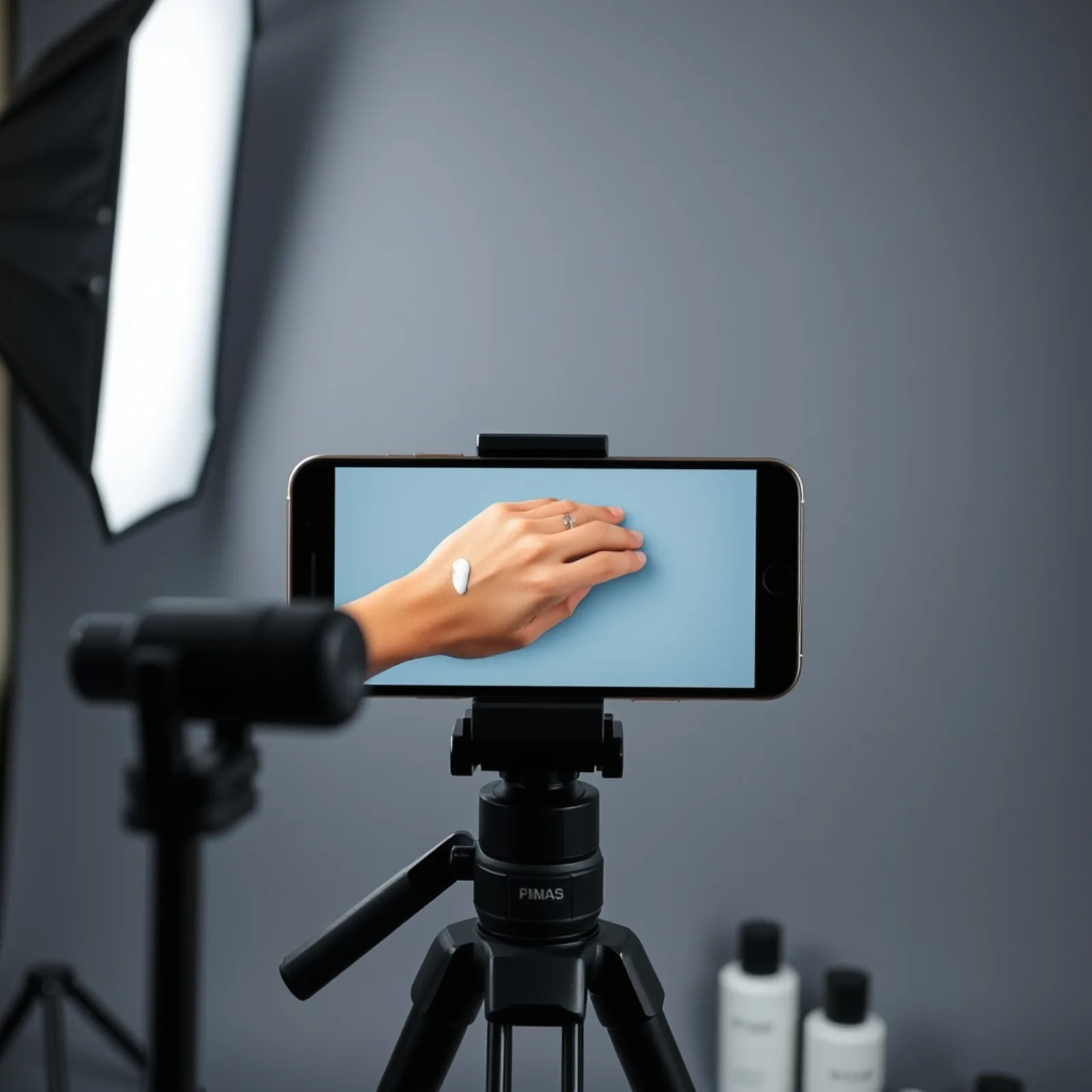
Misconception: “you have to ride trending sounds”. A trending sound widens distribution beyond your audience. It has never moved anyone from scrolling to the product page. In beauty, it is the continuity of the demonstration shot that holds retention, and retention that holds the rest.
How many views can a beauty brand realistically expect, and why do the benchmarks contradict each other?
There is no usable “average view” in beauty on TikTok: the four public benchmarks of 2026 give 7,200, 113,800, 229,000 and 751,700 views per post. A ratio of 1 to 100. Any page that gives you only one of these figures without saying what sample it covers is selling you an illusion of a benchmark.
Here is where they come from, and why they do not measure the same thing.
- 7,200 views per post raw calculation from the #beauty hashtag on TikTok Creative Center (42.8M posts, 310.4bn views, recorded on 17/08/2026). That is everyone: individuals, dead accounts, spam. The real median of an account that is starting out is closer to this figure than to the others.
- 113,800 views Apaya 2026 synthesis (Rival IQ + Dash Social), on a panel of tracked beauty brands, average engagement 3.9%.
- 229,000 views Dash Social, 2026 Beauty Industry Benchmark Report, panel of established brands. The same report gives 171,000 views on Instagram and 145,000 on YouTube.
- 751,700 views Webtonic, Beauty & Skincare Video Marketing Statistics 2026, on 2.56M posts analysed, with an average engagement of 7.13%. A sample pulled upwards by the posts that broke through.
Three panels of brands, one open hashtag, four calculation methods. Nothing abnormal. Simply: none of these numbers tells you what your account will do next month.
The only solid directional marker in these reports is the trend: according to Dash Social in 2026, views on beauty posts are up 23% year on year while average engagement falls from 3.6% to 2.8%, with average retention around 23%. Many read this as running out of steam. It is mechanical: when the platform pushes your videos further beyond your community, the denominator grows faster than the numerator. You reach more people who don't know you, so they like less.
The three metrics that replace the view
- 3-second retention, by format and by creator. It is the only indicator that tells you whether your demonstration starts fast enough. Below your own account's average on three videos in a row, the format is dead, not the algorithm.
- The cost per retained creative. Not per video delivered. If you pay €200 per video and three out of ten pass the distribution threshold, your real cost is €666.
- GMV per active affiliate creator, if you are on TikTok Shop. Ten creators signed up and two who sell is not an affiliate programme, it is a mailing list.
Same reasoning on the media side: public sector CPMs are there to frame a discussion, not to run a budget. Better to build your own CPM benchmark in 14 days than to align your plan on a US average. For information, Pennock recorded in 2026 a TikTok beauty CPC between $0.60 and $0.90 with CPA down 22% year on year, while Blueprint Media (State of DTC 2026) noted Meta beauty CPMs up 30 to 40%. It is the gap that is interesting, not the absolute value.
Organic, paid UGC, affiliation or influence: which setup for which objective?
The four setups have neither the same buyer, nor the same contract, nor the same KPI, and a brand that confuses them pays three times for the same video. The classic mistake: ordering UGC to “keep the account alive”, then being surprised that the videos don't convert in ads because nobody negotiated the media rights.
| Setup | What you are buying | Entry cost France 2026 | First signal | Steering KPI | Main risk |
|---|---|---|---|---|---|
| Embodied organic (brand account) | A stock of angles tested for free + brand memory | €1,500 to €4,000/month (our 2026 quotes, 8 to 20 videos) | 60 to 90 days | Number of videos exceeding your median 3-second retention | Improvised claim in a caption or a live |
| Paid UGC run as ads | Testable variations + the media rights | €150 to €350/video (Takema 2026); spread €50 to €800 depending on rights (Balma 2026) | 7 to 14 days | Cost per retained creative | Rights not negotiated, non-compliant claim to redo |
| Creator affiliation on TikTok Shop | Direct revenue, paid on commission | Samples + logistics + commission to negotiate by category | 14 to 30 days | GMV per active creator | Product messaging outside your editorial control |
| Paid influence (nano to mid) | Social endorsement and a burst of reach | $50 to $500 nano, $200 to $2,500 micro, $5,000 to $25,000 mid (Foundry CRO 2026, US grid) | Immediate, but not repeatable | Sales under a dedicated code / cost per product page visit | Partnership disclosure missing or illegible |
| Live shopping (emerging) | Live conversion on a narrow catalogue | Technical set-up + host; 16% of TikTok Shop FR sales (LeptiDigital, 2025) | From the 3rd live | Average basket × concurrent viewers | Improvisation: everything is said live, nothing is reread |
The setup that has changed the game in France is affiliation. Over December 2025 – May 2026, the Kalodata data relayed by Lengow give €6.64M of monthly GMV for the Beauty & Skincare category on TikTok Shop France, up 41.9% in one month, of which 69.8% was achieved through creator affiliation. In other words: a brand that doesn't open its affiliate programme leaves two thirds of the category to its competitors. If you are starting from zero, first read how TikTok Shop France works in full, because opening a shop is prepared on the logistics side before it is prepared on the content side.
Misconception: “TikTok is about awareness”. Not any more in beauty, not any more in France. A Korean brand launched on TikTok Shop France in March 2026 reported around €5M of GMV in an interview with E-commerce Mag. That is not a branding budget, it is a revenue line.
What does a month of beauty TikTok content cost in France in 2026?
Expect between €2,500 and €20,000 a month depending on the tier, and always reason in cost per retained creative, never in cost per video delivered. The ranges below come from our 2026 quotes for French beauty and skincare brands; they cover production, rights and management, excluding media budget.
Launch tier, €2,500 to €4,500/month. Eight to twelve videos, two creators, two angles at most, 6-month media rights. Goal: find out which of your two promises holds up. We are not looking for profitability at this stage, we are looking for an angle that clears the retention threshold. Three months are needed before deciding anything.
Traction tier, €5,000 to €9,000/month. Twenty to thirty videos, four to six creators, systematic variations on the two angles that held, plus feeding a fledgling affiliate programme. This is the tier where the unit cost really drops, because shoots are batched.
Scale tier, €12,000 to €20,000/month. Forty to sixty videos, rotation of creators, long formats for retargeting, product seeding to twenty to fifty affiliates, and a creative strategist who makes the calls every week.
Now, the calculation that changes everything.
On our beauty campaigns, the rate of creatives reaching the distribution threshold is generally between 20% and 35%, our figures, not a published study. At €200 a video and a 30% retention rate, the creative that actually runs costs €666. At €350 a video with a tight casting and a 50% rate, it costs €700. The two quote lines have nothing in common, the real cost is the same. That is exactly why a quote of €90 per UGC video is not good news.
The four beauty-specific extra costs
- Casting by skin tone and skin type: an additional selection round, sometimes two for a multi-shade foundation. Count 10 to 20% extra casting budget.
- Category exclusivity: forbidding the creator from shooting for a competing brand for 3 to 6 months costs money, generally 20 to 30% of the fee. In beauty it is almost always negotiated; elsewhere, rarely.
- The re-shoot for a non-compliant claim: the line nobody budgets for, which happens one time in ten when the claims sheet wasn't handed over beforehand. A re-shoot costs the price of a new video.
- Samples and logistics: twenty creators means twenty shipments, twenty follow-ups, and a lead time of 10 to 15 days between the purchase order and the first shot. On a “14 days” format, add fifteen more days.
What can you legally say and show in a beauty video?
A cosmetics video must be able to justify each of its promises with evidence in the product file, flag any paid partnership and never artificially enhance a result shown on screen. The framework comes from Regulation (EC) No 1223/2009 and Regulation (EU) No 655/2013 on the common criteria applicable to cosmetic claims, supplemented in France by Law No 2023-451 of 9 June 2023 on commercial influence. We are not a law firm: have your regulatory manager validate your grid before the first go-live. According to the DGCCRF's 2024 review, more than 260 influencers were checked in 2024, 40% of whom showed irregularities, resulting in 40 warnings, 65 compliance orders and 8 criminal reports.
| On-screen element | Allowed | Prohibited or to be framed | Mention / evidence | Who approves |
|---|---|---|---|---|
| Product claim | Cosmetic effect backed by a test on file (hydration, glow, comfort) | Any therapeutic promise: “cures acne”, “treats eczema” | Reference of the test and the sample | Regulatory affairs |
| Before / after | Identical conditions: light, framing, angle, no makeup | Change of lighting, pose or complexion between the two shots | Duration of use and protocol displayed on screen | Regulatory + production |
| Beauty filter | No use on a shot that shows the product's result | Skin smoothing, complexion correction, eye enlargement | Explicit flag if kept | Production |
| Image retouching | Identical overall grading across all shots | Erasing spots, slimming the silhouette | Retouching disclosure if appearance is altered | Post-production |
| Paid partnership | Visible, legible and permanent disclosure from the start | Disclosure at the end of the caption, hidden behind “more” | “Commercial collaboration” / “Advertising” | Legal + social media |
| Customer testimonial | Real review, consented in writing, not scripted word for word | Invented review, actor presented as a customer | Signed rights assignment + date of the review | Legal |
The filter deserves one more word. Many brands think it “helps” the demo. It destroys it: skin smoothing makes the before/after implausible, the comments spot it within minutes, and you go from demonstration to accusation of lying. We have seen it often enough to make it a set rule: native camera, beautification off, and we adjust the light rather than the skin.
Same subject on the side of AI-generated content, avatars included. The issue isn't “does it work”, sometimes yes, but “does the viewer know what they are dealing with”. We went into the question in the 5 degrees of UGC authenticity and the 2026 law. In beauty, our position is simple: no avatar on a shot that shows a result on skin. Never. According to the European Commission, the transparency obligations of Article 50 of the AI Act have applied since 2 August 2026 to providers and deployers of AI systems alike.
Misconception: “a beautiful visual is enough”. Dash Social described in 2026 a shift from “aesthetic-first” to “audience-first” in the beauty category. Field translation: the perfectly graded packshot video does worse than a hand, a texture and a well-chosen sentence, filmed in a bathroom.
Which beauty brands are smashing it on TikTok, and what is actually copyable?
The beauty brands that dominate TikTok didn't find a sound, they held a cadence: several posts a week, for quarters, on a small number of angles. The rest is a matter of budget, and budget is not copyable. Let's look at what is.
e.l.f. Cosmetics: cadence as a weapon
The American brand posts at a pace that most French teams would find unreasonable, reacts to comments within the day, and accepts publishing videos that do nothing. That is the important point: its system assumes a high, accepted failure rate.
Copyable with €3,000/month: the frequency and the responsiveness, provided you accept a low-production format. Not the diversity of the filmed catalogue.
Typology: ingredient education
The French brand built a recognisable grammar: one molecule, one concentration, one benefit, one texture shot. Few faces, a lot of hands and bottles, a tone close to a technical data sheet. It works because the promise is verifiable, and because the education can be varied endlessly without ever really repeating itself.
Copyable with €3,000/month: yes, largely. It is the cheapest format to produce in the beauty market. A table, a light, a smartphone.
The K-beauty wave on TikTok Shop
The Charm.io report on beauty on TikTok Shop (February 2025 – January 2026) puts Korean brands at the top of sales, note, US market data. In France, the dynamic follows: Kuider Akani's interview in E-commerce Mag mentions around €5M of GMV for a Korean brand launched in March 2026. Their mechanic relies on the volume of affiliates and a low entry price, not on the quality of the editing.
Copyable with €3,000/month: the affiliation mechanic, yes. The entry price, only if your margins allow it. Many French brands that try affiliation at 30% commission on a €22 product discover they are selling at a loss.
Misconception: “this brand broke through thanks to a viral video”. When you trace back the account, you almost always find four to six months of daily posting before the video in question. Virality is a result of volume, not an entry strategy.
How do you build 30 days of beauty content without repeating yourself?
A month of beauty content fits into five angles, each varied six times, shot over two batched days. Thirty videos, five ideas. Brands that look for thirty different ideas burn out in three weeks and produce an incoherent account.
The five angles, for a skincare product:
- Sensoriality: texture, scent, finish on skin.
- Ingredient proof: the molecule, its concentration, what it does.
- Skin concern: one skin, one symptom, one answer.
- Use and routine: placement in the day, combinations to avoid.
- Price-value: how many doses, how many weeks, compared to what.
The six variations per angle: change of hook, change of creator, change of location, change of length, change of proof used, change of call to action. Only one variable is changed at a time, otherwise you don't know what produced the gap. The full logic is detailed in the 3 then 5 to 8 variations per angle rule.
The calendar, for its part, doesn't look like a classic editorial calendar. Two shoot days a month, two weeks apart. The first produces the twenty planned videos. The second is used to vary what worked in the first week of distribution and to shoot the replies to comments. It is this offset that stops you publishing thirty videos decided a month earlier, when you still knew nothing.
Last rule, on recycling organic into ads: an organic video only goes into advertising if its 3-second retention exceeds your account median and if the rights were signed before the shoot. Not after. A creator who discovers her face in an ad three weeks later has every reason to be angry, and you have no contractual basis to continue.
Producing TikTok content for a beauty brand in 2026 looks far less like creation than logistics: samples shipped on time, skin tones validated before scripts, an up-to-date claims sheet, two studio days a month and a retention table reread on Monday morning. The brands that win this category are not the most creative. They are the ones that deliver every week, without exception, while the others wait for the right idea.
Frequently asked questions
- What is a good slogan for a beauty product on TikTok?
- On TikTok, the slogan doesn't carry: it is the first sentence spoken that decides. A usable claim meets three criteria: it can be said in under two seconds, it describes a cosmetic effect verifiable by a test in the product file, and it promises no therapeutic effect. “No more stickiness in 10 seconds” beats “reveal your glow” in every test.
- Do you need a brand account or should you go only through creators?
- Both, but not for the same reason. The brand account serves as a free angle laboratory and a reassurance page when someone checks that you exist before buying. Creators bring the volume of variations and, on TikTok Shop France, nearly all of the revenue: 69.8% of beauty GMV goes through affiliation according to Kalodata (Dec. 2025 – May 2026).
- How many videos a month at minimum for a beauty brand?
- Eight videos a month is the floor below which you can learn nothing: with two angles and four variations, no gap is interpretable. Twenty to thirty videos a month make up the tier where the unit cost drops and format trends become readable. Beyond forty, you need a creative strategist to make the calls, otherwise production runs idle.
- Do you need to open a TikTok Shop store before producing content?
- Open the shop first if your logistics can keep up and your margins can bear 10 to 25% affiliate commission. Producing content without a shop in France amounts to sending traffic to an external site, with the leakage that implies. Check your margins beforehand: many brands discover too late that they sell at a loss through affiliation.
- Can you use AI avatars for beauty content?
- For catalogue content or an ingredient explanation, it is debatable but conceivable, with disclosure. For a shot that shows a result on skin, no: you are displaying evidence that does not exist, which falls under the common criteria applicable to cosmetic claims and destroys credibility in the comments. Our set rule: no avatar on a demonstration.
- How much does a beauty UGC creator cost in France in 2026?
- The Takema 2026 grid puts beginners at €150 to €200 per video, with an observed average around €170 and experienced profiles around €350. The Balma grid for beauty shows a spread of €50 to €800 depending on rights and complexity. Add category exclusivity, often 20 to 30% of the fee in cosmetics.
Let's talk about your beauty content cadence
You now know that beauty performance on TikTok is won on cadence, casting and compliance, not on the right idea. Esekai produces creative ads, UGC and organic content in-house for beauty and e-commerce brands, with a dedicated Creative Strategist, in-house shooting and editing, and iterations every week. We only do vertical video. On the call: 30 minutes on your formats, your budget and an action plan. No agency pitch deck.
Book a call →30 minutes to talk formats, budget and action plan.