

Authentic UGC is produced spontaneously by a real customer, with no consideration; simulated UGC is commissioned from a paid creator, briefed and scripted to look spontaneous. Both are legitimate, but they do not buy the same thing: the first buys proof, the second buys volume and rights. In France since January 2026, only the second requires a written contract and, if the creator publishes it themselves, an “Advertisement” label. Between these two extremes there are three intermediate notches that almost nobody names. They are what decides your cost per video. According to FashionNetwork (January 2026), from €1,000 excluding VAT, commercial collaborations between brands and influencers must be covered by a written contract since 1 January 2026, on pain of penalties for both parties and their intermediaries.
When an e-commerce director tells us “we want real UGC, not fake”, we always start with the same question: how many videos a month do you want? If the answer is more than five, the debate is closed. Truly spontaneous UGC does not scale. It never has. What the market has called “UGC” since 2023 is, in its overwhelming majority, an audiovisual production service sold by independent creators, with a brief, a script, a deadline and an invoice. That is not a scandal. It is simply another commodity, which you need to buy with your eyes open.
What does UGC mean, and why does the word no longer mean anything in 2026?
UGC stands for “User Generated Content”: originally, any content created by a person who is not the brand and who is not paid to do it. An Amazon review, an Instagram photo of a dish, an unboxing posted by a customer. The term comes from Web 2.0, not from advertising. It describes a production phenomenon, not a video format.
What happened between 2021 and 2026 is a complete shift in meaning. Today, when a brand says “I want UGC”, it does not mean “I want my customers to produce content spontaneously”. It means: “I want a vertical video shot on a smartphone, in natural light, with a person talking to camera who doesn't look like they're in an ad”. UGC has become a visual style. An aesthetic spec. You buy a look, not an origin.
A quick disambiguation while we're here, because Google mixes the two up: in France, UGC also refers to the Union Générale Cinématographique, the cinema chain. No connection. If you are looking for showtimes, you are on the wrong article.
The problem with this shift is not semantic, it is commercial. A buyer who thinks they are buying authenticity and receives a briefed service has paid a price without understanding the goods. And a buyer who refuses on principle the briefed service condemns themselves to three videos a quarter. Both are wrong, for opposite reasons.
Authentic or simulated UGC: where exactly does the line fall?
There aren't two camps, there is a five-notch slider, and the line between “authentic” and “simulated” falls where consideration appears. As soon as there is consideration, money, a free product, a discount, entry into a prize draw, you change regime: legal, economic and narrative. The content can remain excellent. It is simply no longer spontaneous.
Internally we think in five degrees. It is the grid we bring out in the scoping meeting, before we even talk budget, because it settles 80% of misunderstandings.
| Degree | Who speaks | Control of the message | 2026 unit cost (€ excl. VAT) | Achievable monthly volume | Rights held by default |
|---|---|---|---|---|---|
| 1, Spontaneous | Real customer, no consideration | None | €0 (cost of collection and sorting) | 1 à 3 | None |
| 2, Solicited | Prompted customer (gift, follow-up) | Low | Value of the free product + the operation | 5 à 10 | To be signed case by case |
| 3, Commissioned | Paid and briefed UGC creator | High | €74 to €350 according to Roads.social (2026) | 20 à 60 | Those written into the contract, limited duration |
| 4, Staged | Actor, written script, supervised shoot | Total | €400 to €1,500 (French market observations) | 10 à 30 | Full, negotiated assignment |
| 5, Synthetic | Nobody (avatar, AI voice) | Total | A few euros, marginal cost | Unlimited | Depends on the tool's terms of use |
The ranges for degrees 4 and 5 come from our quotes and from what we see passing through the French market, not from a published study; treat them as an order of magnitude, not a rate card. For the detail of what you really pay when you buy a rights assignment, we did the exercise line by line in the breakdown of usage rights and their cost.
What each degree really buys
Degree 1 buys proof. Nothing else. A screenshot of a customer review placed on a product page or a customer story reposted is worth something because it cannot be verified any other way: nobody has any reason to doubt a stranger who has nothing to gain from it. This is the register of social proof, and it obeys its own rules; we detailed the 6 proof carriers and their hierarchy of credibility in a dedicated article.
Degree 3 buys something else: throughput and rights. You order 30 videos, you receive them in 10 days, and you can push them in paid on Meta and TikTok without asking anyone. Authenticity there is a staging convention, just like the long take in cinema. It is manufactured, owned up to, and it works because the audience accepts the convention, as long as it is not caught red-handed in a lie.
The trap is believing you can buy proof at degree 3. You can't. A paid creator who says “this product changed my life” proves nothing at all. They are telling a story. If your problem is a trust deficit, expensive product, unknown brand, scam-prone category, degree 3 will not fix it, whatever the budget. You need degree 1 or 2, even in small quantity, even ugly.
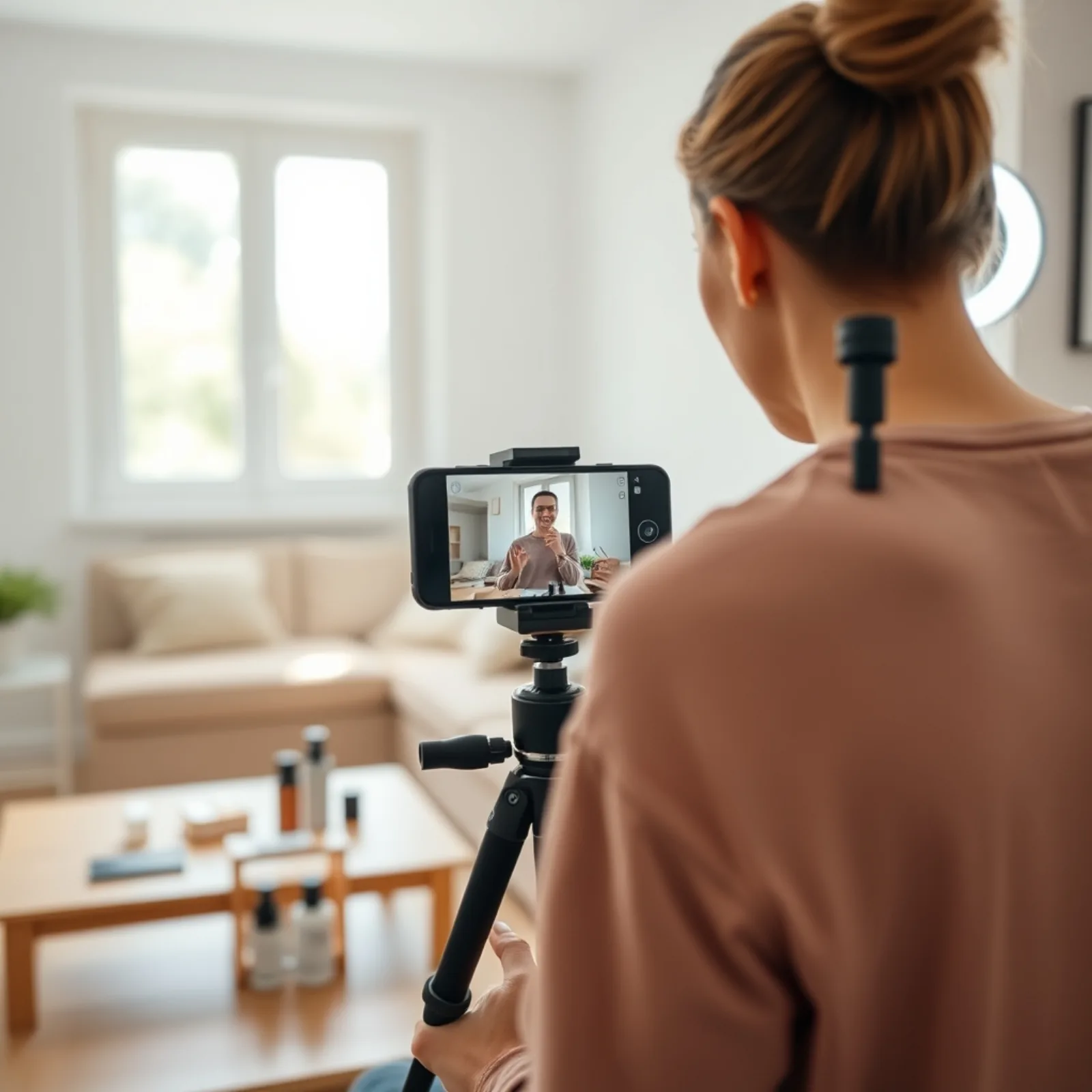
How do you recognise simulated UGC in 8 signals?
Commissioned UGC is spotted by its production markers, not its content: these are the technical gestures that a lone, unpaid person has no reason to make. Here are the ones we check when we audit a new client's creatives and, let's be honest, the ones we watch for in our own deliverables so as not to cross the line.
- The lighting is too clean. A real customer films at 9 p.m. under a yellow ceiling light. A pro creator looks for the window, sets up a reflector or a mini LED. Even skin tone, no hard shadow under the nose: it's been lit.
- There is B-roll that is impossible to shoot alone. The shot of the hand pouring the product, filmed from a low angle while the person talks. Either there is a second person, or it was shot in two passes. A spontaneous customer does neither.
- The account has no history. Three posts, all for different brands, created in the last six months. A creator's profile, not a consumer's.
- The edit is calibrated. Cuts every 2 to 3 seconds, a hook in the first half-second, animated subtitles synced word by word. According to Moggo (2026), this rhythm has become the standard on TikTok and Reels, which is precisely what makes it a marker of professional production, not of spontaneity.
- There is a closing packshot. Logo, product name, URL. No customer ends their video with the brand's logo.
- The voice-over is re-synced. The lips don't quite match, the sound level is constant while the shot changes room. The signature of a multi-take edit.
- The framing matches from one shot to the next. Same distance, same axis, same height after a cut. That means a tripod. A phone propped on a pile of books moves between takes.
- The label is missing. Creator content, published on their account, with an affiliate link or a promo code, and no mention of a partnership: that is a breach, and the 2023 law already makes the brand jointly liable alongside the agency and the creator.
These eight signals are not flaws. They are the direct consequences of the brief. If you ask for a hook in 0.5 seconds and three product shots, you are mechanically ordering signals 1, 2, 4 and 7. That is why the brief is where the perceived degree of authenticity is decided, not the casting. We documented this mechanism in the 4 locks of the brief.
A brand once asked us to “make the videos less clean”. We removed the LED, ditched the tripod, left in a take with some stumbling. The hook rate went up. The conversion rate didn't move. Visual authenticity buys attention, not conversion.
What does French law say in 2026 about paid UGC?
Law No. 2023-451 of 9 June 2023 regulates commercial influence, defined as using one's own notoriety with one's own audience in return for payment; a UGC creator who delivers files that the brand publishes on the brand's channels is not, in principle, engaged in commercial influence. That is the legal dividing line between degree 3 and the rest, and it does not depend on who pays: it depends on who publishes.
The implementing decree came into force on 1st January 2026. Since January 2026, a written contract is legally mandatory only for commercial influence services reaching a cumulative €1,000 excl. VAT per advertiser per year; the “Advertisement” label is required when the creator publishes themselves. According to Tanke's analysis (late 2025), liability is joint between the brand, the agency and the creator. Operational translation: if your creator forgets the label, it is no longer their problem alone.
On the label itself, the framework has been stable since 2023: the promotion must be flagged with “Publicité” or “Collaboration commerciale”, clearly, legibly, identifiably for the whole duration of the content, and in French. Its absence amounts to a misleading commercial practice. Blog du Modérateur reminded readers in early 2026 that the obligation applies from the very first follower and from the very first consideration, including a simple free product or an invitation. According to the ARPP's Observatoire de l'Influence Responsable (2025), the gap in breaches between small and large creators was 15 points in 2023 (23% versus 8%) and 10 points in 2024 (15% versus 5%). In 2025 it is only one point.
What falls foul of the checks? According to the DGCCRF review relayed by Kohen Avocats in early 2026, the majority of misleading practices identified consisted of not stating the commercial nature of the post, or not identifying the person on whose behalf it was published. Not twisted cases. The two basics.
| Practical case | Who publishes? | Consideration? | Mandatory label |
|---|---|---|---|
| Video bought from a creator, pushed in Meta Ads by the brand | The brand | Yes (service) | No: it is an advertisement identified as such by its format |
| Same video, published by the creator on their account | The creator | Yes | Yes: “Publicité” or “Collaboration commerciale”, Law 2023-451 |
| Customer who posts a Reel after receiving a free product | The customer | Yes (gift) | Yes, from the first follower |
| Spontaneous video review reposted in a story by the brand | The brand | No | No ad label, but written authorisation is essential (image rights) |
| Video with an AI-generated avatar in Meta Ads | The brand | Not applicable | AI content disclosure required by the platforms, each with its own rules |
One point many advertisers discover too late: the legal regime is not chosen, it is established. You can call your creator a “service provider” in every one of your documents; if they publish on their account with their notoriety and their audience, they are doing commercial influence. The classification follows the facts. That is precisely why the difference is first and foremost contractual, and not a matter of follower count.
We are not lawyers and this article does not replace legal advice. On hybrid set-ups, a creator who publishes AND assigns rights for paid, with whitelisting, the line is frankly grey, and we systematically recommend a review by a lawyer before signing an annual framework.
Is AI-generated UGC still UGC?
No: a synthetic avatar is not a user, so AI-generated content is not UGC, it is advertising produced at zero marginal cost that borrows UGC's visual codes. Calling it anything else is an abuse of language that will end up costing dearly those who keep it going.
The figure that should cool enthusiasm: according to Kantar US Media Reactions 2025, more than 60% of American consumers worry that generative AI will produce false or misleading ads. This is not an aesthetic opposition to AI, it is a suspicion of deception. And suspicion of deception is exactly what UGC was supposed to neutralise. Using an AI avatar to simulate a customer testimonial is therefore spending your budget producing the opposite of what you are buying. The same Kantar US Media Reactions 2025 study indicates that about half of American consumers like AI-generated visuals in ads, but that more than half remain uncomfortable with and wary of AI-generated ads.
None of which means AI is useless in vertical video production. We use it every day: generating hook variants, subtitling, format adaptations, translation, backup voice on a botched shot. There, it saves hours without telling anything false. The line we impose on ourselves is simple: AI can do everything in the chain, except play the role of a person claiming to have used the product.
The risk, incidentally, is not that the audience detects the avatar. They already do, and in six months the generators will be better. The risk is reputational and asymmetric: an avatar that is never spotted brings you nothing more than an actor would; an avatar spotted on a health or finance testimonial, you pay for in comments, screenshots and reports. A poor gain/loss ratio.

What is UGC on Instagram, and how does it differ from TikTok?
On Instagram, UGC mainly means Reels, stories mentioning the brand and collaborative posts; the difference with TikTok is not cultural, it is technical, down to the aspect ratio, the paid partnership tag and reuse in Partnership Ads.
Three concrete production gaps, the ones that change the deliverable you order:
- The aspect ratio. TikTok lives in full-screen 9:16. Meta pushes 9:16 in Reels but also serves 4:5 in the feed and cropped Stories. If you order a single master, demand a safe framing that survives cropping; we mapped the placements in 9:16 vs 4:5 by placement.
- The Collab post and the paid partnership tool. Instagram natively includes the “Paid partnership with” label. It covers part of the transparency obligation, but the platform label does not exempt you from the explicit mention in French required by law. Use both.
- The second advertising life. Creator content on Instagram can be amplified as a Partnership Ad from the creator's account, which keeps their avatar, handle and like counter. It is the format that blurs the authentic/simulated line the most, and also the one that requires the most explicit rights assignment.
On tone, the gap has narrowed a lot since 2024. A good Reels UGC and a good TikTok UGC look more alike than in 2022. What still differs is tolerance for length: beyond 35 seconds, retention drops off faster on Reels than on TikTok in what we observe on our e-commerce clients' accounts. With an honest caveat: it varies enormously by category, and we don't have a dataset large enough to make it a general rule.
How do you make money with UGC in 2026, and how much does it cost on the brand side?
A UGC creator makes money by selling video files to brands, not by selling their audience: according to Roads.social (2026), the observed range is €74 to €350 per piece of content, versus €1,000 to €50,000 for an influencer selling their reach. The two trades sometimes share the same name. They do not share the same business model.
On the creator side, profitability comes down to three variables: the number of deliverables per shoot (filming three angles in one session changes everything), the sale of additional rights (duration, territory, whitelisting), and the rewrite rate. A creator who redoes every video twice because of a vague brief is working at half price without knowing it.
On the brand side, the displayed price is never the price paid. You need to add casting, products sent and lost, validation back-and-forth, editing if the creator delivers raw rushes, and the rights assignment beyond 3 months. We costed these items in our detailed 2026 pricing grid; that is generally where budgets slip, not on the unit rate.
The figure nobody publishes: the reject rate
Here is the real hidden cost of authenticity. On degree 1 or 2 UGC, rushes recovered from real customers, the unusable share is enormous: framing upside down, sound drowned out by the TV, a competitor's product in shot, and above all the usage authorisation the person never sends back. A lot gets thrown away. On briefed degree 3, rejects fall to a fraction of that, because the creator works to a technical spec.
The accounting consequence that comparisons forget: a “free” degree 1 video that takes three weeks of collection, ten solicitations and a legal chase for the assignment is not free. It costs team time, it arrives when it feels like it, and you cannot plan the quantity. Authenticity is paid for in reject rate and delay. That is its real price tag.
The calculation to make is not “how much does a video cost” but “how much does a usable video cost, rights included, delivered within my campaign window”. The ranking of the five degrees changes completely depending on which one you reason from.
And what about the famous “2.4x more authentic”?
The whole SERP repeats it: UGC is supposedly 2.4 times more likely to be perceived as authentic than brand content (Influee compilation, 2026). Read carefully: perceived as. It is a perception declared in a questionnaire, not a media performance. The same goes for “92% trust recommendations from real people”, which descends from a Nielsen study more than ten years old and has been copied into thousands of articles without anyone going back to the source.
These figures are not false, they are unusable for arbitrating a budget. What you arbitrate on is: hook rate at 3 seconds, hold rate at 50% of the duration, outbound CTR, CPA, and the frequency at which the creative wears out. The same Influee figure also cites a 140% higher conversion rate among buyers exposed to a UGC gallery on a product page, an obvious correlation (people who scroll to the gallery are already more engaged), not causality. If you build a business case on that, you are heading for an unpleasant surprise. Our measurement benchmarks are detailed in the 3 ratios to measure on Meta Ads video.
Authentic or simulated: how do you choose according to your objective?
The choice between authentic and simulated UGC is settled with three questions, in this order: how many videos do you need per month, which rights must you hold, and who will publish the content? None of these questions is ideological. All three are production constraints.
Question 1, How many videos per month?
Fewer than 5: aim for degrees 1 and 2. Organise the collection, set up the authorisation request, repost. It's slow and it is the most credible option. Between 10 and 40: degree 3, the only notch that keeps pace without wrecking the budget. Beyond 40, with several angles to test in parallel, you enter a throughput logic where degree 4 becomes economically relevant: an actor who runs through six scripts in a day works out cheaper per video than a creator per individual video.
Question 2, Which rights do you need?
If the content goes out in paid, in-store display, on the website or in a newsletter, you need a written assignment covering those media, with a duration. Degree 1 offers none by default: a public post is not an authorisation for commercial use. It is the most common mistake we see, and it is fixed with a private message and a tick box, not with a gamble.
Question 3, Who publishes?
You publish on your accounts and your ads: service regime, no “Advertisement” label to add manually, standard assignment contract. The creator publishes on their account: commercial influence regime, mandatory label, written contract above €1,000 excl. VAT, joint liability. This question alone determines your legal exposure, and it is settled before choosing the creator, not after. The law firm De Gaulle Fleurance (analysis of the decree of 28 November 2025) warns that players who work without a compliant contract expose themselves to nullity of the contract, disputes, evidentiary difficulties, even administrative penalties during inspections.
The mix we most often recommend to an e-merchant spending between €15,000 and €60,000 of media a month: a degree 3 base to feed the paid tests, two or three carefully chosen degree 1 pieces on product pages and in retargeting, and zero degree 5 on anything that looks like a testimonial. It is not a universal rule. On a niche brand with an activist community, we invert it completely: degree 1 becomes the engine and degree 3 a volume supplement.
One last thing, and it runs against our immediate commercial interest: if your product doesn't yet have satisfied customers, no degree will save you. Thirty videos from briefed creators on a product nobody likes make thirty ads that look alike and a rising CPA. UGC, authentic or simulated, amplifies an existing signal. It does not create it.
Frequently asked questions
- What are the 3 types of marketing?
- The classic triad contrasts outbound (bought advertising, display, TV), inbound (content the audience comes looking for: SEO, blog, newsletter) and earned media (what you get without buying it: reviews, word of mouth, press pick-up). Spontaneous UGC belongs to earned. UGC commissioned from a creator, on the other hand, is outbound disguised as earned, which is exactly what makes the authentic/simulated debate interesting.
- Is UGC bought from a creator “fake” UGC?
- It is simulated UGC, not fake UGC. Nothing is fraudulent as long as the creator does not claim to be a customer they are not and the product claims are accurate. The problem starts when a brand sells this content as a spontaneous customer testimonial. The format is honest; it is the story told about it that may cease to be.
- Do you need to state “Advertisement” if you publish the content on your own accounts?
- No. When the brand publishes itself on its accounts or its ads, the content is already identified as commercial by its context and the creator acts as a production provider. The “Publicité” or “Collaboration commerciale” label required by Law 2023-451 applies when it is the creator who publishes on their own account, to their own audience, in return for consideration.
- Can you reuse a customer review or a spontaneously posted video without permission?
- No. A public post is not a rights assignment. You need written authorisation covering the person's image rights, the medium, the territory and the duration of use, all the more so if the content goes into paid advertising. A private message with a simple form is enough in most cases, but it must exist and be archived.
- UGC content example: what does each of the 5 degrees look like in practice?
- Degree 1: a customer films her parcel in her living room and tags you. Degree 2: she does it after receiving a €20 voucher. Degree 3: a creator paid €180 shoots three hooks at home according to your brief. Degree 4: an actor performs a script in front of a handheld camera, in an apartment set. Degree 5: an AI avatar recites the script.
- How long does UGC stay effective before wearing out?
- On our e-commerce campaigns, a UGC creative pushed hard in paid starts to run out of steam between 2 and 5 weeks, depending on daily budget and audience size. The reliable signal is not the age of the video but the frequency and the drop in hook rate at 3 seconds. The same concept can go out again for several weeks with a new hook, without going back to shoot.
Which degree of UGC for your next month of production?
Choosing between customer proof and briefed volume comes down to three constraints: monthly throughput, rights to hold, distribution channel. Esekai is a vertical video studio: creative ads, UGC and organic content for TikTok, Reels and Shorts, with a dedicated Creative Strategist, in-house shooting and editing, and fast iterations. We are not a 360 agency. Thirty minutes on the phone: formats, budget, action plan. No agency presentation.
Book a call →30 minutes to talk formats, budget and action plan.