

A UGC agency in Paris produces vertical videos shot by creators and licensed to the brand to run as ads. Not to be confused with an influencer agency, which buys the creator's audience. In 2026, expect €100–300 for a simple organic video and €300–800 for a video designed for ads, usage rights extra. Paris changes the logistics (casting, locations, travel), not creative performance. The real metric remains the cost per winning creative. This article does not compare production models: it untangles what the expression really covers. According to Médiamétrie's L'Année Internet 2025, relayed by CB News in February 2026, 68% of French people visit their social networks and messaging apps every day, or 43.9 million people.
“UGC agency in Paris”: what are you actually buying?
Behind this expression sit five providers with incompatible business models: a solo creator, a sourcing platform, an influencer agency, a vertical video production studio and a 360 agency. Type the query, call the top five results, and you will get five quotes with different deliverables, different rights and different billing units. And you will choose on price, because there is nothing else you can compare.
We see it every month in meetings. An e-commerce director arrives with three proposals on the table: €1,200 for ten videos, €4,500 for eight, €9,000 a month “all inclusive”. They think they are negotiating. In reality they are comparing a batch of raw footage, a pack of scripted creatives with six months of ad rights, and a social media retainer that includes account management. Three different jobs, one word.
The test that settles it, in three questions to ask before you even request a price:
- Who writes the creative angle? You, the creator, or a strategist on the provider's side? If nobody can answer, the angle will be improvised on the shoot.
- Who owns the rights, for how long, and on which media? This is the line that makes the bill vary by a factor of three.
- Who handles distribution? If the video is published on the creator's account, you are buying influence. If it lands in your Business Manager, you are buying production.
| Model | What you buy | Who writes the angle | Default rights | Main risk |
|---|---|---|---|---|
| Solo UGC creator in the Paris region | 1 to 3 videos, their face, their flat | You (they execute) | Organic only, 30 days | No scalability, a single face |
| Platform / marketplace | Access to a talent pool + a briefing tool | You, alone | Vary by creator | Uneven quality, zero direction |
| Parisian influencer agency | An audience and a post | The creator | Often none for ads | No transferable file |
| Vertical video production studio | A monthly flow of testable creatives | A creative strategist | Ads, contractual duration | Monthly commitment |
| 360 agency / brand content | A global strategy, UGC as an option | A planner, far from the field | Negotiated case by case | Subcontracting, long lead times |
If you want the economics of each model in detail, we published the full breakdown in the 4 UGC agency models and their prices. Here, the subject is elsewhere: understanding why the same query returns five different trades, and what the Paris address adds to it.
Three entities carry the UGC acronym in France: user-generated content, the cinema chain, and by extension the agencies that produce the former. When a search engine mixes the three on the same results page, it is not an algorithm bug, it is the symptom of a market that has not yet settled its vocabulary.
What is the best influencer agency, and why is that the wrong question?
There is no “best influencer agency” in absolute terms, because influence and UGC do not buy the same thing: one buys an audience and a post, the other a video file and a usage licence. Asking the question in those terms is like asking which is the best car without saying whether you are moving house or going racing.
The difference is not creative. A UGC creator and an influencer sometimes shoot exactly the same video, with the same phone, in the same kitchen. What changes is the contract. Influence sells you exposure on a third-party account, with a qualified audience and mandatory commercial partnership disclosures. UGC sells you a master, which you edit in your ad account and test against fifteen others. The reasoning is developed in the difference is contractual, not creative.
The two combine very well. But not on the same budget line, and not with the same success metric. We have seen brands burn €15,000 on influence hoping for a volume of ad creatives. They got six posts, zero files usable in ads, and a report in reach.
Reframe the question around your objective
- Awareness on a precise target → influencer agency with real audience-matching work. The metric: cost per thousand qualified impressions, not follower count.
- Paid acquisition → vertical video production studio. The metric: number of angles tested per month and cost per winning creative.
- Social proof on product pages → creators sourced directly or via a platform, with perpetual web rights. High volume, low creative demands.
- Product launch with a conversation peak → a combination of influence (on launch day) + UGC (the following thirty days, as ads to engaged audiences).
A point we own up to, even though it works against the sale: if your real need is awareness on a launch, a production studio like ours is not the right partner. We produce creatives, we do not sell audience.
What does Paris really add to your UGC bill, and what does it not add?
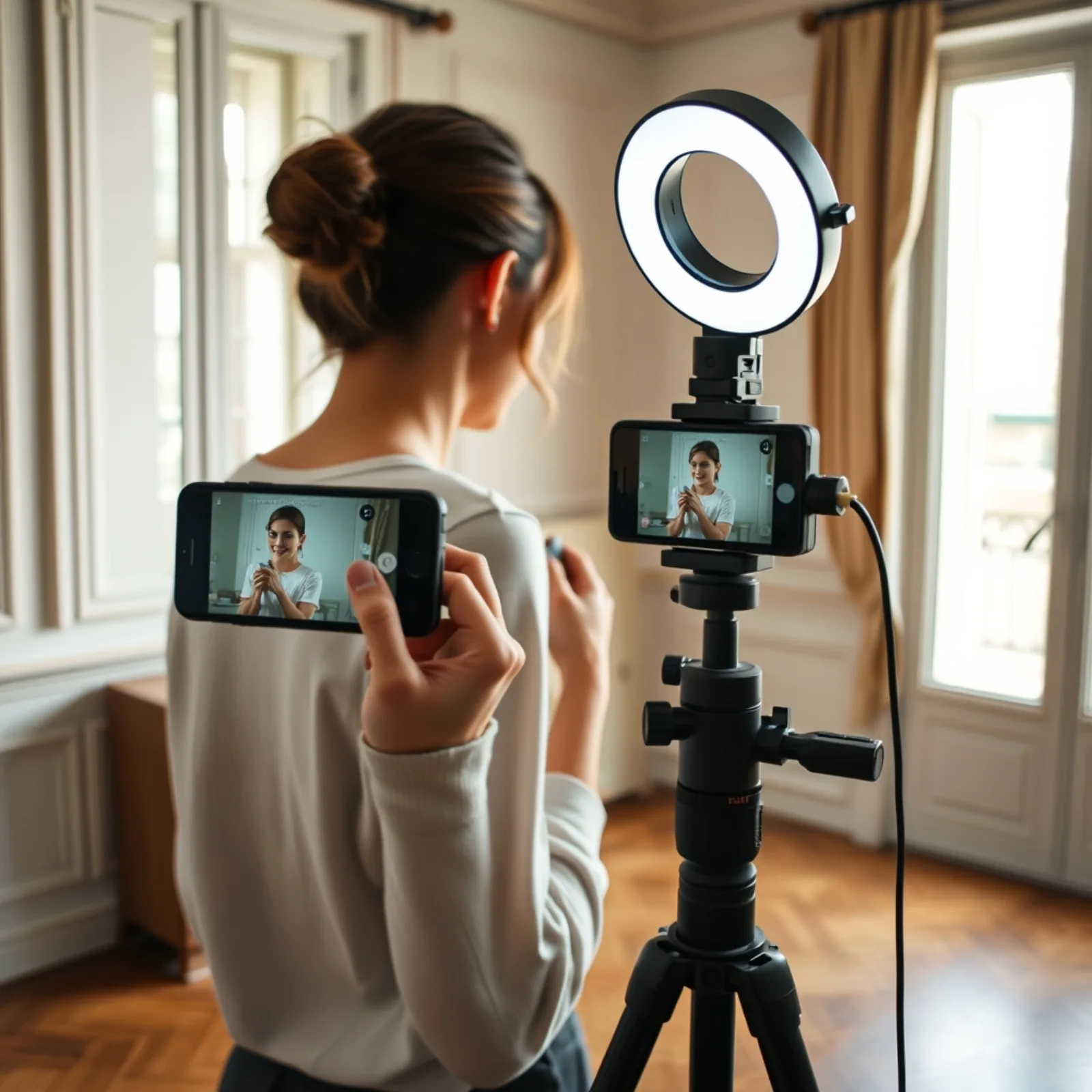
Paris improves production logistics (casting density, sourcing lead time, access to locations) and has no measurable effect on creative performance. On our campaigns, a hook shot in a flat in the 11th arrondissement and a hook shot in a house on the outskirts of Toulouse have the same three-second hold rate, at equal script quality. The address is a logistical criterion. Not a creative one.
We are based in Paris, at 40 rue du Colisée, with a team that shoots all over France. So we see both sides of the meter. What Paris concretely brings: a creator pool dense enough to cast a specific profile in 48 to 72 hours, the ability to chain two brands in the same day at the same location, and varied settings less than thirty minutes away by metro.
What Paris costs, on the other hand, nobody publishes. Hiring a shooting flat is negotiated by the half-day and quickly outweighs two creators. Travel within the city takes an hour per crew move with equipment. Parking a van of equipment is a lottery. And as soon as you leave private premises, permits for filming on public roads add administrative delay that nobody wants to take on for a 25-second video. According to the City of Paris, a filming permit request via the AGATE platform must be submitted at least three weeks (15 working days) before the shoot.
| Item | Paris shoot | Mobile crew in the regions | Effect on performance |
|---|---|---|---|
| Casting lead time | 48 to 72 h for a precise profile | 5 to 10 days depending on the city | None (affects speed, not results) |
| Shooting location | Half-day hire, a real cost line | Often the creator's home | None, even favourable to native format |
| Transport & travel | 1 h per equipment move | Train + car, spread over 2 to 3 days | None |
| Creatives shot per day | 6 to 10 depending on setup changes | 8 to 14 (dedicated day, zero travel) | Indirect: more angles tested |
| Cost per creative delivered | Competitive under 8 videos | Competitive beyond 12 videos | None at equal script quality |
The tipping point, as we observe it in our own schedules: below about ten videos per session, Paris casting wins because the fixed travel costs are not amortised. Beyond that, a day blocked in the regions with two or three creators at one location produces more creatives for the same budget, because no time is lost in transport. The full criteria are in the local or national agency decision grid.
The trap of the “Parisian studio” that does not exist
Some of the Parisian addresses shown on these sales pages are registered offices. Sourcing is done by a platform, editing is subcontracted elsewhere, and nobody in the structure has ever held a camera. That does not make the work bad, it makes the lead time unpredictable, because every iteration goes through three intermediaries. The useful question to ask in a meeting: “who edits my videos, and is that person an employee of yours?”. The answer is often more instructive than the portfolio.
What is the rate of a social media agency in Paris in 2026?
2026 rates are only comparable if you identify the purchase unit: the price per video, the monthly creative-output package, or the overall social media retainer, three things that Parisian quotes present under the same name.
Let's start with the published, dated figures. According to featt.fr, in a grid updated on 4 May 2026, a 30 to 60-second UGC video with a simple script, shoot and basic editing sits between €100 and €300 in France, and a video designed for ads, scripting included, between €300 and €800. VOGZ, on 9 June 2025, recorded an observed average price of around €212 per video. Creatorschool, on 26 July 2026, distinguishes the beginner creator at €150–200 from the experienced one from €350, and places complex production (60 to 120 s, co-written script, multi-setup shoot) between €800 and €3,000 and more.
Komunity, on 19 June 2025, points to an entry level of €80–100 for a 20 to 40-second vertical video, with a warning we repeat to our clients: at that price, you may receive only the raw footage. A TikTok Marketing Partner certified agency, Katall, announced as of 8 January 2026 a range of €300 to €1,000 for a simple to-camera video with a supplied script. These ranges do not overlap. It is numerical proof that “a UGC video” is not a stable purchase unit.
| Purchase unit | What is delivered | 2026 range | Source & date | What is NOT included |
|---|---|---|---|---|
| Raw footage | Unedited files, 20–40 s | 80–100 € | Komunity, 19/06/2025 | Editing, subtitles, ad rights |
| Edited organic video | 30–60 s, simple script, basic editing | 100–300 € | featt.fr, updated 04/05/2026 | Advertising use, variations |
| Ads-designed creative | Scripting, crafted hook, punchy editing | 300–800 € | featt.fr, updated 04/05/2026 | Long-term rights, multi-country |
| Multi-setup production | 60–120 s, co-written script, several sets | 800–3 000 €+ | Creatorschool, 26/07/2026 | Media, post-test iterations |
| Rights (cross-cutting line) | Advertising usage licence | +15 to 30% / 30 days; up to +40 to 150% | Creatorschool 26/07/2026; Creazity 15/10/2025 | Renewal beyond the period |
Influentials, in an article dated 18 August 2026, puts the overall range between €50 and more than €500 per video and identifies rights as the first factor of variation in the bill. That is exactly what we see in our own quotes. Two brands can pay €340 and €690 for an identical video: the first took 30 days of distribution in France, the second 12 months multi-country with paid social. The detail is set out in what usage rights really cost in France.
The social media retainer, a different object
A Parisian social media retainer does not buy videos: it buys account management, community management, editorial planning and sometimes media reporting. Videos are one line among others, often capped at four or six a month. We have no public, dated range for the 2026 retainer in France, and we would rather say so than invent a figure. What we do know: when an e-commerce brand needs twenty creatives a month, the social media retainer is the most expensive format per file delivered.
One environmental point that changes the trade-off: social CPMs have been trending upward since 2025 according to several market observers, and we have no verifiable sourced figure to cite here. When media costs more, the only variable still under your control is the creative refresh rate. Paying €250 more for a video that will last six weeks in distribution is more profitable than paying €90 for a video that burns out in five days.
The unit price hides your internal time
A quote shows a price per video. It never counts the hours your team will spend running the model. Yet that is where the gap between the options narrows, and sometimes reverses.
With a creator sourced directly or a platform, you are the one who casts, writes the brief, chases, validates, requests corrections, handles invoicing and checks that the rights are properly signed. On one or two videos, that is absorbable. As soon as you coordinate several creators in parallel, it becomes a part-time job that nobody budgeted for, most often taken out of the time of the person who should be analysing the results.
Before comparing two quotes, answer three questions:
- Who writes the briefs on your team, and how long does it take them per video?
- Who manages the back-and-forth when a video comes back off-brief?
- Do you have an in-house media buyer able to read the results and rebrief alone? If so, a platform may be enough. If not, you are buying volume with nobody to learn from it.
The honest calculation: price of the videos plus valued internal time, divided by the number of creatives actually put into distribution. A cheap video that sits in a shared folder, for lack of time to edit and test it, costs more than a video delivered ready to run.
How can you tell a Parisian UGC agency that keeps up its output?
A UGC agency's asset is not the size of its creator pool, it is the proportion of creators already tested in your product category. A pool of 3,000 profiles, none of whom has shot a food supplement, is worth less to a nutrition brand than twelve creators who already know how to deliver a product pitch without triggering a moderation rejection.
The figure that explains why this criterion matters: in June 2025 Komunity recorded 93% growth in the number of UGC creators in a year, to around 5,700 verified profiles in France, but only 4% with more than four years of experience. The pool has exploded, the skill has not. The same report puts the premium for an experienced creator at 30–50% over a recent profile. On our schedules, that premium pays for itself from the second session, simply because there is no re-shoot.
The operational proof to ask for, in this order:
- The brief-to-first-delivery lead time, stated in working days, not “quickly”. Under 10 working days in Paris is workable. Beyond 20, the test cycle becomes unusable.
- The re-shoot rate over the last six months. An agency that does not know it is not measuring anything.
- The number of distinct angles delivered per month, not the number of videos. Ten videos on a single angle is one angle tested.
- The variations included: hook-swap versions, formats by placement, burned-in subtitles or not. Three hooks on the same video body cost less than three shoots and give three test results.
- Who validates what, with a contractually set number of rounds of revisions. The absence of a limit guarantees schedule drift.
To read a portfolio for more than its aesthetics, we have documented twelve proofs to look for in the 12-proof portfolio evaluation grid. The simplest: ask for two videos from the same client six months apart. If the writing has evolved, there was iteration. If it is the same structure, there was production, not strategy.
Casting: advertising proof before audience
A creator's follower count says nothing about their ability to carry an ad. An organic creator writes for their community: they take time to set a mood and speak to people who already know them. In paid distribution, nobody knows them, and the video has to hook a stranger mid-scroll. These are two different trades, even when the face is the same.
What we look at in casting, and what you can demand from any agency:
- Videos already run as ads, not an organic feed or screenshots of page statistics. A creator with no advertising history is not excluded, but they take a short test before the full batch.
- Basic technical quality: sound, readable lighting, stable framing. A creator who cannot handle their microphone will cost you a re-shoot.
- The place of the hook in their previous videos: does the tension arrive straight away, or after an introduction?
- Their behaviour in front of the brief: a good creator asks questions about the target, the main objection, the real use of the product. One who asks none will improvise.
Register matters as much as technique. For the same product, we distinguish three profiles that do not serve the same stage of the funnel:
- The witness: they tell how they use it and the doubts they overcame. Useful close to conversion, in retargeting notably.
- The educator: they demonstrate, explain, compare. Essential for a technical or expensive product, where the objection is rational.
- The lifestyle creator: they put the product in context without a heavy pitch. Better suited to discovery than to direct sales.
Varying these profiles is part of the breadth of angles in the first month: two creators with opposite registers on the same script often teach you more than two hooks on the same face.
What is the best luxury marketing agency in Paris, and is UGC compatible with luxury?
Raw UGC is not a luxury format, but premium native creative is: vertical format, social codes, a consistent art direction and full control of location and casting. A house cannot afford a shaky shot in a badly lit bathroom. It can very well afford a 20-second vertical video, shot handheld, with clean framing and thoughtful lighting.
Paris captures this demand because luxury has its headquarters there. A good share of the brands typing “UGC agency Paris” are not looking for UGC: they are looking for social content that does not betray their brand territory. The question “best luxury marketing agency” then translates into three concrete capabilities, not agency size:
- Creator selection on speech register, not on audience. A creator who says “it's such good value for money” about a €2,400 bag destroys ten years of positioning.
- Art direction framing before the shoot: palette, density of light, product gestures, no third-party brands in the frame. We work with shot moodboards, not ambience moodboards.
- Long-term rights from signature. A premium brand does not want to renegotiate a licence on an asset that has become emblematic. Better to pay +40% for rights once than reopen the discussion after six months.
- Contractual brand safety: non-compete clause for the period, obligation of partnership disclosures compliant with the French commercial influence framework, written approval before any publication on the creator's account. According to the ARPP's Observatoire de l'Influence Responsable 2025, the gap in non-compliance rates between small creators and large influencers fell from 15 points in 2023 (23% versus 8%) to 10 points in 2024 (15% versus 5%), then to a single point in 2025.
What we do not know, and will not pretend to know: how far the UGC register transposes to the most locked-down categories, high jewellery and watchmaking in particular. We have seen the format work on premium beauty, accessible leather goods and spirits. On a €40,000 product, the argument of spontaneous use no longer holds, and we say so before signing. The definition and costs of the intermediate register are set out in native creative in vertical video.
Are the “10 best agencies in France” rankings reliable?
Most “top 10 agencies” rankings are commercial spaces: the rank is bought, swapped for a backlink or self-awarded by the agency publishing the ranking. That does not mean the agencies listed are bad. It means the order carries no information about your need.
| Signal observed | What it reveals | Verdict |
|---|---|---|
| The agency publishing the top is on it | Self-citation, no committee | Ignore |
| No methodology or quantified criteria | The rank is editorial, therefore arbitrary | Ignore |
| “Sponsored profile” or “premium” label | A paid directory in disguise | Ignore for the rank, useful as a list |
| Same 10 names on 6 different sites | Circular copying, single source | Ignore |
| Dated ranking, published criteria, verifiable client reviews | Real editorial work | Usable as a starting point |
The substitution is simple: instead of looking for a rank, score three or four candidates yourself on verifiable criteria. Lead time, rights, angles per month, ownership of the edit, re-shoot rate. We have turned this exercise into a scored grid in audit rather than rank: the 100-point grid. A brand that applies this grid to three Parisian agencies gets a score gap of 20 to 40 points. No public ranking will give you that.
The market context behind these lists
The creator economy is worth $8.14 billion in France in 2025, up around 19% over a year, with 348,058 monetised creators against 303,648 the previous year, according to Creatorschool (26 July 2026). The global UGC platform market is said to grow from $4.7bn in 2022 to a projected $71.3bn in 2032. This growth attracts many newcomers, and many rankings built to capture their traffic.
How should you frame your first 90 days with a UGC agency in Paris?
Three months are enough to decide, provided you contractualise from the quote the number of angles, the iteration lead time and the cost per winning creative, not the number of videos. A brand that signs for “12 videos a month” has no way of knowing, in February, whether it should renew.
Month 1: breadth of angles and baseline
We look for diversity, not perfection. Six to eight distinct angles (problem/solution, demonstration, comparison, testimonial, objection, before-after), each with two or three hook variants. The goal of the first month is to measure a gap, so you need contrast. You come out of month 1 with a baseline three-second hold rate and a reference cost per acquisition. Nothing more.
Month 2: iterating on the survivors
Two or three angles have held up. We develop them: new hooks on the same body, new creators on the same script, new ratios by placement. This is where in-house editing changes everything: with us, a hook variant is delivered in 48 hours because the editor is in the next room. An agency that subcontracts editing will answer seven to ten days, and month 2 will be eaten up by two iterations instead of six.
Month 3: the decision rests on a single number
Divide the quarter's production budget by the number of creatives that passed your break-even threshold in distribution. That is your cost per winning creative. On our e-commerce accounts, a healthy ratio is around one winning creative for every five to eight produced; beyond ten, there is an angle or brief problem, and we tell the client before they discover it. The calculation method is detailed in the real cost per winning creative.
Three KPIs to put in black and white in the quote: number of distinct angles delivered per month, maximum iteration lead time in working days, and scope of rights with an end date. Add an exit clause at 90 days with 30 days' notice. An agency confident in its output will sign it without discussion.
One last point, the one that has come up most often in meetings since late 2025: AI-generated UGC. We use it, but on specific tasks: subtitle variations, packshot variants, voice dubbing for market tests. On the face and speech of a human recommending a product, the synthetic creatives we have tested on our accounts last less long in distribution than real shoots. Not on ethical principle. Because the hold rate drops. That may change in 2027. It is not the case as we write these lines, and a UGC agency in Paris that promises you otherwise is selling you a hypothesis.
The brief, the distribution rights and the reporting that make these 90 days readable
The quote's KPIs are useless if the starting brief fits in two lines. A creator, however excellent, knows neither your target, nor your customers' objections, nor your legal constraints. Without a framework, they improvise, and every improvisation is paid for in back-and-forth.
The minimum brief, video by video:
- The angle and the objection addressed, not just the product.
- The explicit hook, with its variants planned at the writing stage rather than after the first results.
- The distribution specs: 9:16, built-in subtitles, safe zones by placement, CTA legible on screen.
- What has already worked or failed on your account. Briefing without looking at the advertising history means starting from scratch.
On the rights side, one line is often forgotten: distribution from the creator's account. Spark Ads on TikTok or partnership ads on Meta require specific authorisation from the creator, separate from the transfer of the file. If you plan to use them, have it written before the shoot, with the channels and derived formats (Stories, Reels, Shorts) listed by name. The TikTok for Business help centre, updated in June 2026, states that Spark Ads let you run other creators' organic posts as ads, provided you have their authorisation.
Finally, reporting must go down to the level of the creative, the creator and the hook, never just the campaign level. One simple indicator to track each month: the share of delivered videos that were actually put into distribution. If it is low, the problem lies upstream, in the brief or the selection, not in media buying. And if your production studio has no access to this data, it will produce blind the following month.
Frequently asked questions
- What is the best luxury marketing agency in Paris?
- None is, in absolute terms. For a premium brand, the three capabilities that matter are creator selection on speech register, an art direction framing validated before the shoot, and long-term rights signed from the start. These criteria can be checked in a meeting. The agency's size or its rank in a ranking does not guarantee them.
- What is the best influencer agency?
- The question has no absolute answer, because an influencer agency sells an audience and a post, not a video file usable in ads. Choose according to the objective: audience matching for awareness, creative output for paid acquisition. If your need is to test angles in ads, what you need is a vertical video production studio, not an influencer agency.
- What is the rate of a social media agency?
- A social media retainer covers account management, editorial and community management, with a video quota often limited to four or six a month. For pure production, the grids published in 2026 put the edited organic video between €100 and €300 (featt.fr, May 2026) and the ads-designed creative between €300 and €800, rights extra.
- What are the 10 best web agencies in France?
- The published rankings are mostly paid directories, sponsored rankings or self-citations: the rank carries no information about your need. Keep them as a list of candidates, never as a hierarchy. Score three agencies yourself on verifiable criteria: brief-to-delivery lead time, scope of rights, number of angles per month, ownership of the edit.
- Can a non-Paris UGC agency shoot in Paris?
- Yes, and the reverse is true too. What matters is not the head office address but access to a pool of Île-de-France creators and the ability to move a crew with its equipment. Below about ten videos per session, local casting remains the most efficient. Beyond that, a dedicated day in the regions produces more creatives for the same budget.
- How many videos a month do you need to test properly?
- Allow six to eight distinct angles in the first month, each with two or three hook variants, so roughly fifteen to twenty files. Below that, the sample is too small to tell a good angle from good luck. What matters is never the number of videos but the number of genuinely different angles put to the test.
- Can the same UGC video run on TikTok Ads and Meta Ads?
- Yes, a 9:16 vertical master runs on both, but rarely as is. Scroll behaviour differs: on TikTok, native codes of sound, pace and editing weigh more, whereas Meta's Reels and Stories placements tolerate more varied formats. Plan hook variants per platform and read the results separately, because metrics are not comparable from one channel to the other.
- Should you give the UGC agency access to your ad account?
- Read access is enough, and it changes the quality of the following month. Without it, the agency produces without knowing which hooks, creators or angles held up in distribution. With it, it can rebrief on the winning creatives and stop iterating on those that fall off. If you prefer not to open the account, at least share an export of results per creative every week.
Let's talk creative output, not agency rank
You have five incomparable Parisian quotes on the table and no way to decide. Esekai is a vertical video production studio: creative ads, UGC and organic content for TikTok, Reels and Shorts, with a dedicated Creative Strategist, in-house shooting and editing, and iterations delivered in days rather than weeks. We are not a 360 agency. Thirty minutes of meeting: formats, budget, action plan. No agency presentation.
Book a meeting →30 minutes to talk formats, budget and action plan.