

A native creative is an advertising creation designed to adopt the form, style and behaviour of the content around it, so that it blends into the feed without breaking it. Technically, it is a set of assets (headline, text, image or video, logo, landing page) that the platform assembles according to the codes of its placement. On TikTok, Instagram Reels and YouTube Shorts, it takes the form of a 9:16 vertical video shot in the codes of the feed, and labelled as advertising. Type the query into Google and you get a technical doc, four articles on native advertising and three companies with the same name. Three different things. We separate them here. According to the 35th Observatoire de l'e-pub from SRI and UDECAM, published in February 2026, Social accounted for €4.18bn in France in 2025, or 34% of the digital advertising market, up 15% thanks to the rise of video.
Native creative: an advertising creation that borrows the format and codes of its host placement in order to blend into it. It differs from display through its integration into the content, and from organic content through its mandatory advertising label.
What does “native” mean in marketing?
“Native” means “born in this place”: a native creative is native to its host platform, not to the brand that pays for it. That is the whole shift in meaning, and it is where most briefs go wrong from the very first line.
The word comes from the Latin nativus, meaning that which is born in a place. In advertising, it describes neither the advertiser, nor the product, nor the creator. It describes a relationship: the one between the ad and the environment that hosts it. A video can be produced 100% in a studio by a luxury brand and still be native if it matches the codes of the feed it lands in. Conversely, a corporate film reframed to 9:16 is still a corporate film, even if it is posted by a creator with 80,000 followers.
The operational criterion fits in one sentence, and it is the one we use internally when making calls on a creative:
A creative is native if, once the advertising label is removed, a user who is scrolling could not immediately tell that it comes from an advertiser.
This criterion is descriptive. It describes a formal property of the asset, not a licence to deceive. The advertising label, for its part, is never optional: since February 2024, the European Digital Services Act requires that any ad displayed on a very large platform be identifiable as such, clearly and in real time. French law no. 2023-451 on commercial influence goes further for paid content carried by creators: a “Publicité” or “Collaboration commerciale” label, legible throughout the whole video. We come back to this below, because it is precisely where nativity and compliance rub against each other. Arcom points out that, since 17 February 2024, the European Digital Services Act has applied to all online platforms, whatever their size.
Google, in its Display & Video 360 documentation, puts it differently: a native ad “looks like part of the content of a publisher's app or page”, the term “native” referring to “adopting the style, tone and placement of the publisher's content”. A correct definition. But it dates from a world where the placement was a web page with an editorial grid. In 2026, the dominant placement is a full-screen vertical feed with the sound on.
Native creative, native advertising, native app, native language: what is the difference?
These four expressions share the word “native” but refer to four different frames of reference: the host placement, the editorial slot, the operating system and the speaker. Nobody has put them side by side, and that is the first reason this query returns an incoherent results page.
| Term | Field | Native to what? | One-sentence definition | Example |
|---|---|---|---|---|
| Native creative | Advertising creative | To the host placement | A set of assets adopting the style of the surrounding content | 9:16 in-feed TikTok video |
| Native advertising | Media buying | To the editorial slot | Ad format integrated into a publisher's content feed | Taboola recommendation, sponsored article |
| Native app | Development | To the operating system | App written in the OS's own language rather than for the web | iOS app in Swift vs PWA |
| Native language | Linguistics | To the speaker | Anglicism for “mother tongue” | Native speaker |
| Native Creative (proper noun) | Company names | , | Namesake companies with no link to the concept | Studios in Naperville, Tokyo, New England |
Same morphological logic, three technical frames of reference, and a fourth case that is merely a commercial namesake. If you search for “native creative” and land on a Facebook page of photographers in Illinois, it is not Google that is buggy: it is that the expression, in French, had not yet had a page that tackles it head-on.
What is native advertising, and how does it differ from native creative?
Native advertising is a media buy: it describes where the ad appears. Native creative is an asset: it describes what the ad contains. You can perfectly well buy native and deliver a creative that is not. It is the most common mistake, and the most expensive.
Native advertising refers to all the ad formats that slot into a content feed instead of interrupting it: in-feed on a media site, a recommendation widget at the bottom of an article, a sponsored article, a sponsored search result, an in-feed placement on a social network. It is a category of inventory. French agencies that have been writing on the subject since 2018 stop there: they describe the channel, never what you put in it.
Yet it is the asset that decides performance. An in-feed TikTok placement billed on a CPM basis does not magically become native because the media plan line is called “In-Feed Ads”. If you push a reframed 16:9 film into it, with a logo in an opening bumper and a studio voice-over, you have bought native and delivered broadcast. The media is native. The creative is not. And the user sees only the creative.
We see this scenario with roughly one in two brands that come to us with a history of disappointing campaigns. The media was bought well. The creative brief, meanwhile, had been written by the team that produces the corporate films. This confusion between the media bought and the asset produced overlaps with another trade-off we have covered in detail: creative ad or brand content, what you are really buying.
On the market side, the orders of magnitude deserve to be set straight. In October 2025, Market Research Future estimated the global native advertising market at $111.13bn in 2024, projected to reach $124.88bn in 2025 and $400.95bn by 2035, at a CAGR of 12.37%. SNS Insider, in September 2025, rather uses 16.2% annual growth between 2025 and 2032; the scopes differ, and both are defensible.
The $402bn figure everyone copies
On pages dated 2025 or 2026, you will come across the claim that “native advertising will reach $402 billion in 2025”. This figure comes from an Adyoulike forecast published in 2021, which predicted a native market above $400bn in 2025 (+372% compared with 2020). The latest 2025 estimates hover around $125bn. A gap of a factor of three. When a source serves you the $402bn for 2025, you know it has not reopened its data in three years, and you can treat the rest of the page accordingly.
What does a native creative look like in 2026 on TikTok, Reels and Shorts?
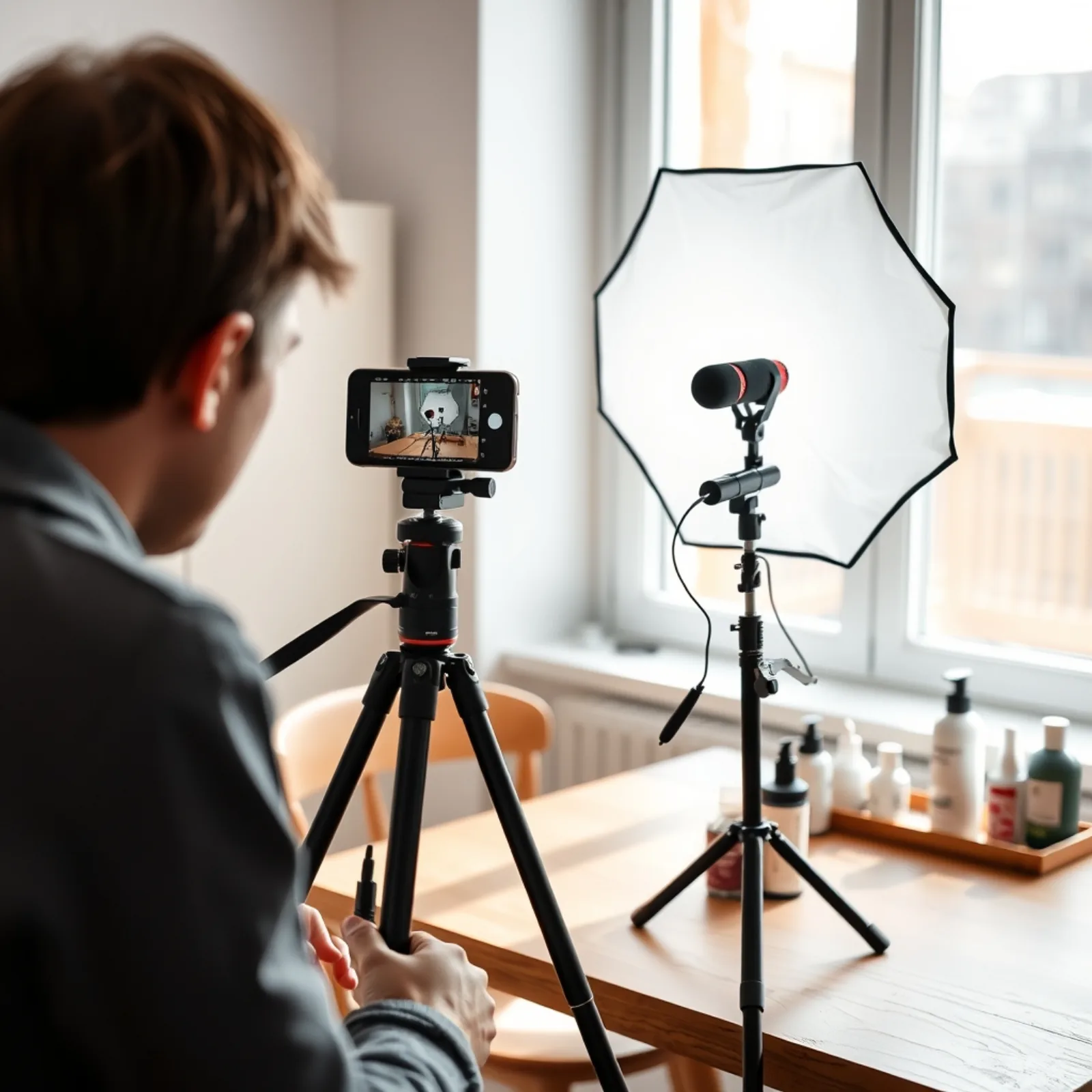
In 2026, a vertical native creative can be recognised by six markers: smartphone framing, available light, a spoken hook in the first two seconds, active sound that is essential to understanding, platform typography, and a brand that appears through use rather than through a logo.
Here are four treatments we produce regularly, with what is native in them and what is not.
1. The Spark Ad / whitelisting
An existing organic post by a creator is boosted as paid media from their own account. The creator's handle, their comments, their history all stay visible. It is the most native format by construction: the advertising object is a post. What is not native: the sponsored link at the bottom, the mandatory label, and sometimes a product shot added at the brand's request that breaks the rhythm. First metric affected: the 3-second hold rate, because the viewer recognises an account and not a brand.
2. The face-to-camera UGC testimonial
A creator talks to the front camera, indoors, in window light, with auto-generated subtitles. Native: the arm's-length framing, the hesitations left in the edit, the non-corporate vocabulary. Not native: reusing the wording of the product site, the three benefits listed in the order of the brief, and the final packshot on a white background. In 2025 we stopped ending these videos with a packshot: in our tests it improved neither CTR nor CPA, and it added 1.5 seconds of video that nobody watches.
3. The POV product demo
First-person camera, hands in frame, a real gesture, live sound. The format that works best on products with a visible benefit: cosmetics, food, small appliances, technical textiles. Native: the clumsiness of the gesture, the sound of the product. Not native: stock library music. On our campaigns, replacing purchased music with a sound from the platform's catalogue makes a clear difference to 6-second retention, although we cannot cleanly separate the effect of the sound from the effect of the editing that goes with it.
4. The reply to a comment
The video opens on a pinned comment, a real comment, not one written by the agency, to which the brand replies. A highly native format because it literally exists nowhere other than in the interface. It requires an active account with real comments. A brand that has been posting for six weeks does not have the material.
The specs, non-negotiable
- 1080 × 1920, 9:16 full frame. No bars, no automatic cropping from a 16:9 master. According to Google's internal data (2024, worldwide), adding a vertical video to an ad group that previously contained only horizontal videos increases view-through rate (VTR) on YouTube Shorts by more than 40% in Video View campaigns, according to the Google Ads help centre.
- Safe zones: keep roughly 130 px free at the top and 480 px at the bottom on TikTok, where the username, description and CTA button sit. A subtitle placed too low slips under the interface.
- Subtitles: native (generated by the platform) when you post organically or as a Spark Ad, burned in with the platform font when you upload a campaign asset. A serif brand-guidelines typeface on a Reel shows within 300 milliseconds.
- Sound on by default: the voice carries the information. If the video can be understood on mute, it was probably designed for a 2019 Facebook feed.
- Useful length: 9 to 22 seconds for acquisition, up to 45 seconds when the product needs a demonstration. Beyond that, you need a narrative reason.
The hook remains the first marker of nativity, ahead of framing. It is the point that separates two otherwise identical creatives fastest; we have set out the 8 hook structures that stop the scroll in 3 seconds in a dedicated article.
How do you produce a native creative that stays native after internal approval?
Nativity almost never dies on the shoot: it dies in approval. Logo moved up to the start “for awareness”, a three-line legal disclaimer, voice-over redone in a studio because “the creator doesn't articulate well”, brand-book typography imposed. Each of these trade-offs is defensible taken in isolation. Stacked up, they turn a native asset into a vertical TV spot.
To make these trade-offs open to discussion rather than something imposed, we score each creative out of 12 before it runs. The scorecard serves as a common language between the creative strategist, the brand manager and legal: instead of saying “it looks like an ad”, we say “we're going from 10 to 6, and here's what drives it”.
| Criterion | Native (2 pts) | Hybrid (1 pt) | Broadcast (0 pts) | Metric affected |
|---|---|---|---|---|
| Framing & lighting | Smartphone, available light | Hybrid, soft LED out of frame | Studio, cyclorama, colour grading | 3-second hold rate |
| Hook (0–2 s) | Spoken sentence, face or gesture | On-screen text + product shot | Animated logo bumper | 3-second view rate |
| Voice & sound | Live sound, platform catalogue | Live sound + music bed | Studio voice-over, purchased music | 6-second retention |
| Typography & subtitles | Platform font, word by word | Neutral sans-serif, short sentences | Brand typeface, lower third | Completion |
| Editing rhythm | Hard cuts, jump cuts | Cuts timed to the music | Animated transitions, motion design | Frequency at saturation |
| Brand placement | Through use, product in hand | Logo at the end, 1 s | Logo at the opening + packshot | CTR |
Reading the score: 10 to 12 is native. 6 to 9 is a deliberate hybrid, and sometimes it is the right choice, we will get to that. 0 to 5 is broadcast in 9:16, which is not a fault in itself but must be a decision, not an accident of approval.
The tipping point: when fake spontaneity turns against you
There is a danger zone between 6 and 9. The creative has the look of native but the substance of corporate: smartphone framing, but a script recited word for word. That is where the “it's an ad” comment appears, followed by its less friendly variants. We see it regularly on beauty campaigns where the creator was too constrained. A comment of this kind that rises to the top of the thread degrades the asset's performance; on our accounts, we prefer to stop delivery and relaunch a variant rather than try to drown it out. A half-native asset costs more than an openly advertising one.
The countermeasure is three lines added to the production brief, even before casting: what is non-negotiable on the legal side (label, product claims), what is non-negotiable on the brand side (product name spoken, once), and everything else, which belongs to the creator. If your approval document contains more than ten blocking points, the creative will come out at 5 out of 12.
How much does a native creative cost, and at what volume of variants?
The relevant price is not that of a video, it is that of the variant that survives the test. A single native creative costs less to produce than an advertising film, but native works by volume: what you save on the shoot, you reinvest in variants.
Order of magnitude observed on the French market in 2026: a single UGC creative falls within a wide range depending on usage rights and the creator's profile, and a shoot session rarely produces a single video. The breakdown of cost items, rights assignments and usage periods is covered line by line in our article on the real cost of a UGC video in France. The reasoning to keep here is different: divide the total budget by the number of creatives that last more than two weeks in delivery. That is your cost per winner. On the e-commerce accounts we manage, one variant in five to one in eight clears that threshold, depending on the maturity of the account and the breadth of the audience.
| Environment | Indicative CPM | Reference CTR | “Native” means here | Variants to plan for |
|---|---|---|---|---|
| Programmatic native display | $5–12 (AI Digital, 2026) | 0,08–0,15 % | Headline + image assembled into the publisher's template | 4 to 8 headline/visual combinations |
| Standard display (benchmark) | $1.50–4 (AI Digital, 2026) | often < 0.10% | Nothing: banner outside the feed | Set of IAB formats |
| TikTok in-feed | ≈ $13.26 (Triple Whale, 2025) | 1.77% overall / 0.49–0.73% on link | 9:16 video, sound ON, spoken hook | 10 to 20 per month and per offer |
| Reels | Variable, often < TikTok | Link CTR structurally higher | Faster-paced editing, denser text | Adaptation, not duplication |
| Native retail media | Depends on the retailer | Purchase-intent effect generally higher than display, with no consolidated public benchmark figure, to be checked study by study | Product page and the retailer site's grid | Per product reference |
A methodological warning, and not a decorative one: the CTRs in this table cannot be compared from one row to another. A CTR of 0.12% in native display and a CTR of 1.77% on TikTok do not measure the same action, nor the same clickable surface, nor the same intent. Putting the two in the same report is the most widespread analytical error among buyers, and it systematically leads to overestimating social or condemning display.
The point that should hold your attention is elsewhere. On Triple Whale's full-year 2025 data, TikTok CTR falls by about 12.5% and CVR by almost 37%, while ROAS rises by about 6% and CPA falls. Fewer clicks, far fewer conversions, but media efficiency holds. In operational terms: attention is harder to win, and it is the asset that makes the difference. When media gets more expensive, the only variable that stays entirely under your control is the asset. That is exactly what makes nativity decisive in 2026, and not just aesthetic. For the sector-by-sector reading, we have compiled French CPM, CPC and ROAS benchmarks on the media side.
Which misconceptions make native campaigns fail?
Five beliefs come up in almost every incoming brief, and each one costs money.
“Native, so cheaper”
False at the overall budget level. True per unit. You save on the set, the cinematographer, the colour grading. You spend on volume of variants, creator fees, usage rights renewed every three or six months, and creative strategist time to read the tests. A brand that moves from the annual film to native does not reduce its production line: it spreads it differently, over twelve months instead of one week.
“Native means hiding that it's an ad”
False, and illegal. Article 26 of the DSA has required clear identification of advertising on large platforms since February 2024. Law no. 2023-451 requires, for commercial influence in France, a label legible throughout the video. The ARPP publishes its recommendation on digital advertising communication, to be checked in its current version before each campaign. Native plays on form, not on concealing status. A brand that asks to remove the label is not looking for native: it is looking for a legal problem. The subject is adjacent to that of brand safety in video marketing. Arcom specifies that the first phase of DSA implementation was launched in August 2023 for the largest digital players, whose services are used by more than 45 million citizens of the European Union.
“Our native CTR is low, the campaign is failing”
Depends entirely on the environment. In July 2026, AI Digital noted that the “0.05–0.1%” average often quoted for display masks gaps of 5 to 10× depending on inventory. Compare a CTR with its own history, on the same placement, with the same audience. Not with a figure from an article.
“UGC is native by definition”
No. Poorly briefed UGC can be spotted in a second: delivery too regular, product-sheet vocabulary, an impeccable wide shot, no hesitation. We see deliverables from UGC platforms that score 4 out of 12 on our scorecard. The creator filmed on a phone, but recited a script written by an agency that does not write for speech.
“A native creative can be recycled as is from TikTok to Reels”
The codes have diverged since 2024. Density of on-screen text, tolerated length, relationship to music, the place of the face: nothing is identical. A TikTok video with the watermark dropped onto Reels is penalised, and it shows. Porting requires a re-edit, not an export.
The nuance we own up to, even if it does not help sales
Not everything has to be native. On a premium product launch, a clean, well-lit 9:16 broadcast asset with strong art direction can come out ahead of a native creative, because the product itself is the argument and the high-end texture is part of the message. We have seen this in high-end retail and in watchmaking. Native dominates in performance acquisition and in testing volume. It is far from automatic in awareness or at the high end. A mature account runs both, with distinct roles in the funnel.
What we do not know, and what no benchmark settles: from what relative weight broadcast starts to damage the perception of an account built on native. We reason case by case, looking at frequency and comments, not applying a rule of three.
How do you know if your supplier can produce native?
Five questions are enough to separate a studio that produces native from a studio that produces reframed films. They all concern verifiable practices, not intentions.
- “Show me two variants of the same script, one that won and one that was cut.” Expected answer: both videos, the date of the cut, and the metric that decided it. A supplier who only shows winners is not testing.
- “What do you actually shoot with?” Expected answer: a phone model, a lavalier mic, possibly an LED panel. If the answer starts with a cinema camera, you are buying production, not native.
- “Who writes the hooks, and how many per shoot?” Expected answer: a creative strategist, between 4 and 10 hooks shot for the same video body. A single hook per video is a classic advertising shoot plan.
- “How do you handle the advertising label without breaking the hook?” Expected answer: a precise position on screen, a choice between platform label and overlaid label, and an opinion on both. Vagueness here signals costly legal back-and-forth.
- “What is your lead time between the performance feedback and the next variant?” Expected answer: days, not weeks. Native lives on iteration; a three-week approval cycle cancels the advantage of the format.
These five questions are a targeted extract on nativity. For a full review of a supplier (process, ownership of rushes, reporting, scaling up volume), we publish a 100-point content agency audit scorecard.
One last benchmark, the one that costs the most to ignore: native creative is not an aesthetic to order once. It is a production regime. A brand that orders ten native creatives in January and nothing until June has not done native, it has done a shoot. Nativity is maintained because the codes of the feed shift every quarter, and a creative that scored 11 out of 12 in March is worth 7 in September. It is uncomfortable to budget for. It is also what separates the accounts that scale from those that replay the same video until saturation.
Frequently asked questions
- What does “native” mean?
- “Native” comes from the Latin nativus, “born in this place”. In advertising, the word describes the relationship between an ad and its environment: a native creative adopts the style, tone and format of the content around it. It is native to the host placement, never to the brand that funds it.
- What is native advertising?
- Native advertising refers to ad formats inserted into a content feed rather than beside it: in-feed on a media site or social network, a recommendation widget, a sponsored article, a sponsored search result. It is a category of media buying: it describes where the ad appears, not what it contains.
- What is a native app?
- A native app is developed in the language specific to an operating system, Swift for iOS, Kotlin for Android, rather than in web technologies. It accesses the device's functions directly. The term belongs to software development and has nothing to do with native advertising, despite the shared word.
- What is the definition of “native language”?
- “Langue native” is a calque of the English native language. The correct French term is “langue maternelle”: the language acquired in childhood by a speaker. You also come across “native speaker”, translated as “locuteur natif”. A linguistic register, unrelated to marketing.
- “Native Creative”, “Native Creative Design”, “Go Native”: what are they?
- They are company names, not concepts. A photo and video studio in Naperville, Illinois, a communications firm in Tokyo, a design studio in New England. They take up three of the ten Google results for this query, with no connection to the advertising notion of native creative.
- Does a native creative have to be labelled as advertising?
- Yes, without exception. Article 26 of the DSA has required clear identification of any ad on large platforms since February 2024. In France, law no. 2023-451 requires, for commercial influence, a “Publicité” or “Collaboration commerciale” label legible throughout the video. Nativity concerns form, not status.
Have your creatives scored on the nativity scorecard
You now know where nativity dies: in approval, not on the shoot. Esekai is a vertical video studio, creative ads, UGC and organic content for TikTok, Reels and Shorts, with a dedicated Creative Strategist, in-house shooting and editing, and iterations in days rather than weeks. Thirty minutes to talk: we discuss formats, volume of variants, budget and action plan. No agency pitch deck.
Book a call →30 minutes to talk formats, budget and action plan.