

A vertical video for a restaurant is a 9:16 format of 15 to 45 seconds, filmed on site, meant to fill a specific slot rather than to collect views. Its effectiveness is measured in useful views, those generated within the catchment area, then in covers, directions clicks and bookings. Three uses make it pay: filling quiet periods, selling a high-margin dish or menu, and recruiting staff. A realistic budget in France: €400 to €1,500 a month excluding media. Everything else (followers, virality, counters) is window dressing. According to the Digital Report France 2025 by We Are Social and Meltwater, relayed by Blog du Modérateur, social networks are the most used type of site or app in France: 92.2% of internet users use them, ahead of messaging apps (88.7%) and search engines (88%).
What is a vertical video really for when you have 40 covers and not 40,000 visitors?
A restaurant vertical video isn't bought to build an audience: it is bought to fill a named slot, push a high-margin dish, or bring in CVs. The difference from e-commerce is physical, not strategic. A website takes 3,000 orders on the same evening without flinching. Your dining room does not. Forty covers, two services, a ceiling that neither the algorithm nor a million views will move by a centimetre.
That is why reasoning imported from e-commerce collapses in restaurants. ROAS assumes an elastic basket and extendable stock. You have an average ticket that moves by €3 at best, and a capacity locked by the number of chairs and the size of the range. The right unit of account is not return on ad spend: it is the incremental cover on an identified slot, multiplied by your margin over food cost.
A slot has a name. Tuesday evening at 11 covers when you can seat 38. Thursday lunch outside the business district. The Sunday brunch launched in September that never took off. As long as the goal stays “grow my visibility”, no video can fail or succeed, and that is exactly the problem.
| Job | Dominant format | Reach radius | Unit of measurement | Time to read results |
|---|---|---|---|---|
| Fill a quiet slot | Dining-room atmosphere + dated offer | 10 to 25 min travel | Covers in the slot vs the 4 weeks before | 7 to 21 days |
| Push a high-margin dish or menu | Gesture, reveal, carving, plating | Local area + customers who have already visited | Number of sales of the dish, average ticket | 3 to 10 days |
| Recruit in the kitchen or front of house | Team at work, the chef's words | Job catchment area, 30 to 45 min | Useful applications received | 10 to 30 days |
Most restaurateurs who call us are paying for job number one and measuring an indicator that doesn't exist in this table: views. We spend the first meeting renaming the objective. Sometimes it ends with “so I don't need you”: when the weekend is already full and there is no quiet slot to defend, a video does not manufacture extra seats.
How many of your views are really in your catchment area?
Only the useful view counts: a view generated by an account located within your travel radius. The formula fits on one line: useful views = total views × share of audience located in the area. A video with 400,000 views, 4% of them within your twenty-minute radius, produces 16,000 useful views. A video with 12,000 views, 70% of them local, produces 8,400. The real gap between the two is far smaller than the headline gap, and the second cost ten times less to produce.
The data exists, for free. TikTok shows the audience breakdown by territory on pro accounts, and Instagram gives the top cities of the accounts reached. Pull three posts, note the percentage from your urban area, average them. That gives you your locality coefficient. Below 15%, your organic is a national medium that flatters you without filling you. Above 45%, you have a usable neighbourhood channel.
Neighbourhood restaurant or destination restaurant: not the same calculation
A destination restaurant, an address people take the train for, book three weeks ahead and drive forty minutes to reach, can monetise wide virality. Malou.io documented in 2026 the case of Monbleu in Paris: millions of views with fewer than 2,500 followers, using only behind-the-scenes content. True, and spectacular. It is only transferable if your address is itself a destination. A town-centre brasserie in Angers does not have the same addressable market as a highly identifiable Parisian concept.
The 74% figure copied everywhere
You will certainly have come across the statistic: “74% of French people choose their restaurant thanks to social networks”. It has circulated on dozens of French blogs since 2025, with no accessible study behind it. We have never managed to trace it back to a primary source. The same goes for “55% of TikTok users visit a restaurant after seeing its menu”: untraceable to source. Treat both figures as unverifiable.
What is sourced is more nuanced, and more useful. According to the OpinionWay survey for SIAL published in 2025, more than one French person in two says they are influenced by social networks when it comes to food, and 40% of them look there for recommendations to choose a restaurant. On discovery channels, Instagram comes first among the social networks cited for discovering a restaurant (22%) in the 2025 DoorDash survey carried out in the United States (Dynata panel, 1,504 American adults, fieldwork late February to early March 2025), ahead of Facebook (19%), TikTok (18%) and YouTube (16%): a ranking within social networks, on an American sample, not a French one. TouchBistro, in its Diner Trends Report 2025, notes that 41% of diners used social media to find out about a restaurant, jumping to 67% among Gen Z. Toast, in a report published in 2026 based on an October 2025 survey, attributes 38% of restaurant discovery among Gen Z to TikTok.
Social is not the first channel for choosing a restaurant. Word of mouth and online reviews are still cited before social networks by consumers; to be sourced precisely before publication, with page and report. Vertical video feeds all three: it gives an image to recommend, a visual to check, a reason to come.
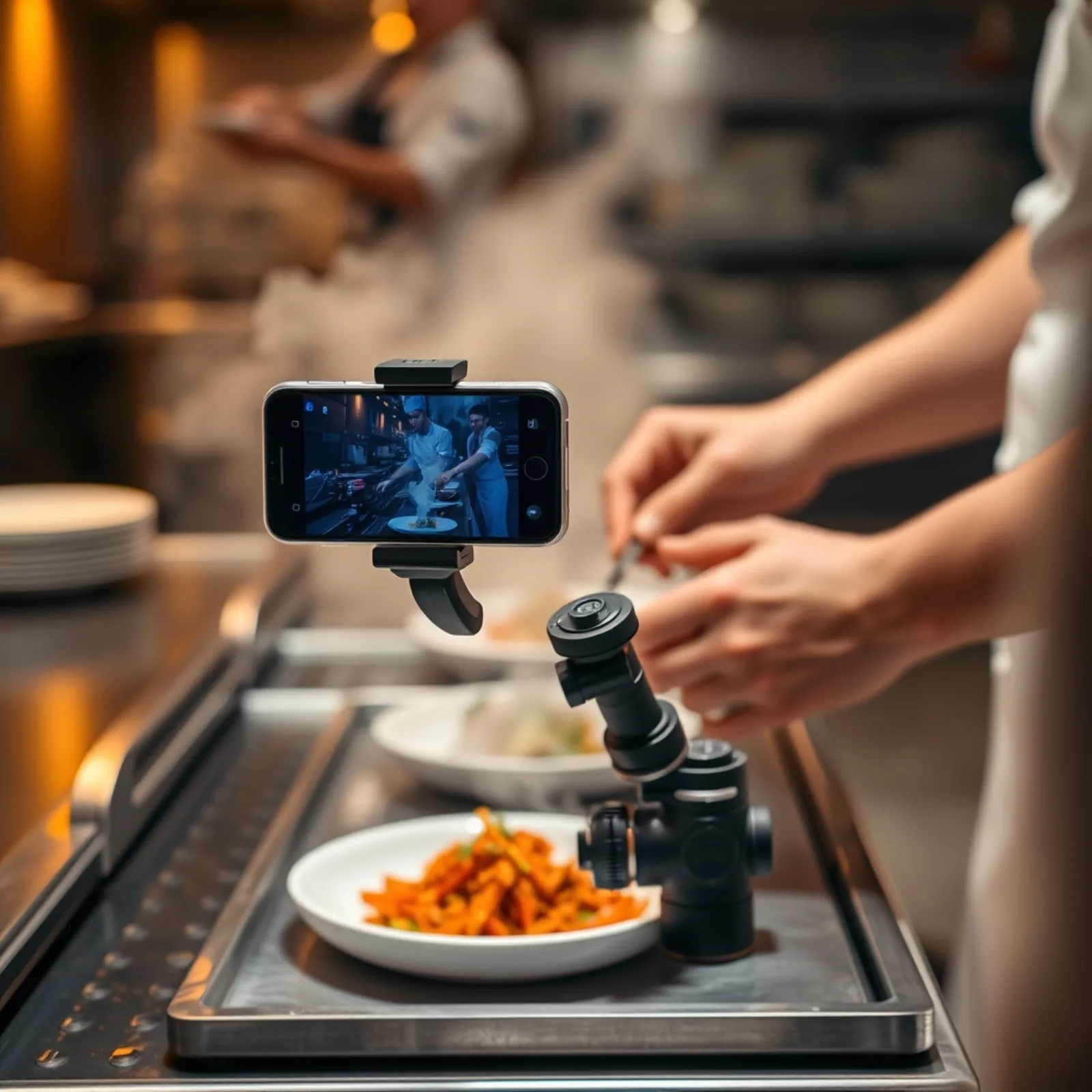
What should you film to sustain a month of posting without shooting every day?
Five families of shots are enough to feed four to twelve posts a month, and they are shot in a single day of service. The classic trap is to film only plates. Restroworks noted in 2025 that content featuring people clearly outperforms product-only shots. Your dishes tell no story on their own: it is the hand carving, the arm pouring, the chef's eye setting the rhythm.
- The gesture. Dish reveal, carving a cut of meat, saucing, flambéing, plating at the pass. It is the best-performing family and the cheapest to produce: it already exists, all you need is a phone and an angle. The first three seconds do all the work, see the 8 hooks that stop the scroll in 3 seconds.
- The dining room. The atmosphere at 7:45pm, the terrace late in the afternoon, the lunch-service light, real background noise. These shots answer the question someone on the fence is asking: what will it look like when I'm there?
- The face. The chef explaining why they changed bread supplier, the head waitress telling the story of the dish that goes out most. Camera at eye level, no teleprompter, one or two takes.
- The proof. The real customer commenting on the way out, the Google review read aloud, the producer who delivers on Tuesday mornings. The choice of who carries it changes everything: we detailed the 6 proof carriers in video and what they cost.
- The useful. New opening hours, the €19.50 lunch deal, parking behind the church, Sunday opening, the Christmas menu. Few views, many conversions. Don't neglect it.
Over twelve videos a month, the mix we recommend looks like this: five gestures, two dining-room shots, two faces, two proofs, one useful. There is no sacred rule in it; it's a starting point we adjust after three weeks of data. On length, be-hype gave windows of 15 to 45 seconds on TikTok and 20 to 60 seconds on Reels for food in 2025-2026; Malou.io recommends in 2026 staying between 15 and 30 seconds on discovery content, placing the hook in the first three seconds and limiting yourself to three to five hashtags.
A well-organised shoot day, one full service, two hours before opening, one hour after, gives you enough to publish for three to five weeks. That is the real gain: you stop filming every day between two orders.
Should you push your restaurant videos with local ads, or stay organic?
Organic alone is no longer enough for local discovery: the space is taken. An industry survey picked up by Restaurant Velocity in 2025 indicated that 99% of full-service restaurants have at least one active social profile, against 69% with a truly working website. Eurostat measured in 2025 that 78.25% of European accommodation and food service businesses use social networks, against 63.57% for all businesses. Everyone posts. Free reach is shared among everyone.
Paid promotion solves the radius problem. You buy exactly what interests you: people within 10, 15 or 20 kilometres, at the time they decide where to eat. Restaurant Velocity recommended in 2026 starting at $15 to $30 a day on Facebook and Instagram for a campaign focused on a single objective: a booking, an offer, an event. In France, on mid-sized-town catchment areas, a floor of €10 to €15 a day for three weeks already gives readable volumes. Below that, learning doesn't stabilise and you pay for noise. The general logic is detailed in the media floor rule for an SME.
Three settings make the difference on a restaurant account. A radius drawn by hand rather than a default radius, excluding half the circle when it falls in an industrial zone or on the other side of a river with no bridge nearby. An objective aligned with the job: traffic to directions to fill a service, messages for a group booking, conversion if you have a booking module. And a time window: push the lunch menu at 10:30am, not at 10pm.
The trap is out-of-area virality. A video that takes off with a national audience pushes up your counter, your followers, and absolutely not your Tuesday evening. Worse: it can pull the algorithm towards an audience that will never come, and degrade the local reach of the following posts. When that happens, we cut the organic push and shift the budget to a proximity format.
How do you know a video has filled a table?
No tool will ever link a view to a cover with certainty: you measure with a body of evidence, on four points, over a rolling 7 days. The general structure is the one we use everywhere else, described in the 4-tier measurement protocol; in restaurants it simplifies radically because the act of purchase is physical.
- Point 1, the business listing. Directions clicks, phone calls, clicks to the website. These are the signals most correlated with real visits. Pull them every Monday, over a rolling 7 days, and compare with the average of the four weeks before the campaign.
- Point 2, bookings. Volume by slot, not total volume. If you push Tuesday evening, look only at Tuesday evening. A rising monthly total proves nothing.
- Point 3, the question at the door. One sentence, asked by the person seating guests: “have you seen us somewhere before?”. Note it in a notebook at the pass. It's low-tech, and it is the most reliable data you will have.
- Point 4, the offer marker. A dish, a free dessert, a code mentioned only in the video. The till count then becomes exact for that fraction.
What we can't do, and it has to be said: isolate the share of the weather, a match, a bank-holiday bridge or a local press article. For a single venue, the statistical noise is enormous. The only honest defence is to compare the same slot over several consecutive weeks, and to accept some uncertainty. A restaurateur who promises you attribution down to the cover is selling comfort, not measurement.
Who shoots your vertical videos: you, an employee, a creator or a studio?
The right set-up is not chosen by budget but by throughput: how many publishable videos a month, for how many slots to defend. Below four posts a month and with a single weak slot, the boss's phone does the job. Beyond eight posts and two slots, it breaks, and what breaks first is the service.
| Set-up | Realistic throughput / month | Monthly cost France 2026 (excl. media) | Main job covered |
|---|---|---|---|
| The restaurateur with a smartphone | 2 to 6, very irregular | ≈ €0 but 4 to 6 hrs/week taken from service | Upkeep, neighbourhood awareness |
| Employee as “content lead” (10-15% of an FTE) | 6 à 12 | €300 to €600 of allocated payroll | Fill a slot, recruit |
| Local UGC creator paid per video | 3 à 8 | From ~€300/month freelance (SIEWEB, 2026) | Sell a dish, customer proof |
| The city's food micro-influencer | 1 to 2 posts | €150 to €800 + free meal (be-hype, 2026) | Local discovery spike |
| Vertical video studio on subscription | 8 to 15 formats from 1 day | €500 to €3,000/month depending on scope (SIEWEB, 2026) | All three, including paid |
| Set-up | Rights for ads | Natural radius | Shoot-to-publication lead time |
|---|---|---|---|
| Restaurateur with a smartphone | Totals | Local, narrow | A few hours |
| Content-lead employee | Not acquired automatically: provide for a written copyright assignment and a signed image release | Local | 24 à 72 h |
| Local UGC creator | To negotiate line by line in the contract | Depends on paid | 5 to 10 days |
| Food micro-influencer | Rarely included, often a paid option | Their community, often urban | 7 to 21 days |
| Subscription studio | Included, paid usage included | Managed by radius | 3 to 7 days |
The tipping line: as long as you are defending a single slot with four videos a month, stay in-house and keep your money for media. As soon as two slots coexist, say weekday lunch and Sunday, and you want to be able to push with ads, you need proper rights and a steady throughput. That is where outsourcing becomes cheaper than the lost service time. For the exact amounts, we published the 2026 price grid reduced to cost per cover rather than repeat it here.
A word on food micro-influencers: the invoice almost never covers the right to turn their video into an ad. You buy a post, not an asset. For a restaurant that wants to recycle its content into geotargeted paid for six months, it is a poor deal, unless the goal is a spike in awareness at opening.
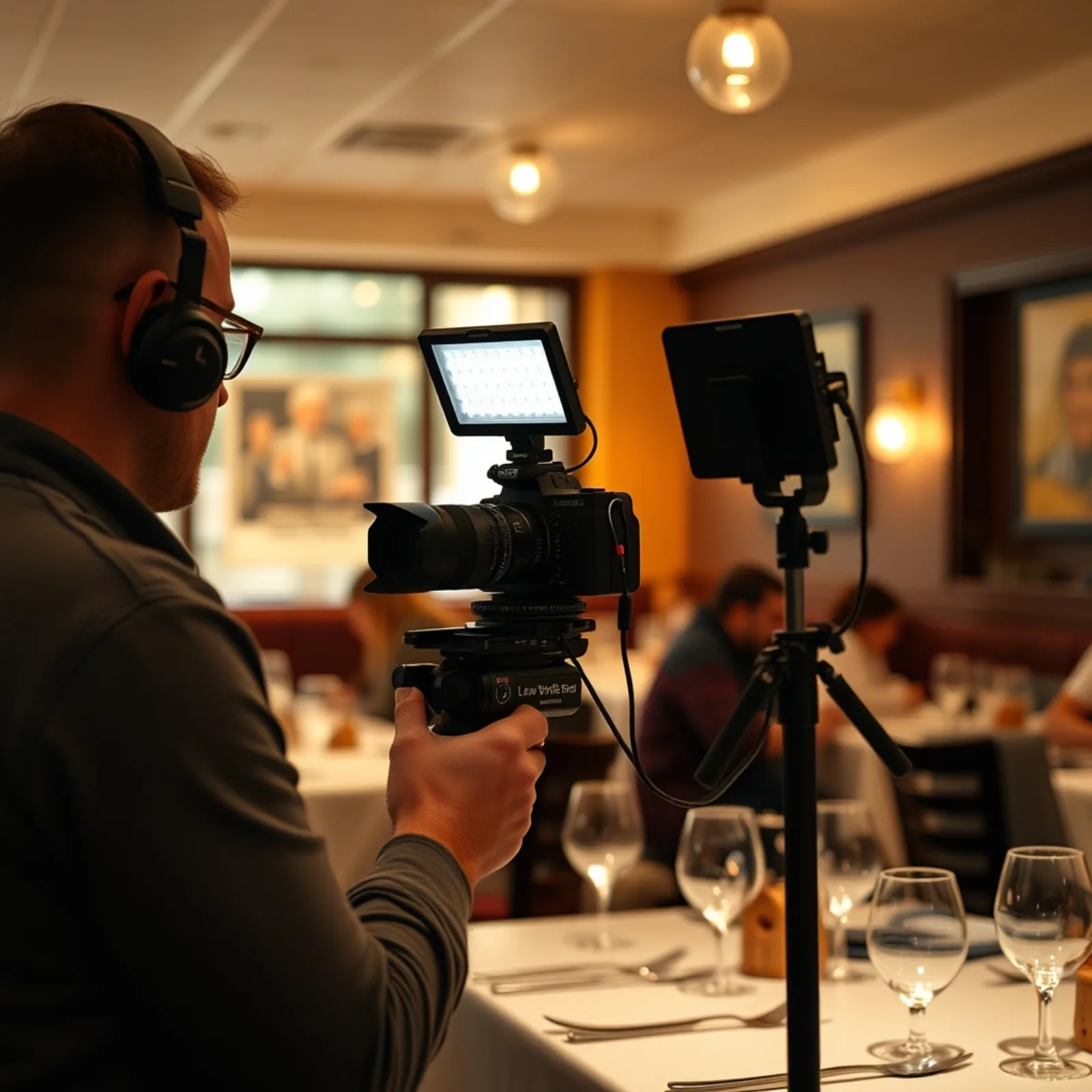
What if the best return on your vertical video were a hire?
In a sector short of staff, a recruitment video costs not a euro more to shoot, since it is filmed on the same day as the rest. While the team is in place, the kitchen is clean and the light is good, you take twenty minutes more: the chef saying to camera what they are looking for, two shots of the brigade during the rush, a shot of the posted rota. Three videos are often enough to support a job ad, with no guarantee of results: the volume of applications depends on the role and the city.
What it changes compared with an ad: the candidate sees the range, the size of the team, the cleanliness of the prep area, the atmosphere of service. In a kitchen, these are exactly the pieces of information that decide an application. A 22-year-old commis doesn't read a job posting; they look at whether the kitchen looks liveable. Across all sectors, France Travail's BMO 2026 survey, relayed by Banque des Territoires, indicates that 39% of recruiters surveyed point to working conditions that make recruitment difficult.
We have no reliable public benchmark on cost per application in French catering, and I will refrain from inventing one. On the set-ups we have shot, the order of magnitude lies between a few euros and around fifteen euros of media per useful application, with a huge gap depending on the city and the role: a kitchen porter and a sous-chef are nothing alike. What is certain is the point of comparison: set that amount against the cost of a recruitment firm or a month of service run short-staffed.
The format that works best is not the disguised ad. It is the real work footage, with one honest sentence: hours, days off, advertised salary. Without a displayed salary, the volume of applications drops; we see it every time. According to Toute l'Europe in 2026, the European pay transparency directive will oblige employers to state the pay or a salary range in their job offers or before the first interview.
Opening, relaunch or cruising: which set-up for your moment?
A restaurant that is opening and a restaurant established for six years do not buy the same product: the first needs a burst, the second a steady flow. Confusing the two is costly both ways: a burst for an established venue burns budget without changing habits, and a simple upkeep flow for an opening misses the window of the first six weeks.
Scenario 1, Opening (0 to 8 weeks)
One to two shoot days before opening, 15 to 20 formats in the bank, daily posting for the first three weeks, paid push on a 15-minute radius with a single objective: get people to come a first time. Typical budget observed on the French market: €1,000 to €2,500 of production plus €400 to €900 of media over the month. The deliverable to demand is dateable, reusable formats, not a 90-second opening film you will never run again.
Scenario 2, Relaunching a dead slot (3 months)
A single named slot, six to ten videos a month, all built around the same promise: the lunch deal, Sunday with the family, after-work drinks. Geotargeted push at €10-15 a day in the relevant time window. Weekly measurement on that slot only. Three months is the minimum: building a consumption habit takes longer than selling a pair of trainers.
Scenario 3, Cruising mode
Four to eight videos a month, half a shoot day each month, rotation of the five families of shots, reduced but never cut media budget. Aim: stay visible within the radius, showcase the changing menu, support the two or three annual peaks: Valentine's Day, Mother's Day, New Year's Eve. €400 to €900 a month excluding media is more than enough for this mode.
One last thing, and it may be the only one that matters. A restaurant's Instagram or TikTok account is not a medium: it's a second menu, consulted before pushing the door. 24% of French people systematically or often photographed their dish in a restaurant according to the American Express/Ipsos Lifestyle Trends Observatory of 2023, an already dated figure, which rose to 42% among 25-34-year-olds. Pictures of your dining room already exist, taken by your customers, outside your control. Producing a vertical video for a restaurant means taking back control of what people see of you before they book. Only then do we talk about slots to fill.
Frequently asked questions
- How much does a video for a restaurant cost in France?
- Allow €400 to €1,500 a month excluding media for a regular set-up, according to the SIEWEB 2026 pricing guide, which places content creation between €300/month freelance and €3,000/month at an agency. A shoot day producing 8 to 15 publishable formats remains the best cost-to-throughput ratio for a single venue.
- How long should a restaurant TikTok video be?
- Between 15 and 45 seconds on TikTok, 20 to 60 seconds on Reels for food content according to be-hype (2025-2026). Malou.io recommends in 2026 staying between 15 and 30 seconds for discovery, with the hook in the first three seconds. A useful format, opening hours, a new lunch deal, can drop to 10 seconds.
- Do you need to be on TikTok and Instagram at the same time?
- Duplicating a 9:16 video across both platforms costs a few minutes. What costs is producing two distinct editorial lines. Publish the same format everywhere, then after three weeks look at where your local audience is: TikTok weighs more among under-27s, while Instagram remains the first restaurant discovery channel according to DoorDash (2025).
- How do I fill my restaurant at lunchtime with videos?
- Name the slot, build six to ten videos around a single promise (deal, price, speed), push them with geotargeted ads on a 10-15 minute radius, run between 10am and 11:30am. Measure only the covers in that slot, compared with the previous four weeks. Allow three months before concluding.
- Should I pay a food influencer in my city?
- Useful for a discovery spike at opening, less so for upkeep. The 2026 French rates recorded by be-hype run from €150 to €800 plus the meal for a micro-influencer. Check the genuinely local share of their audience and negotiate advertising rights explicitly: they are rarely included, and without them you are not buying a reusable asset.
- Should you believe the figure that 74% of French people choose their restaurant on social networks?
- No. This figure has circulated on French blogs since 2025 with no accessible study behind it. The sourced data is lower: OpinionWay for SIAL (2025) indicates that one French person in two says they are influenced by social networks in food, of whom 40% look there for restaurant recommendations. DoorDash measured Instagram at 22% and TikTok at 18% as discovery channels in 2025.
Let's talk about the slot you want to fill
You now know that a restaurant video is judged on useful views and covers, not on a counter. Esekai is a vertical-video studio: in-house shooting and editing, a dedicated Creative Strategist, 9:16 formats for TikTok, Reels and Shorts, advertising rights included and fast iterations. Not a 360 agency. In the 30-minute meeting, we talk formats, budget and action plan, not an agency pitch deck.
Book a call →30 minutes to talk formats, budget and action plan.