

A video ad hook is the opening of a vertical video ad, the first 2 to 3 seconds, whose job is to stop the scroll and qualify the viewer. It combines a visual hook, a text hook and a sound hook. Its performance is measured by the hook rate: 3-second views ÷ impressions. In 2026, a hook is considered effective above 30% on Meta and 40% on TikTok (Segwise, July 2026). The rest of this article treats the hook not as a catchy line, but as a production variable: quantifiable, testable, repeatable in series. According to Médiamétrie's L'Année Internet 2025, relayed by CB News in February 2026, mobile accounts for 80% of the time the French spend online, and 92% among 15-24 year-olds.
What is a video ad hook, and what is the definition of “hook” in French?
“Hook” translates into French as “accroche” or “amorce”: in video advertising, it is the opening segment of a vertical creative, between 1 and 3 seconds long, designed to interrupt the scrolling gesture and select the right viewer. The word comes from the English for a hook on a hook-and-line. The image is apt: you catch, you hold, and above all you pull someone towards what comes next.
Where most definitions stop, two things need adding. A hook is not just text. It is a stack of three simultaneous signals: what you see on the first frame, what you read in the overlay, what you hear. A text-only hook is half a hook.
And a hook is not a literary piece. It is a production object with a cost, a lifespan and a success rate. On our shoots, we never talk about the hook, we talk about hooks, in the plural, because we capture several for the same video body. That is the whole difference between writing a catchphrase and operating a stock of openings.
Do not confuse: three different “hooks”
- Hook in music: the melodic phrase or fragment of chorus that is the most memorable part of a track, the one you sing without knowing the words.
- Hook in computing: a mechanism that intercepts a system call or an event in order to graft code onto it (hooking, webhook, React hooks).
- Advertising hook: the opening of a video ad, measured by the hook rate. This is the subject of this article.
The word is also used in fishing, boxing and long-form screenwriting. Same family of idea, different metrics.
How do you measure a hook: what are the hook rate and the hold rate really worth?
The hook rate is calculated by dividing 3-second views by impressions; the hold rate is calculated by dividing 75% views or complete views by those same impressions. Two fractions, two identical denominators, two completely different diagnoses.
A worked example, to reproduce exactly as it is on your own campaigns: 8,400 3-second views ÷ 30,000 impressions = 28% hook rate (Imagine.art, June 2026). As a guide, several publishers put the Meta short-form average at around 25-30%, with no official Meta data to back it up. In other words: a creative at 28% is neither good nor bad, it is exactly in the pack.
Where to read these figures. In Meta Ads Manager, you need to customise the columns and look for “Video plays at 3 seconds”, then divide by hand by impressions, as Meta does not show a ready-made “hook rate” column. In TikTok Ads Manager, the closest metric is the 2-second view rate, available in the custom video metrics. On both platforms you also retrieve the 25 / 50 / 75 / 100% milestones to build the hold rate.
The myth of the “universal 3 seconds”
Six pages out of ten explain that the hook rate is measured at 3 seconds, everywhere, all the time. That is wrong, and the error is costly in reporting meetings. TikTok counts a view as soon as playback starts and additionally exposes 2 s and 6 s views; Meta exposes 2 s and 3 s plays. The definitions differ, so the rates are not comparable. Mechanical consequence: TikTok hook rates are structurally higher than Meta hook rates, and the two cannot be compared with each other. An advertiser who sees 46% on TikTok and 31% on Meta does not have a better creative on TikTok. They have two different counting rules. The official glossary of video metrics in TikTok Ads Manager, updated in November 2025, defines the 2-second view as a play of at least 2 seconds within a single impression session, excluding replays.
Comparing a TikTok hook rate with a Meta hook rate is comparing a mark out of 20 with a mark out of 30. Hook rates are only compared within the same platform, on the same placement, over the same time window.
| Reading the hook rate | Value | Source and date | What you do with it |
|---|---|---|---|
| Meta “effective” threshold | ≥ 30 % | Segwise, July 2026 | Keep the creative in test |
| TikTok “effective” threshold | ≥ 40 % | Segwise, July 2026 | Roll out the winning hook |
| Meta short-form market average | 28 % | Coinis, 2026 | A reference point, not a target |
| “Average” / “strong” zone | 25-40 % / 40 %+ | Prooflytics, 30 May 2026 | Used to sort a batch of 10 creatives |
| Alert threshold | < 20% | Reloop, 11 May 2026 | Rework the opening, go back and reshoot |
One last warning on reading. A hook rate means nothing under 8,000 to 10,000 impressions: the statistical noise exceeds the gap between two variants. We have seen teams kill an opening at 22% on 1,200 impressions, then watch it climb back to 38% a week later on real volume. These creative metrics also sit within a broader media framework: CPM, CPC and ROAS benchmarks by sector give the cost context in which your hook rate does or does not turn into money.
Why does a high hook rate not make a good ad?
Because the hook is a qualification filter before it is an attention maximiser: a 30% hook rate on the right profiles is worth more than 70% on the wrong ones (DHS Digital, newsletter #95, 2 June 2026). This is the most unpopular position in this article, and the one we defend most often in client meetings.
The reasoning is simple. A very generic hook, a scream, a fall, a shock line unrelated to the product, attracts everyone. Everyone includes 80% of people who will never buy your product. You pay for 3-second views that fill your hook rate column and empty your CPA. The hook then stops being a sales tool and becomes a reporting tool.
The reverse exists too. A hook that names a precise problem, “your sunscreen pilling under your foundation”, deliberately loses 70% of the audience in the first second. Mediocre hook rate. And yet the remaining 30% are exactly the people concerned, and the conversion rate goes up. We stopped overselling the hook rate in 2025 for this reason: it is a creative diagnostic indicator, never a campaign KPI.
The drop-off at second 4 to 6
The real leak point of a vertical creative is almost never second 2. It is second 4 to 6, when the viewer understands what they are about to be sold and decides whether to stay. A hook rate of 45% followed by a collapse to 4% completion is paid clickbait: the opening promised something the body does not deliver. Nobody in the SERP names this case, even though it accounts for a large share of the creatives we audit.
The repair is not done on the hook. It is done on what follows, and it is a job of narrative structure, not of catchphrase. Our 4 structures for converting in 15 to 60 seconds detail what must follow the hook so that the promise holds all the way to the call-to-action.
The hook rate × hold rate diagnostic matrix
| Hook rate | Hold / completion | Diagnosis | Likely cause | Studio action |
|---|---|---|---|---|
| High (> 40%) | High | Winning creative | Opening and promise aligned | Roll out new hook variants on this body |
| High (> 40%) | Collapsed (< 5% at 75%) | Paid clickbait | The hook promises something other than the video | Rewrite the body, definitely not the hook |
| Low (< 20%) | High | Opening too slow | No hook, or a logo on the first frame | Reshoot only the first 3 seconds |
| Low | Low | Stillborn angle | Wrong product insight | Start again from the brief, not the edit |
| Medium (25-30%) | Medium | Lukewarm creative | Generic hook, already seen in the feed | Test an opposite hook archetype |
| High, degraded CPA | Indifferent | False positive | The hook attracts a non-buying audience | Narrow the promise, accept a lower hook rate |
This matrix is the tool we pull out first when a client arrives with a table of 40 creatives and no idea what to cut. It does not say which creative is good. It says which workshop should take the file back: the set, the edit or the strategy.
How do you make a good hook? A studio's three-layer method
A good hook stacks three independent layers, visual, text and sound, each of which must work on its own if the other two fall away. Sound off: the text is enough. Overlay hidden by the interface: the image is enough. Screen turned face down in a pocket: the voice is enough. A hook that depends on a single layer is a fragile hook.
Layer 1, the visual: what is shot, not what is edited
The first frame decides. A face already in motion, a product already in hand, a gesture already under way. What the viewer must not see: a static wide shot, a white studio background, a logo, an opening transition. Movement within the frame always beats camera movement in this format.
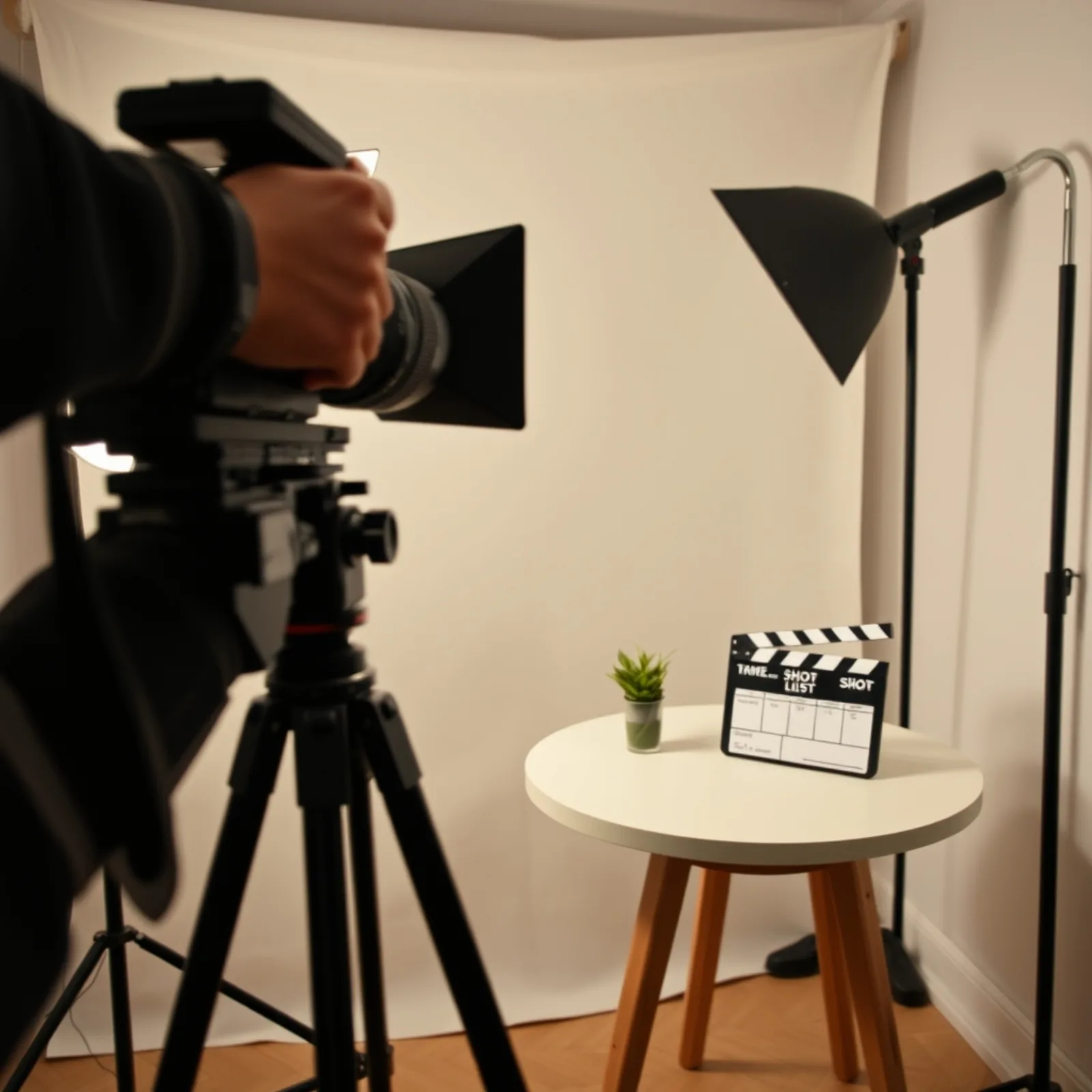
A point that media agency articles cannot write: a visual hook is shot, it is not edited. If nobody filmed the hand squeezing the cream tube, no editor will manufacture it. That is why the list of hooks has to be locked before the shoot, not after. We have had enough sessions where the client asked for a “before/after comparison” variant in post-production, when the “before” exists on no rushes at all.
Layer 2, the text: readable in 0.4 seconds
- Five to eight words at most. Beyond that, the viewer has scrolled before finishing reading.
- A single idea. No subtitle above the hook, no brand name in the same block.
- Placement in the upper third, outside the interface safe zone, never stuck to the face.
- Real contrast: white text on a light background is a dead hook in direct sunlight on mobile.
Layer 3, the sound: the voice starts before the image
On the creatives that hold, the first syllable lands within the first 200 milliseconds. A half-second blank at the opening and you lose the benefit of active sound. Silence at the start of a video is the most frequent set defect, because the creator waits for the clapperboard before speaking. We now ask them to start the sentence during the slate announcement.
The five defects that kill a hook before the edit
- The creator looks at their notes at second 1; the gaze dropping cancels the contact.
- The product is not in the frame at the opening, so a product hook cannot be made.
- The room sound changes between variants: impossible to stick a hook onto another body.
- No usable “silent” take for a 100% visual or 100% overlay hook.
- The frame moves ten centimetres between take 2 and take 7: the hooks are no longer interchangeable.
These five points are brief topics, not post-production ones. We built them into our shooting document after losing too many usable variants; the detail is in the 7 UGC creator brief mistakes, notably on how to ask for variants without breaking the continuity of the shoot.
Can you give me an example of a hook, and a counter-example?
Here are six pairs: on the left the hook as it arrives in 90% of client scripts, on the right the version we shoot, with what changes in the measurement. We are not trying to stack sixty examples. We take six apart.
| The script's hook | The shot version | What it changes |
|---|---|---|
| “Discover our new moisturiser” | “I stopped buying €60 creams because of this” (product already in hand) | The first frame contains an object and a conflict, rather than an announcement |
| Animated logo 1.5 s then packshot | Product gesture already under way from frame 1, brand revealed at second 2 | The brand signal stays early without burning the hook |
| “You won't believe what comes next” | “Look what comes out of the filter after three months” | Curiosity tied to the product: the hold rate no longer collapses |
| “3 reasons to use X” | “Reason no. 2 is the one nobody tells you” (we start with 2) | We drop the contents announcement and go straight into the content |
| Wide shot of the creator seated, smiling, 0.5 s of silence | Tight frame, movement already under way, voice starting on frame 1 | In our tests, this is the fix that moves the hook rate the most |
| “For all those who want beautiful skin” | “If your sunscreen pills under your foundation, listen up” | Hook rate down by choice, CPA improving |
The last line is the one to read twice. It contradicts the stated objective of half the creative dashboards.
On the question of the logo: an early brand signal pays off; according to the TikTok/MediaScience study, around 50% of the impact of a TikTok ad is decided in the first two seconds. Brand signal, not brand intro. A recognisable product in hand ticks the box; a full-screen animated logo ticks it too, but kills the hook rate. We choose the former.
If you are looking for the structured list of opening families, direct question, contradiction, before/after, demonstration, number, confession, it has already been written elsewhere: the full typology of the 8 hook archetypes. This article deliberately does not repeat it.
What are the best hooks for TikTok, and do they work on Reels?
The hooks that win on TikTok are those that look like native content: handheld camera, live voice, fast rhythm, no advertising aesthetic, and they travel badly as they are to Reels and Shorts. Three reasons: the counting threshold differs, the safe zones are not in the same places, and the audience's expectation is not the same. According to Médiamétrie's 2025 figures picked up by Siècle Digital, 68% of the French, or 43.9 million people, check social networks every day: it is in this daily feed that your hook has to pass as native content.
On TikTok, the opening can be messy. A frame that moves, the start of a sentence right in the middle, a recognisable trending sound. It is a native signal and both the algorithm and the audience reward it. On Instagram Reels, the same take comes across as amateur: the format tolerates less mess and rewards a steadier frame, a desirable product, clean text. On Shorts, the share of the audience watching with sound off is higher in what we observe, so the overlay becomes the carrying layer.
| Platform | Counting threshold | Average VCR 2026 | Format constraint | Common porting mistake |
|---|---|---|---|---|
| TikTok | 2 s (Hawky.ai, March 2026) | 25-35% (Prooflytics) | Active sound dominant, busy bottom of frame | Reusing a Meta creative that is too clean, too slow |
| Instagram Reels | 3 s (Meta) | 15-25% (Prooflytics) | Top and bottom safe zones very restrictive | TikTok overlay hidden by the Reels interface |
| YouTube Shorts | View counting specific to Shorts (no comparable 2 s/3 s threshold) | 30-35% (Prooflytics), to be read in Google Ads view metrics | Large share of sound-off viewing | 100% voice hook, unreadable without sound |
What we do not know, and need to own up to: the portability of a hook from one platform to another cannot be predicted. We have openings that score 44% on TikTok and 19% on Reels with the same edit, and others that hold on both. The only rule that survived our tests: reshoot the opening, keep the body. Two versions of a hook cost less than one lost creative.
A word on short views, often looked down on. TikTok for Business pointed out in February 2026 (relayed by Pulsads) that videos watched for less than six seconds generate a measurable impact. A 3-second view is not a failure, it is an exposure. That does not justify making hooks for the sake of hooks, but it changes how you value a batch.
How much does it cost to produce a hook, and how many should you test?
A hook variant captured during a shoot that is already set up costs a fraction of a new creative: a few minutes on set and one edit version, versus half a day of full production. It is the cheapest variable in the whole creative chain, and the one least often budgeted.
The production reasoning fits in one sentence: the set is built, the lighting is dialled in, the creator is in place, the product is clean. Adding an opening is three to five minutes on set. Adding a creative means redoing all of that. On our shoots, the list of hook variants is locked beforehand and shot back to back, identical frame, so the edit can swap them without a visible join.
| Type of production | What is delivered | Openings included | Marginal cost of a variant |
|---|---|---|---|
| New creative (script + shoot + edit) | 1 finished video, 1 angle | 1 | 100% reference |
| Hook-first shoot (1 body, N openings) | 1 body + 6 to 8 edited openings | 6 à 8 | Low: minutes on set + one edit version |
| Overlay-only variant (post-production) | New text on an existing opening | Unlimited in theory | The lowest in the grid |
| Opening reshoot after diagnosis | 3 new seconds on a validated body | 2 à 4 | Intermediate: the set has to be rebuilt |
The third line deserves a warning. “Unlimited in theory” does not mean unlimited in practice: beyond three or four different overlays on the same image, you are testing synonyms, not angles. The marginal gain falls to zero very quickly. It is the classic mistake of teams discovering hook testing and delivering fifteen variants of the same sentence.
How many hooks to test per month
The cadence does not depend on your ambition, it depends on your media budget. A hook variant needs a sufficient volume of impressions to be judged; we are talking several thousand impressions per variant. Multiplying variants on a small budget produces unreadable figures.
- Modest media budget: 3 to 4 openings a month, on 1 single video body. Beyond that, no variant reaches significance.
- Mid-range budget: 8 to 12 openings a month, spread over 2 bodies and 2 angles.
- Substantial budget: 20 openings or more, with weekly reinjection of the winners.
The right indicator is neither the number of hooks produced nor the average hook rate. It is the cost per validated hook: total spent on production and test media, divided by the number of openings that cleared your internal threshold. This calculation fits into a broader line of reasoning on the cost per winning creative, of which the hook is precisely the cheapest variable to vary.
A fundamental reason to justify this budget: AI automation of targeting and bidding is advancing strongly on TikTok Ads, with no reliable public figure to quantify it. Targeting, bidding, placements, all of that is increasingly out of your hands. The creative remains the last place where a human decision changes the result. And within the creative, the first three seconds concentrate the biggest performance gap for the lowest cost of change. According to IAB Europe's AdEx Benchmark 2025, video now accounts for more than half of display advertising investment in Europe.
How to industrialise your hooks: the five-step hook-first pipeline
Industrialising your hooks means moving from “we write a good catchphrase” to “we operate a stock of openings”: angle × hook matrix, modular shoot, strict naming convention, cut rule, reinjection of the winners. Five steps, in this order, with none skipped.
1. The angle × hook matrix
First we list the product angles: price, time saved, visible effect, main objection, unexpected use. For each angle, we write three possible openings from different families. Four angles × three hooks = twelve cells. We tick the cells that can be shot with the planned set and creator. What remains is the shooting plan.
2. The modular shoot
One video body, shot once, cleanly. Then the openings back to back, frame locked, same lighting, same mic distance. The creator chains them: “take 1”, “take 2”… We systematically add a silent take, gestures only, for the 100% overlay variants. It is the take everyone forgets and the one that saves the most campaigns when a hook has to be redone a month later.
3. The naming convention
Without a readable file name, no learning is possible: after three months you no longer know which opening won. The format we use: brand_product_angle_hookXX_platform_version. The hook number must match the matrix row, not the editing order. It seems bureaucratic. It is the condition for media reporting to trace all the way back to the set.
4. The cut rule
It is written before launch, not during. An example of an operational rule: below the alert threshold of 20% hook rate after a sufficient volume of impressions (Reloop, May 2026), the opening is cut without discussion and the angle is retested with a hook from the opposite family. Without a written rule, everyone defends their favourite variant and the budget gets diluted.
5. The reinjection
A winning opening is not an end point, it is a template. You stick it onto the other video bodies, translate it to another angle, reshoot it with another creator. And you monitor its fatigue: a winning hook ends up saturating its audience, and the decline shows up on the hook rate first, before it reaches the CPA. It is the only case where the hook rate is a reliable, early warning signal.
What we cannot predict: the lifespan of a winning hook. It depends on audience size, media pressure and sector. On broad fashion e-commerce audiences, we have seen openings hold for several weeks; on narrow niches, wear-out arrives much faster. Any agency that gives you a standard lifespan has not looked at its own curves.
One last point, counter-intuitive for many marketing teams. The hook is not where you put the campaign's best idea. It is where you put the most recognisable one. A brilliant idea that needs two seconds to understand loses to an ordinary idea that is instantly legible. Context matters too: several studies (IAS/Neuro-Insight, Kantar) suggest that a coherent context and an emotional creative improve memorisation, without a single consolidated figure. A successful video ad hook, at bottom, is three seconds that look enough like the feed not to be rejected, and enough like your brand not to be forgotten.
Frequently asked questions
- Should a hook last less than 3 seconds?
- A useful hook lasts 1 to 3 seconds, but duration is not the criterion: the criterion is the platform's counting threshold. TikTok measures at 2 seconds, Meta at 3 seconds (Hawky.ai, March 2026). So design your opening to be complete before 2 seconds on TikTok and before 3 seconds on Meta and Reels.
- Where can you find free video hooks, and why do banks of copied hooks wear out?
- Free lists circulate everywhere and work for a few weeks. The problem is mechanical: as soon as a wording is copied by thousands of advertisers, it becomes an advertising signal and the audience recognises it before listening. Use them as a grid of opening families, never as text to copy word for word.
- Can a hook be purely visual, with no text or voice?
- Yes, and it is often the sturdiest with sound off: an unexpected product gesture, an immediate before/after, a material that transforms. Imperative condition: this hook is shot, it is not edited. If nobody filmed the gesture, no post-production will manufacture it. Plan a silent take from the shooting plan onwards.
- Should the brand go in the hook?
- An early brand signal pays off: TikTok ads with a brand cue in the first two seconds get +39% recall and +27% purchase intent according to the Nielsen Ad Recall Global Benchmark 2025. But signal does not mean a full-screen animated logo. Recognisable packaging in the hand ticks the box without costing hook rate.
- Does the hook change with Spark Ads or whitelisting?
- The principle stays the same, the production constraint changes. With Spark Ads, you boost an existing post from the creator: the opening is already fixed, you cannot vary it. To test several openings on the same body, you need to commission a dedicated session with variants captured back to back, frame locked.
- What should I do if my hook rate is good but my CPA is getting worse?
- This is the false positive case: the opening attracts a non-buying audience. Narrow the promise and accept a lower hook rate. According to DHS Digital (June 2026), a 30% hook rate on the right profiles is worth more than 70% on the wrong ones. The hook qualifies as much as it attracts; that is its most profitable function.
Let's shoot your hooks, not just your scripts
You now know that an opening variant is the cheapest change in your creative chain, provided it is captured on the shoot. Esekai is a vertical video studio: creative ads, UGC and organic content for TikTok, Reels and Shorts, with a dedicated Creative Strategist, in-house shooting and editing, and iterations in days. We take 30 minutes to talk formats, budget and test plan. No agency pitch deck.
Book a call →30 minutes to talk formats, budget and action plan.