

A creative ad script is built from six switchable blocks, hook, context, demonstration, proof, objection handling, CTA, not a linear story. Each block is written with three elements: its text, its duration limit, its shooting constraint. The goal is not an elegant flow, it is being able to swap a block in the edit without reshooting. Allow 15 to 30 seconds in total, 1.5 to 3 seconds for the hook, a single CTA. What follows is the document we actually send to the shoot, not a copywriting theory. According to Médiamétrie's L'Année Internet 2025, 15-24 year olds spend 61% of their online time on social networks and messaging apps, and that share rises to 63% among 11-14 year olds.
What exactly is a creative ad script, and how does it differ from a brief?
A creative ad script is a production document: it says what to film, in what order, within which duration limits. The brief says what to tell and why. Confusing the two is the leading cause of unusable rushes that we see. A provider sends four paragraphs of intent, the creator understands what to say, and nobody has written what to do. The result: a 48-second take in a single shot, impossible to cut up, impossible to vary.
We stopped accepting continuous-text scripts in 2024. Not out of dogma, but because continuous text produces one video and only one. And a single creative, on an account that spends, is of no use.
| Document | Who writes it | What it contains | What it does not contain | Who approves it |
|---|---|---|---|---|
| Creative brief | Brand + creative strategist | Angle, target, promise, available proof, legal no-gos | The lines spoken on screen, the durations | The brand |
| Script | Creative strategist or scriptwriter | 6 blocks, text intent, duration limits, shooting constraint per block | The detailed edit plan, the music, the transitions | Brand + production |
| Storyboard | Art director or director (optional in UGC) | The frame-by-frame composition | The spoken wording | The production |
| Shot list | DOP or creator | List of shots, framing values, shooting order | The pitch, the promise | The production |
The script is the middle piece. It comes out of the brief, it does not replace it: if your angle isn't settled upstream, no script will save it. The upstream brief is framed in 9 fields, and that is where the promise is decided. The script decides the breakdown.
A word on what this article doesn't cover. A VSL, 3 to 20 minutes, follows a logic of sequential argument where each block builds on the previous one; nothing is swapped in a VSL. A creative ad runs 15 to 30 seconds and follows a switching logic. Two trades, two documents.
What are the 6 blocks of a creative ad script, and what is each one for?
Hook, context, demonstration, proof, objection handling, CTA: six blocks, each with a single role, a duration limit and a metric that judges it. A block that carries no verdict metric is not a block, it is filler. It is the only rule that lets you know, three weeks later, why the creative flopped.
| Block | 15 s format | 30 s format | What it must produce in the viewer | Verdict metric (and denominator) |
|---|---|---|---|---|
| 1. Hook | 1,5-3 s | 2-3 s | Scroll stopped + promise stated | Hook rate = 3 s views / impressions |
| 2. Context | 2-3 s | 4-6 s | Recognition: “that situation is mine” | Retention at 25% of the duration |
| 3. Demonstration | 4-5 s | 8-10 s | Understanding of the product in real use | Hold rate at 50% / ThruPlay |
| 4. Proof | 2-3 s | 4-6 s | Credibility of the claim (figure, before/after, third party) | Outbound CTR = clicks / impressions |
| 5. Objection handling | 2-3 s | 4-6 s | Removal of the barrier (price, doubt, usage) | CTR + add-to-cart rate |
| 6. CTA | 1,5-2 s | 2-3 s | One named action, only one | CVR = purchases / outbound clicks |
| Total | 15 s | 30 s | , | , |
Block 1, Hook: it carries the promise, not the teasing
Four lines are enough here, because the subject deserves its own article: the hook states the promise from the very first second, not an empty opener followed by “let me explain”. According to a TikTok Creative Center summary relayed by Soku.ai (page retrieved in early 2026), 63% of top-performing ads place the key message in the first three seconds. The promise is in block 1, not in block 3. For the fine detail of how to build it, see the detailed method of the 3 layers of the hook.
Block 2, Context: the starting situation, filmed, not told
This is the most butchered block. Most scripts put a generic problem sentence in it (“tired of dull hair?”) whereas its role is recognition: the viewer must see themselves. That comes through set and gesture, not through adjectives. Bathroom at 7:20 a.m., three products on the ledge, a hand picking one up. Two seconds. If your block 2 can be written without a set, it is useless.
Block 3, Demonstration: the product in hand, in a single take
The longest block, and the only one we almost never swap. It shows the product used, not presented. Texture spreading, clasp clicking, spoon plunging in. Production rule: one gesture, one continuous take, no internal cut. A demonstration cut into three is a demonstration people suspect of cheating.
Block 4, Proof: a filmable asset, or nothing
A figure on screen, a before/after under the same lighting conditions, a capture of a verified review, a mention of a third-party test. The question to ask while writing: does this exist as a file today? If the proof doesn't exist, you don't write it, you change block 4. A script that promises a before/after nobody has shot costs a complete reshoot.
Block 5, Objection handling: one objection per variant
Price, usage time, fear of getting the size wrong, doubt about the composition. You handle one. It is the most profitable block to vary: same shoot, five objections filmed back to back, five variants in the edit. On e-commerce accounts we manage, it is often the swap of block 5 that moves CTR, not the hook.
Block 6, CTA: one verb, one destination
“Link in bio, code in the description, and tell me in the comments”: three actions, zero conversions. A CTA says where to go and what to do there. Two seconds, product in hand, eyes to camera. The rest is noise.
How many seconds should be allocated to each block?
Everything that has to convince must be said before the fifteenth second, because the vast majority of viewers will never get further. The advertising benchmarks compiled by Prooflytics (Video Advertising Analytics: Benchmarks, page retrieved in late 2025) give a Meta ThruPlay rate, the view at 15 seconds or more, of between 10 and 20% of impressions. In other words, eight people in ten don't see your block 6 if you put it at second 22.
Further upstream, it is even more brutal. The 3-second view rate runs around 25-35% on TikTok and 25-40% on Meta: most paid views stop before the third second. Kosmos Agence, in its TikTok formats guide published in 2025, mentions a loss of about 35% of the audience in the very first seconds of an In-Feed video.
Hence the limits in the table. They are not aesthetic preferences: they are funnel constraints. On the TikTok In-Feed format, Roads.social reminds us in its TikTok Ads guide (page retrieved in early 2026) that the platform allows 5 to 60 seconds, with an optimal zone between 15 and 30 seconds in 9:16, 1080×1920. This vertical format matches actual usage: according to the 2025 Médiamétrie figures relayed by CB News, mobile accounts for 80% of the time French people spend online, against 66% in 2020, and 92% among 15-24 year olds.
A 30-second creative is not a stretched 15-second one. It is a 15-second in which a block 5 has been inserted and block 3 given room to breathe. If you don't know which block doubled, your 30 seconds is simply chatty.
What we don't know: one figure circulates a lot, “90% of advertising recall would be captured in the first 6 seconds”. We left it out of this article. It is attributed to TikTok Marketing Science by several agencies, but we could not find the primary study, its methodology or its date. An article that claims rigour does not recycle an orphan figure.
Why write a script in switchable blocks rather than continuous text?
Because a switchable script turns one shoot into 5 to 8 variants, where continuous text produces just one. That is the whole thesis. The quality of a script is judged not by the fluidity of its flow but by its ability to produce usable permutations without calling the creator back.
In practice, switchability is won on the shoot, through six rules that we write in black and white in the document:
- One block = one isolated take. We never shoot two blocks back to back in the same take, even if the creator flows naturally from one to the next.
- Clean time-code limits. Three seconds of silence before and after each take. Without that gap, the editor cuts into the breath and the join can be heard.
- Zero cross-references. No writing “as I was saying”, “so”, “and that's where”. Each block must be able to start cold.
- Locked technical continuity. Same outfit, same set, same mic distance, same hour of light for the whole session. A block 5 shot late in the day in warm light cannot be edited behind a block 3 shot in the morning.
- Imposed file naming. B1-V1, B1-V2, B4-V3. The creator renames or announces the block out loud before each take. It is the most boring line in the script and the one that saves three hours of rush sorting.
- Two to four wordings per swappable block. Hook: 4 versions. Objection: 3 versions. Demonstration: only 1, it is the foundation.
Do the maths. Four hooks × three objections = twelve theoretical combinations from a single 90-minute session. We never edit twelve, we edit five to eight, because beyond that you dilute the media budget on variants too close to tell apart. The variation rule is detailed here: how many variants to draw from a single shoot.
The received idea to kill: “a good script = a good narrative structure”. No. A good script is a document that lets you produce eight testable creatives from one trip. Narrative is a means, switchability is the deliverable.
What should be written alongside the text to make the script shootable?
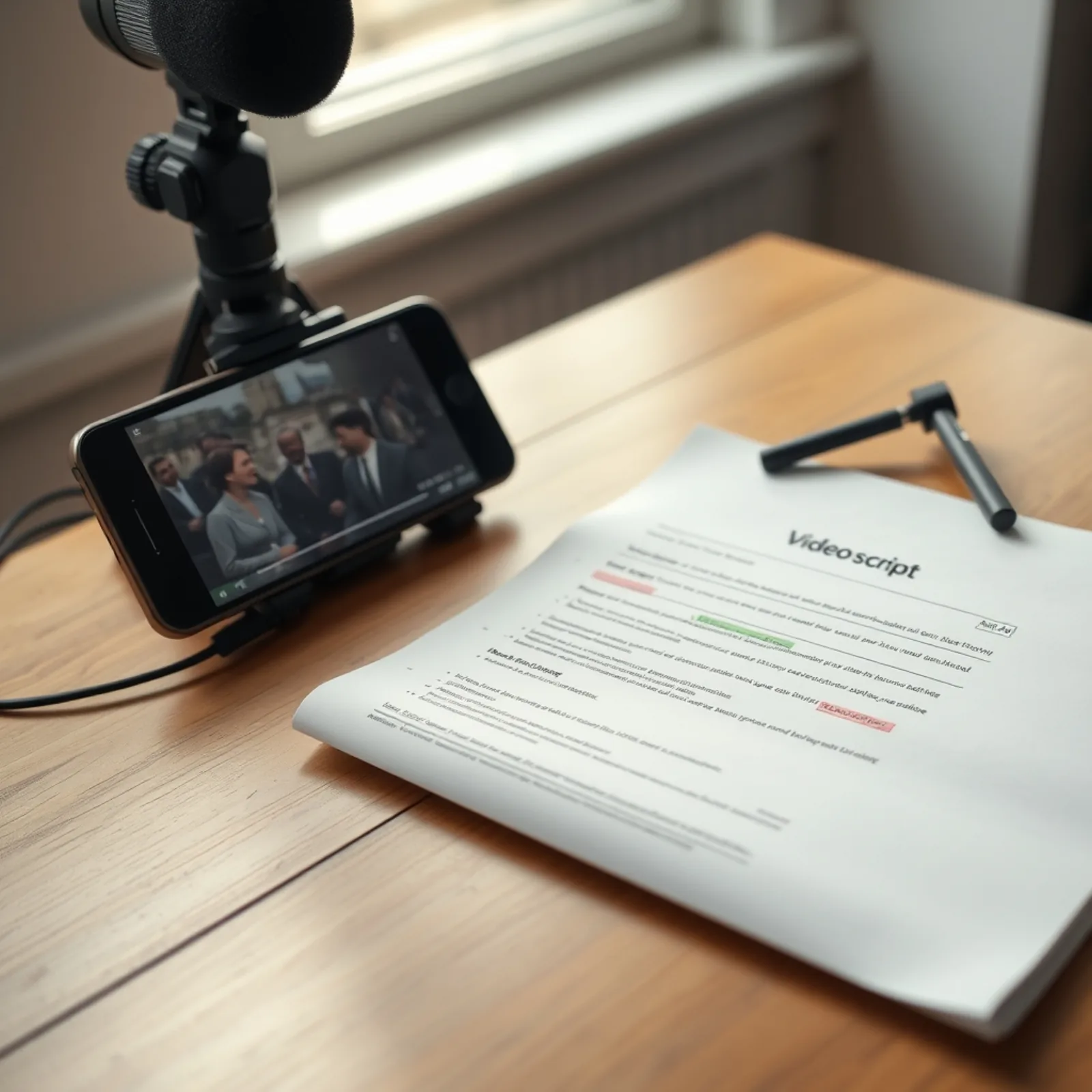
Every line of text must be paired with a physical constraint: shot size, hand position, set, live sound or voice-over, on-screen text, first frame. Without that column, the creator improvises the framing, and improvised framing costs retention points, not style points.
Kosmos Agence, in the same 2025 guide, gives a telling gap on 3-second retention depending on the quality of framing and ratio: above 65% when format and resolution are right, around 38% with poor framing. Nearly thirty points. The “shooting constraint” column is not director's vanity, it is media money.
| Block | Shooting constraint to write in the script | Variable to swap in variations |
|---|---|---|
| 1. Hook | Chest-level shot, product already in frame, live sound, no on-screen text on the 1st frame | Wording + first frame |
| 2. Context | Set identifiable in 1 s, hands visible, continuous lighting | Place / time of day |
| 3. Demonstration | Waist-level shot + macro insert, gesture in one continuous take, no internal cut | Gesture demonstrated / angle of use |
| 4. Proof | Real asset filmed or imported, figure legible for a full 2 s, same lighting for the before and the after | Proof carrier (customer, expert, test, figure) |
| 5. Objection | Back to chest-level shot, live sound, no on-screen text competing with speech | Objection handled (price, usage, doubt) |
| 6. CTA | Product in hand, eyes to camera, 2 s held, no rising music | Action verb + offer mentioned |
Write the intent, not the word for word
A detail that changes everything in UGC: if you write the text word for word, the creator recites. The tone dies, and it shows from second 2. The solution we have applied since 2024: for each block, we write the intent in one sentence, two permitted wordings as examples, the forbidden words (claims, unsubstantiated superlatives) and the duration limit. The creator rephrases in their own words. We keep the meaning, we keep the voice.
Exception: block 4 and block 6. Proof and CTA are said word for word, for legal and traceability reasons. A figure rephrased by a creator becomes a claim you can no longer defend. In France, this content falls under the law of 9 June 2023, which regulates the commercial communications of content creators, as the ARPP reminds us in its March 2024 statement.
How do you know which block made the creative fail?
Each metric points to a specific block: hook rate for block 1, hold rate for blocks 2 and 3, CTR for blocks 4 and 5, CVR for block 6. A script whose faulty block can't be isolated produces no learning. It produces an anecdote, and the anecdote costs as much as the test.
Orders of magnitude to place your figures. Prooflytics (2025 data) puts the 3-second view rate on Meta between 25 and 40% of impressions, and the average Meta video CTR between 1.0 and 2.5%. If your hook rate is 12%, the problem is in block 1 or in the targeting. If your hook rate is 32% and your CTR 0.4%, block 1 is doing its job and it is blocks 4 and 5 that fail to convince, no point rewriting the hook.
The blind spot: your hook rate doesn't only judge your hook
Here is the point that works against an easy sale, and which we repeat anyway in meetings. Sepia-Lab, citing AdSights data published in 2025, notes a hook rate gap of about 14 points between cold audience (18 to 28%, median around 22%) and retargeting (30 to 45%, median around 36%). Those 14 points come from the audience, not from the creative.
Concrete consequence: comparing the hook rate of a creative run in prospecting with that of a creative run in retargeting teaches you nothing. We have seen teams throw out a decent script because it “underperformed” against an older creative that ran on warm audiences. Wrong diagnosis, two weeks lost.
Second trap: the counting threshold. Hook rate is measured at 3 seconds on Meta, but at 2 or 6 seconds depending on the metric chosen on TikTok (Vaizle and AdSights, 2025, via Sepia-Lab). Switching platform without switching denominator produces gaps of 20 points that don't exist. The threshold changes with the denominator: it is the first thing to lock before arbitrating anything.
How much does testing a block cost? Taking a TikTok France CPM assumption of €9 to €12 (agency estimate, to be checked on your account), 30,000 impressions cost roughly €270-360. That is the minimum per variant to read a hook rate without noise. Test four hooks: €1,100 to €1,400. That is the figure that should frame the number of variants you edit, not your creative enthusiasm. For the full reading of results, we use the full 4-tier measurement protocol.
What depends on your case: the volume of impressions needed to decide varies enormously with average basket and purchase frequency. On a €29 product, you read a reliable CTR quickly and a CVR never. On a €300 product, it is the opposite: CVR per variant is unusable for several weeks, and you arbitrate on CTR, accepting the approximation.
Which mistakes make a creative ad script unusable in production?
Seven mistakes come up in nine scripts out of ten received from outside, and all can be spotted on reading, before the shoot. It is the cheapest review in the chain: ten minutes against half a day of reshooting.
- Two CTAs. “Click the link” then “and subscribe”. The viewer doesn't choose, they scroll. One verb, one destination.
- Unfilmable proof. The script announces a before/after that doesn't exist as a file. You find out in the edit, so too late.
- A hook that depends on the edit. If the opener only works thanks to a jump cut, a zoom or sound design, it isn't switchable, and it dies if the editor changes.
- Text written word for word. The creator recites, the eye sees it. Except for blocks 4 and 6, we write the intent.
- No duration limit. Without a limit, the creative comes out at 54 seconds: servable In-Feed (60 s limit), but outside the optimal 15-30 s zone.
- An unsubstantiated claim. “Reduces wrinkles in 7 days” with no study. It is validated before the shoot, not after the platform rejects it.
- Blocks that can't be isolated. A sentence straddling two blocks, a speech join impossible to cut cleanly. The script becomes linear again without anyone having decided it.
Last received idea to correct, the one that costs the most: “a failed hook can be recovered further on”. No. With 65 to 75% of views lost before the third second (Prooflytics, 2025), a brilliant block 2 recovers nothing at all, it is seen by a quarter of the audience. The reverse is also true, and less often said: an excellent hook on a limp block 3 produces a flattering hook rate, a zero CTR and a media budget burned at the top of the funnel.
How long does it take to write a script in blocks, and when does it become profitable?
A script in six switchable blocks takes 45 to 90 minutes to write against 15 to 20 minutes for continuous text, and it becomes profitable from the third variant. These durations are those observed in our own writing sessions, not published data: a creative strategist who knows the product holds the low end, a first collaboration hits the high end.
The calculation fits in three lines. A UGC shoot in France mobilises a creator, a trip, half a day. If that shoot produces one creative, you pay for one creative at the price of a session. If it produces six by permutation, the unit cost is divided by five or six, for one extra hour of writing and one hour of editing per variant. The break-even point arrives quickly.
Where it isn't worth it: a one-shot. A single launch, media budget under a few thousand euros, no intention to iterate. In that case, a well-written linear script does the job and you save an hour. We tell this to clients who consult us for an isolated brand video: the block structure is a throughput tool, not a prestige tool.
The question to ask your provider
“Show me a script you sent to a shoot last month.” Not a portfolio, not a case study. The working document. If it contains six blocks, duration limits in seconds, a column of shooting constraints and a file-naming convention, you are facing someone who produces variants. If it contains three paragraphs of storytelling, you have a copywriter, and you will pay for each creative at the price of a shoot.
We changed our own way of invoicing because of this. The deliverable is no longer “a video”, it is the switchable script, the rushes named by block and the edited variants. Clients who get the named rushes can re-edit themselves three months later, when a new objection comes up from customer service. Those who only receive an exported MP4 call back for a reshoot. A well-structured creative ad script, deep down, is that: the difference between an asset and an expense.
Frequently asked questions
- Should a creative ad script be 15 or 30 seconds?
- Both formats hold, with a different split. In 15 seconds: 3 s of hook, 3 s of context, 5 s of demonstration, 2 s of proof, 2 s of CTA, with no objection block. In 30 seconds, you add the objection handling and double the demonstration time. Beyond 30 seconds, the Meta ThruPlay rate (10 to 20% according to Prooflytics, 2025) makes the final block almost invisible.
- Do you need to write the text word for word for a UGC creator?
- No, except for two blocks. Proof and CTA are said word for word, for legal reasons and claim traceability. For the hook, context, demonstration and objection, write the intent, two example wordings, the forbidden words and the duration limit. The creator rephrases in their own words: the tone stays natural, the meaning is locked.
- What is the difference between a script and a creative brief?
- The brief says what to tell: angle, target, promise, available proof, no-gos. It is approved by the brand. The script says what to film: six blocks, duration limits in seconds, shot size, set, live sound or voice-over, file naming. It is approved by the brand and the production. The script comes out of the brief, it never replaces it.
- How do I know whether it's my script or my targeting that is bad?
- Always compare on an equivalent audience. According to AdSights (2025, via Sepia-Lab), hook rate sits between 18 and 28% on cold audience against 30 to 45% in retargeting, about a 14-point gap due to the audience alone. A hook rate of 24% in prospecting is fine; the same figure in retargeting signals a block 1 problem.
- How many variants can you draw from a single shoot with a script in blocks?
- Five to eight usable variants from one session, by filming four hook wordings and three different objections. The twelve theoretical combinations exist, but beyond eight the variants become too close to be told apart statistically, and the media budget gets diluted. The condition: each block shot in an isolated take, with three seconds of silence before and after.
- Does a script in blocks also suit a VSL or brand content?
- No. A 3 to 20 minute VSL relies on sequential argument where each block builds on the previous one: nothing in it is swappable. Brand content follows a logic of narrative and recall, not unit testing. The six-switchable-block structure serves short video advertising meant to be varied and arbitrated on the numbers.
Do your scripts produce one variant or eight?
If every creative costs you a full shoot, the problem is in the script, not in the media budget. Esekai is a vertical video studio: creative ads, UGC and organic content for TikTok, Reels and Shorts, with a dedicated Creative Strategist, shooting and editing in-house, and iterations delivered weekly. A thirty-minute meeting: we talk formats, limits, budget and action plan. No agency pitch deck.
Book a call →30 minutes to talk formats, budget and action plan.