

Repurposing a video isn't reframing it: it's deriving several outputs, decided before the clapperboard, from a single shoot. You set the aspect ratios (9:16, 4:5, 1:1, 16:9), the durations and the safe zones, shoot wide with the subject centred, then write a hook and graphics package specific to each platform. A well-shot master gives you four to six outputs; a badly framed one, none. The horizontal cut-down remains essential: according to YouTube Help, the standard aspect ratio for the desktop player is 16:9.
Ready to produce? Esekai is a video agency in Paris that plans, shoots and edits vertical videos for brands, with measured results in our case studies.
Is repurposing a video the same as reposting it?
Reposting means posting the same file somewhere else; repurposing means making a different file from the same rushes. Confusing the two explains almost every failed repurposing job we come across in audits. A Reel exported as is and dropped onto TikTok remains the same object: same opening, same pace, often the same watermark in the corner. A cut-down starts from the master and changes the framing, the opening, the ending and sometimes the sound.
Vocabulary matters, because it's what ends up in your quote. Here's the terminology we insist on in production:
- Master: the edited, colour-graded source file, with no graphics, no burnt-in subtitles, and separate audio tracks (voice, music, ambience).
- Rushes: everything that was filmed, including discarded takes and cutaways. They are the raw material for repurposing, not the final edit.
- Cut-down (or output): an export intended for a specific placement, with its own aspect ratio, duration, hook and graphics.
- Cut-down plan: the list of outputs decided before the shoot, which dictates the framing, lighting and shot breakdown.
A raw repost isn't forbidden, it's just mediocre. On the accounts we manage, a video reposted unchanged from one platform to another generally gets between 30% and 60% of the views of the same content properly re-edited. That's an observation from our campaigns, not published data, and the gap depends heavily on account size and topic. What we don't know, and nobody knows publicly: the exact share attributable to the watermark versus the share attributable to an ill-suited hook. The platforms don't publish that figure.
The first misconception to bust straight away: repurposing doesn't save time. It shifts time. You lose some in preparation, gain some in the edit, and only come out ahead overall from the third output onwards.
How many outputs can you really get from a single shoot?
A well-framed half-day shoot gives you four to six usable outputs, not thirty. The endless lists doing the rounds ("30 pieces of content from one video") count the LinkedIn post, the newsletter and the GIF. In video, the genuinely distinct outputs, each requiring its own edit and each able to run as paid, can be counted on one hand.
Here's the grid we fill in with the client before the shoot. The durations are our defaults, and the post-production times are what we see in-house on a clean master.
| Output | Aspect ratio and usable length | Area to keep clear | What needs redoing | Post-production per output |
|---|---|---|---|---|
| Instagram Reel | 9:16, 12 à 25 s | Top ~15%, bottom ~25% | Visual hook, opening line, subtitles | 1 h à 2 h |
| YouTube Short | 9:16, 20 à 45 s | Bottom ~20% (title, button) | On-screen title, link to the long-form video | 1 h à 1 h 30 |
| TikTok In-Feed | 9:16, 15 à 34 s | Right ~10%, bottom ~25% | Sound, on-screen text, tighter pacing | 1 h 30 à 2 h 30 |
| Meta Feed 4:5 | 4:5, 10 à 20 s | Side margins cropped | Reframing the subject, post copy, CTA | 45 min to 1 h 30 |
| 16:9 pre-roll | 16:9, 6 s or 15 to 20 s | Product and logo away from the edges | A proper horizontal edit, not a crop | 2 h à 4 h |
| Stills and carousel | 4:5 and 1:1, 3 to 6 visuals | Text outside the crop margins | Frame extraction, headings, reading order | 30 min to 1 h |
| Total: 6 outputs | 1 master | Combined margins at the shoot | 6 distinct hooks | 7 to 12 h in total |
Seven to twelve hours of post-production for six outputs, compared with four to six half-day shoots if you produce each format separately. That's where the trade-off lies, and nowhere else.
One case deserves separate treatment: long-form video feeding vertical clips. The direction of derivation is reversed, the footage is already in the can, and the question becomes "which excerpt stands on its own". We've covered it in detail elsewhere; the reasoning isn't the same as for a social shoot planned upfront.
What needs deciding before the clapperboard to make a video repurposable?
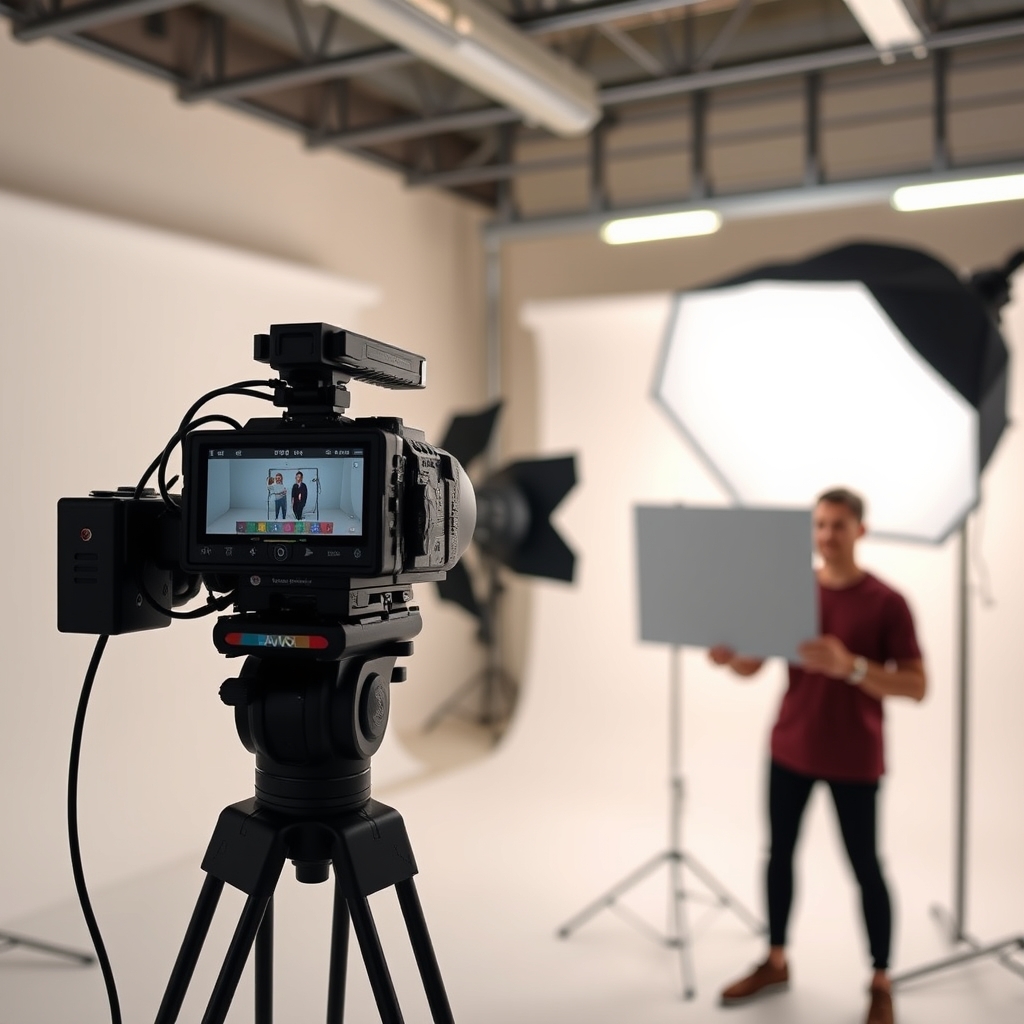
Five decisions are made on set, not in the edit: the framing, the subject's position, the combined margins, the text and the sound. Once the rushes are in the can, no software can rescue a subject pressed against the edge of the frame or a voiceover mentioning a price shown on screen.
Shoot wide, frame centred
We shoot in 4K and compose with the subject in the central third of the image. A 9:16 at 2160 × 3840 cropped to 4:5 keeps a resolution well above what the platforms require. The reverse doesn't work: going from vertical to a usable 16:9, you keep only about a third of the height and the subject falls out of frame. If 16:9 is in your cut-down plan, it gets shot, even quickly, as a second pass or on a B camera. We stopped promising a horizontal "extracted from the vertical" in 2025, because we were redoing the edit three times.
Reserve the margins for every placement, not just yours
The rule we apply: keep the top clear across about 15% of the height, the bottom clear across 25%, and a 10% strip on the right clear in vertical. These are combined margins, set for the most restrictive placement, not an average. To understand where these ratios come from and when 4:5 beats 9:16, we've covered the 9:16 and 4:5 ratios in detail.
Burn nothing in, keep the sound separate
The master goes out with no subtitles, no burnt-in logo and no price shown in the margins. All graphics are added at cut-down level. On the audio side, we always deliver three tracks: voice, music, ambience. A voiceover saying "click the link in bio" makes the YouTube cut-down unusable. Music laid into the master blocks you the day the licence doesn't cover paid. That's two lines in the brief, and they save two rebuilds.
Why does a simple crop destroy performance?
Cropping keeps the image and throws away the context: the opening, the pacing, the sound and the call to action don't play the same role from one platform to the next. A viewer scrolling Reels arrives after ten videos from friends; a Shorts viewer arrives after a search; a pre-roll viewer asked for nothing and has a "Skip" button right in front of them. Three mindsets, three different opening seconds.
What needs redoing for each output, in order of impact: the hook, the subtitles, the CTA, the sound. The hook comes first because it determines everything else. You don't rewrite a hook on instinct, you build it; the method is detailed in our three-layer method for writing a three-second hook. Here, just remember the rule: a cut-down without a re-hook isn't a cut-down, it's a copy.
The second misconception, and it's everywhere right now: "AI reframes on its own". Yes, it does. Automatic subject tracking works very well, we use it every day, and it saves us an hour per cut-down. It doesn't rewrite the opening line, it doesn't change the edit's turning point, and it doesn't know your promotion has ended. The tool moves the dial on technical time; editorial time remains untouched.
You can spot successful repurposing by one thing: the six outputs don't share the same first second. If they do, you've duplicated, not repurposed.
What constraints does each platform impose on cut-downs?
The constraint that breaks a repurposing job is almost never the aspect ratio; it's the safe zone, which changes with the placement and with the length of the on-screen text. The same 9:16 doesn't have the same usable margins in organic and in paid, nor with a two-line caption versus a five-line one. The subject stays visible, the subtitle slips under the button, and the message dies.
The horizontal cut-down, for its part, isn't a nice-to-have: according to YouTube Help, the standard aspect ratio for the desktop player is 16:9, and the player then adapts to the video. Running a vertical video as desktop pre-roll means paying CPM for two black bars. On our clients' YouTube campaigns, it's the first thing we fix.
For TikTok, dimensions, file sizes and interface margins change several times a year, so we keep TikTok dimensions, durations and safe zones up to date rather than repeating them here. The only reliable method, and it's also an admission of ignorance: platforms change their interface without notice, so we run a real graphics test every quarter. We publish a test cut-down, take screenshots on three phones and measure the lost pixels. It takes twenty minutes and saves a quarter of truncated subtitles.
The watermark: the detail that cancels out all the work
A video exported from the TikTok editor carries the logo and the username. Posted on Reels, it displays a rival platform's name on screen, which is rarely rewarded by distribution, and above all it tells the viewer they're watching reheated content. We always export from the editing software, never from the app. It seems obvious, yet it's the most common mistake on the accounts we take over.
How much does an extra output really cost?
A cut-down isn't free: allow between €40 and €250 excl. VAT for a vertical output from an already-shot master, and several hundred euros as soon as a proper horizontal edit is needed. The ranges below are from our 2026 quotes, excluding media budget, for an edited and colour-graded master. They aren't published market rates; they're ours.
| Cut-down | Indicative marginal cost | Rights to check | When it's not worth it |
|---|---|---|---|
| Re-hooked 9:16 Reel | €80–150 excl. VAT | Organic only or paid | Never: it's the core output |
| 4:5 Feed | €60–120 excl. VAT | Same licence as the 9:16 | If the subject already touches the edges |
| YouTube Short | €80–150 excl. VAT | Music needs relicensing | Without a channel being fed in parallel |
| TikTok In-Feed or Spark | €120–250 excl. VAT | Creator's authorisation code | If the creator refuses paid |
| 16:9 pre-roll | €250–600 excl. VAT | Extended media rights | If the horizontal wasn't shot |
| Stills and carousel | €40–90 excl. VAT | Image rights of extras | If the product is never in focus |
The calculation that settles it is simple. A half-day social shoot billed at €1,200 to €2,500 excl. VAT, depending on the set-up, produces one master. Six cut-downs cost between €600 and €1,300 excl. VAT. The cost per output therefore comes to around €300 to €630, versus €1,200 to €2,500 for a dedicated shoot per format. We put the tipping point at four outputs: below that, the extra pre-production (mapping margins, a double camera pass, separate audio tracks) eats up the gain. Above six, quality drops because you're forcing angles that didn't exist in the rushes.
A cut-down can also feed a channel that costs you almost nothing in media. We've applied the same marginal cost calculation to Pinterest for e-commerce catalogues: the logic is identical, only the denominator changes.
Do your usage rights still hold when organic content becomes an ad?
In most of the UGC contracts we audit, the licence covers organic use and stops there: the day you put budget behind it, you are outside its scope. It is the most expensive lock in repurposing, and the one least looked at. A derivative that changes status (organic to paid, brand account to creator account via whitelisting) changes contract.
Four points to lock down before you derive anything:
- Media scope. Organic only, paid, duration in months, territories, named platforms. “All digital media” means nothing when a derivative ends up as a YouTube pre-roll two years later.
- Music. The sound libraries built into the apps are reserved for organic use. A paid derivative gets re-edited onto a track cleared for commercial use, which sometimes means recalibrating the pace of the edit.
- Image rights of the people filmed. Anyone recognisable falls under image rights (Article 9 of the French Civil Code) and, as regards the processing of their image, under the notion of personal data as defined by the CNIL: employees, customers, passers-by in the background.
- Revocability of consent. The European regulation states in black and white that the data subject has the right to withdraw their consent at any time. Pulling out 2023 rushes in 2026 therefore means knowing who signed what, and being able to take down a derivative within 24 hours.
In practice, we keep a tracking sheet per shoot: name of the creator or extra, date, scope, expiry date, files concerned. Two extra columns on a spreadsheet. It is also what lets you price a rights extension honestly rather than discover it in a rush; the topic is covered in our article on what UGC usage rights really cover.
A firm stance, and one that sometimes costs us a sale: if a creator refuses paid usage and your derivatives plan includes three paid outputs, do not shoot with them. The content will be perfectly good, you will not be able to do anything with it, and you will pay twice.
How Do You Measure Repurposing Without Comparing Apples and Oranges?
We never compare two derivatives across platforms on the same metric: the denominators do not count the same thing. A “view” is not triggered at the same threshold on every network, and the three-second retention rate does not have the same base depending on whether it is calculated on impressions or on plays. Putting a Short and a Reel side by side in an Excel spreadsheet produces a wrong conclusion to two decimal places.
The protocol we apply with our clients comes down to three rules. First, each derivative is judged against the history of its own placement, never against another's. Second, outputs are compared on a common metric rebuilt by hand: cost per three-second view, or cost per outbound click. Third, we set an identical window, seven or fourteen days, because a Short keeps picking up views long after a Reel has died.
What we look at to know whether repurposing paid off is the cost per high-performing output, not the volume of content published. On a series of six derivatives, we consider the repurposing worthwhile if two outputs reach their placement's threshold. Three means a good master. Zero out of six, and the problem lies upstream: the shoot only had one angle, and no amount of reframing creates an angle.
What Does a Shoot-Ready Derivatives Plan Look Like?
A derivatives plan fits on one page and is signed off before the shoot, just like the script. Here are the eight lines we fill in with the client, in order, and pin to the call sheet on the day.
- A named list of outputs, with the target placement for each (not “Instagram”, but “paid Reels, cold audience”).
- Target ratio and duration per output, fixed before the shoot.
- Combined safe margins, marked with an overlay on the camera operator's monitor.
- A planned hook per output, one sentence each. Six outputs, six sentences.
- Cutaways to shoot in addition for the horizontal edit, listed in advance.
- Sound handling: voice with no mention of any platform, separate tracks, music added only at the derivative stage.
- Rights status per output: organic, paid, whitelisting, and expiry date.
- Post-production budget set aside, output by output, so the fifth derivative does not fall through the cracks for lack of a budget line.
The real saving in repurposing is not the editing time gained. It lies in not having to bring back an actor, a location, a product and a crew to get a twelve-second shot. Repurposing a video into several formats is a pre-production discipline disguised as an editing trick, and the brands that have understood this shoot less often, not more.
Frequently Asked Questions
- Can you repurpose an already published video without the master or rushes?
- Yes, but the results quickly hit a ceiling. Without rushes, you are working on a file that is already edited, already subtitled and often compressed. Reframing to 4:5 or 1:1 is still possible, and re-hooking is limited to adding a shot at the start. A horizontal derivative, however, is out of reach: the footage does not exist.
- How many outputs can you get from one day of shooting?
- On our productions, a well-prepared half-day yields four to six usable outputs, and a full day with two sets yields eight to twelve. Beyond that, you are forcing angles that are not in the rushes and quality drops. The limiting factor is not the length of the shoot but the number of angles actually filmed.
- Is AI auto-reframing enough to adapt a video?
- For the framing, often yes: subject tracking works well and saves about an hour per derivative. For the rest, no. The tool does not rewrite the opening line, does not change the tipping point of the edit and ignores your rights constraints. The technical time goes down; the editorial time remains.
- Should you repost the same edit on TikTok and Reels?
- Not recommended. An in-app export carries a watermark showing the name of a competing platform, and a hook calibrated for one network falls flat on the other. Export from your editing software and change the first second and the text graphics. The extra cost is around an hour of post-production.
- When is it better to reshoot rather than repurpose?
- As soon as the derivative requires more than four hours of editing and shots that do not exist, particularly for a true 16:9. An extra half-day of shooting, billed at between €1,200 and €2,500 excl. VAT with us, becomes more cost-effective if it also feeds two or three other angles.
- How do I know if my UGC contract covers paid advertising?
- Look for three things: the media scope (organic only or paid), the duration in months and the named platforms. Wording such as “all digital media” with no duration or list protects no one. Add a 24-hour takedown clause, as consent can be withdrawn at any time.
Let's Build Your Derivatives Plan Before Your Next Shoot
You have rushes gathering dust and formats you cannot keep fed. Esekai is a vertical video studio: creative ads, UGC and organic content for TikTok, Reels and Shorts, with a dedicated Creative Strategist, in-house shooting and editing, and fast iterations. We are not a full-service agency. Thirty minutes: formats, budget, action plan. No agency pitch deck.
Book a call →30 minutes to talk formats, budget and action plan.