

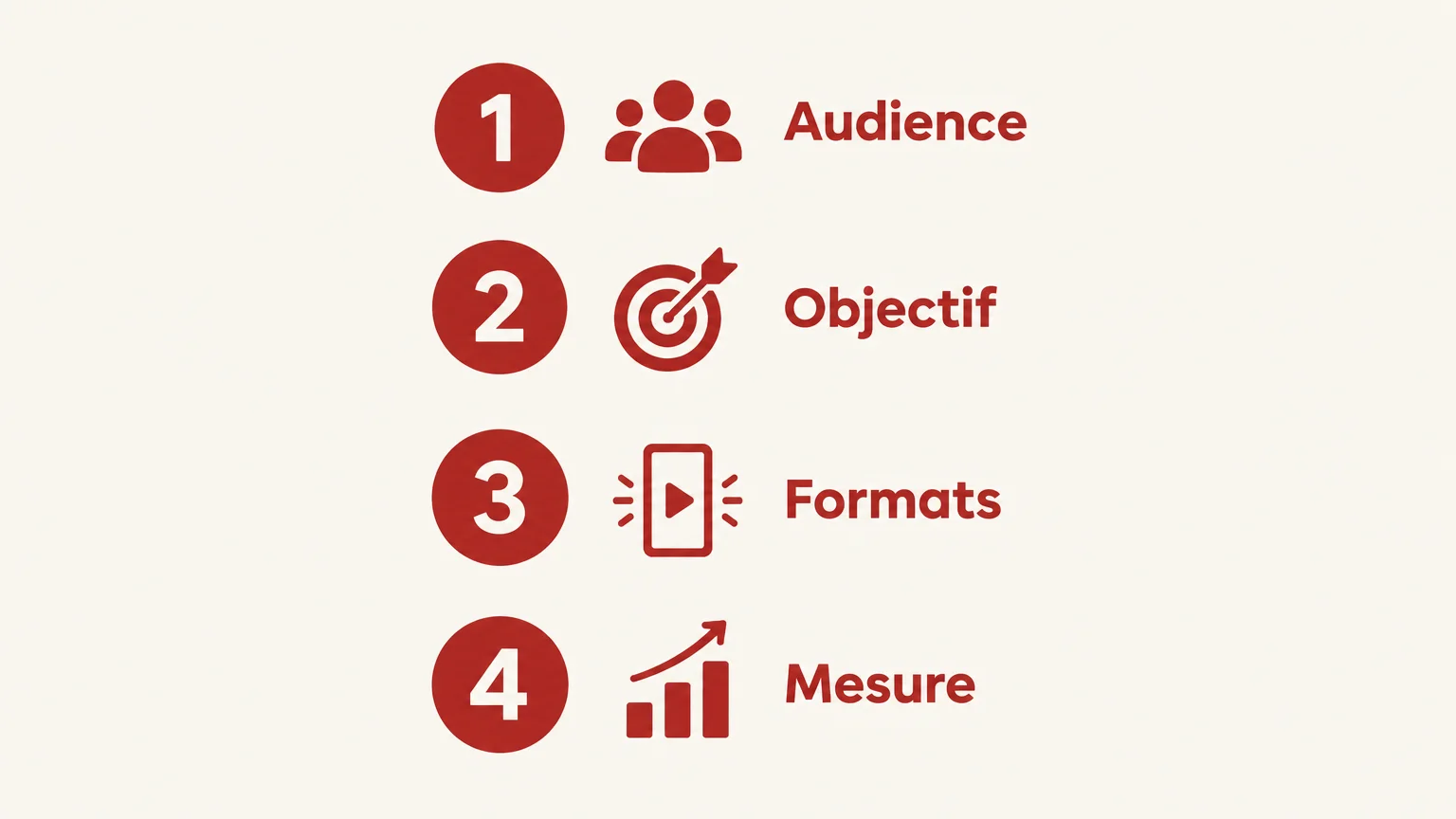
Being everywhere is not a strategy, especially if your resources don't allow you to feed every channel. To work out which social networks to invest in, start from your audience, your goals and the content you can produce regularly. To frame this choice over time, we can help you build a six-month social media strategy, linking your editorial priorities to your resources.
In France, 28.4% of adult internet users go on social networks to look for information about brands and products, according to the Digital Report France 2026 by We Are Social and Meltwater. This figure highlights what is at stake in terms of visibility, but it doesn't tell you which channel will suit your offer. To choose, also look at the purchase journey, the formats required and the results you'll be able to track.
What goal should your social network serve?
A brand looking to raise awareness of a new product doesn't have the same priorities as a company that wants to generate quote requests. First, define one main goal: awareness, engagement, traffic, acquisition or conversion. A secondary goal can complement the first, but avoid asking a single piece of content to meet all these expectations.
Your audience matters as much as your goal. The CNC study published in 2025 found that 73.5% of the French internet users surveyed used social networks every day. It also noted that YouTube, Facebook and Instagram were among the leading networks for video consumption in the countries studied. These benchmarks describe usage, but they are no substitute for analysing your target audience.
Describe your customers in terms that help the decision: consumers or businesses, geographical area, buying habits, needs and selection criteria. Then check where they discover products, look for advice or interact with brands. The size of a potential audience isn't enough if it doesn't match your market.
What content can you produce regularly?

A network becomes a realistic choice when you can publish suitable content on it without wearing out your team. A visual brand can prepare demonstrations, behind-the-scenes content or short videos. An expert business might instead share advice, case studies or viewpoints related to its field.
TikTok, Instagram Reels and YouTube Shorts all host vertical video formats, but the same creative won't necessarily carry over unchanged. The subject, pace, look and call to action need to match the channel and your audience. For luxury brands, we explain how to choose a social media strategy suited to the brand.
Before settling on a network, estimate the work involved: ideas, scripts, shoot, editing, approval and publishing. If you can't keep up the planned pace, reduce the number of channels or choose formats that are easier to adapt. Consistency and editorial adaptation matter more than a broad presence that is hard to maintain.
Which platform suits your audience and market?
Imagine one company selling in France and another looking for customers in China: their platform priorities won't be the same. TikTok can be considered for short videos aimed at discovery. Instagram suits a visual editorial line, while Facebook can complement a Meta strategy, particularly for targeted campaigns or local audiences.
For B2B, look at LinkedIn if your customers are seeking professional expertise and your team can publish industry content. YouTube fits into a longer-term video strategy, particularly when Shorts steer viewers towards long-form videos. RED, also known as Xiaohongshu, is worth considering when your brand is targeting the Chinese market.
The platforms' advertising planning tools counted 45.6 million adult identities in France at the end of 2025, according to Digital 2026 France. This figure, taken from advertising tools, is not the same as a count of unique active people. It gives a benchmark of potential reach, not proof that every platform brings together your future customers.
So compare the networks you shortlist against the same criteria: presence of your audience, content format, production cost, targeting options and the ability to measure the desired action. For a local shop, for example, in-store visits may be more relevant than views. For an e-commerce brand, track qualified clicks and conversions instead.
How can you test and measure without spreading your resources too thin?
Start with a limited test, with one main channel and a clearly defined goal. Choose a few representative pieces of content, set an observation period suited to your sales cycle and decide in advance which metrics matter. Depending on the aim, track reach, retention, engagement, clicks or conversions.
Compare similar pieces of content and change one element at a time, such as the hook, the format or the call to action. In advertising, separate the media budget from the production cost so you understand what each line item pays for. If the results match your goal, gradually increase your investment; if not, adjust the creative, targeting or channel before extending the test.
Our approach links creative and measurement, from video production to media management and social media management. We have worked with more than 350 brands and can point to over €50M in revenue generated and 500M cumulative views. These overall figures don't break down the results attributable to each client. To explore the approach further, read our article on how to make social media a strategic lever.
Choose the networks that serve your priorities
To decide which social networks to invest in, cross-reference your audience's habits, your commercial goal and your production capacity. Select one or two channels, measure metrics suited to your expected outcome, then expand your presence only if the lessons from the test justify it.
Build a strategy tailored to your goals
Choosing a network is only one step. You also need to define the content to publish, produce it in a suitable format and link its distribution to useful metrics. A clear strategy helps you coordinate organic content and paid campaigns, without confusing media budget and production.

We bring together strategy, vertical video production, media management and social media management according to your brand's needs. You can book a free 30-minute, no-obligation call to discuss your content and priorities. To find out more about how we work, discover our social media agency.
Frequently asked questions
Which social network should a small business choose?
Start with the channel where your customers are and that you can feed regularly. Choose a measurable goal, then assess the results before adding another platform.
Do you need to be on every social network?
No, a broad presence is only useful if you can adapt and publish content regularly. One or two well-chosen channels make testing and tracking results easier.
TikTok, Instagram or YouTube: where to start with video?
Compare your audience's habits and the formats you can produce. Test a creative tailored to each platform rather than systematically posting the same video everywhere.
How do you know if a social network is delivering results?
Link each channel to a goal and a metric, such as clicks for traffic or conversions for sales. Analyse the results over a period consistent with your purchase cycle.
What support can a brand get from Esekai?
We offer vertical video production, paid media management and social media management. Depending on your needs, our support can combine strategy, content creation and monitoring of interactions.