

A post with lots of views is not necessarily profitable, and a sale after exposure does not on its own prove the network's effect. To measure the performance of your social media activities, link a specific objective, the spend committed and an attributable commercial value. The return on investment of social media is not just about views or likes. It compares a financial contribution with the resources actually used. Without this framework, you risk crediting two platforms with the same conversion or confusing visibility with profit.
The calculation becomes usable once you set the period, the margin and the attribution rule before the campaign. An organic video, a paid campaign and editorial management do not necessarily produce the same results. Measure each against its objectives, then consolidate their costs and effects without counting the same sale twice.
What formula should you use to measure social media ROI?
A campaign can generate sales and still lose money if its costs exceed its contribution. The formula to use is: ROI (%) = (attributable contribution − total investment) ÷ total investment × 100. Contribution is the value generated after the variable costs of the products or services, but before marketing spend. A measurement guide published by Hootsuite in 2026 sets out this general logic for calculating ROI.
Let's take a fictional example. A campaign costs €5,700, adding up €3,000 of media, €1,800 of production and €900 of working time. It generates €18,000 of attributed sales with a contribution margin of 50%, i.e. €9,000. The ROI comes to around 58%, because (9,000 − 5,700) ÷ 5,700 × 100 ≈ 58. The figure assumes that sales attribution is reliable. It is not an industry average.
ROAS answers a different question. It divides attributed revenue by advertising spend, without necessarily including production costs or margin. In the example, media ROAS is 6, i.e. €18,000 of sales divided by €3,000 of advertising spend. To tell these two readings apart, you can also calculate the expected ROAS for creative ads.
An Accurate Calculation Starts with Full Costs
Imagine you are comparing an ad produced by an in-house team with a video shot by an external provider. If you only count the media budget, the comparison ignores part of the investment and distorts the ROI. Record the costs associated with the activity within a consistent scope, whether it is organic, paid or run across several networks.
Depending on your organisation, the total cost may include media spend, strategy, creative, the shoot, editing, tools and internal working hours. Also add fees for creators or a landing page when they are engaged for the campaign. To avoid double counting, allocate shared costs according to a written rule, then apply it identically in every period.
Also define what generated value means. For sales, favour contribution margin over revenue alone. For leads, assign a value based on observed sales data, such as conversion rate and average margin. If you use an estimate, keep it separate from the revenue actually recorded in your results.
Which metrics should you choose for your objective?

A metric only makes sense in relation to a specific decision. If your objective is awareness, immediate sales are not the only relevant signal. Conversely, a rise in interactions does not prove that your acquisition campaign is profitable.
- Visibility: track reach, impressions and video retention to assess exposure and attention.
- Consideration: look at clicks, page visits, saves and shares to measure the interest shown.
- Conversion: measure qualified leads, purchases, acquisition cost and attributable margin.
- Loyalty: examine repeat purchases or enquiries handled when content supports the customer relationship.
These intermediate metrics help you understand the journey, but they are not all financial gains. A view or a comment does not automatically become monetary value. If you assign an estimated value to awareness or engagement, document the method separately from financial ROI.
When Several Platforms Contribute to a Conversion
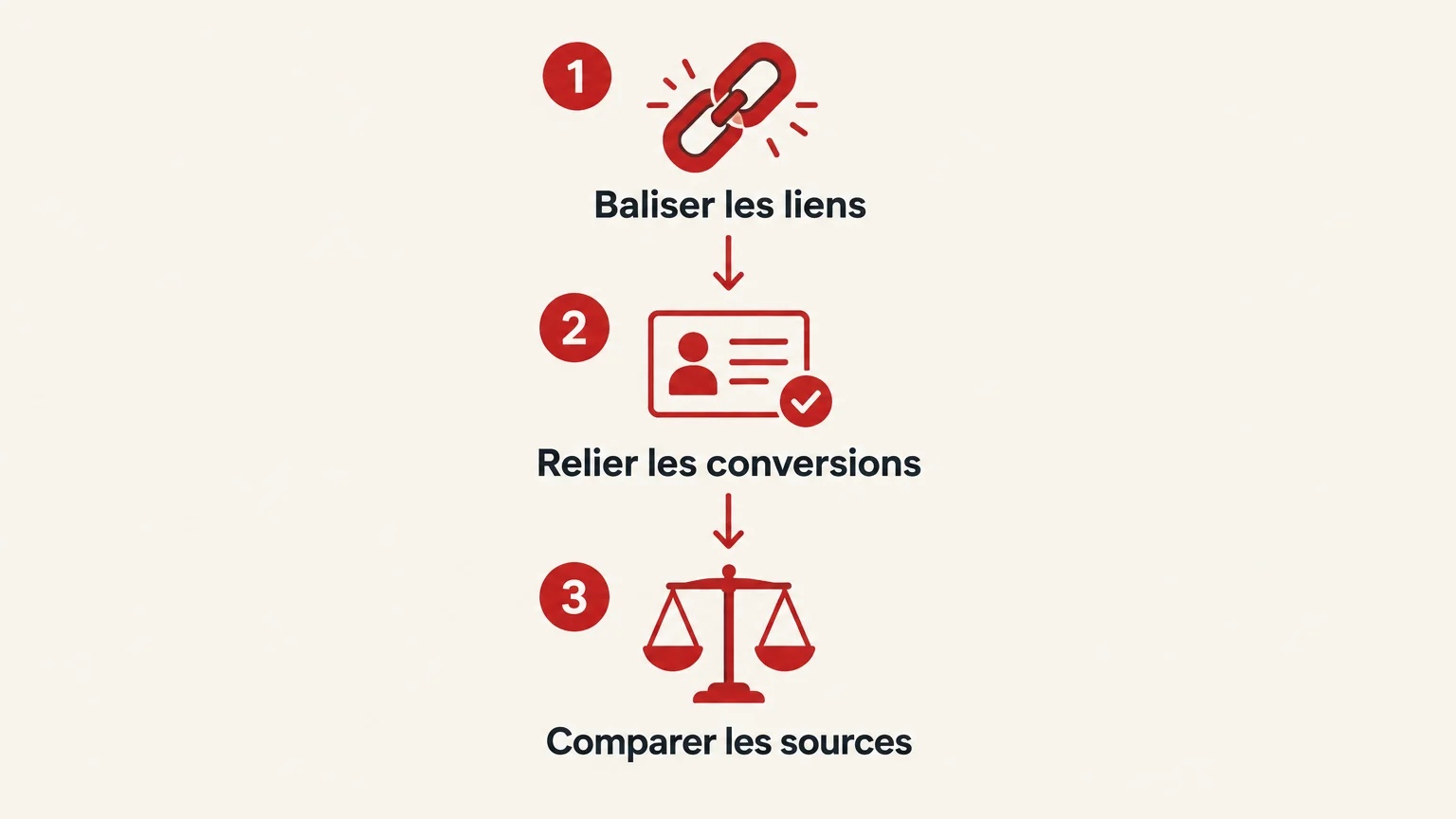
A buyer may discover a brand in a video, come back via an ad, then buy after a search. To track this journey, use consistent UTM links by network, campaign and content. Then link visits to conversion events and to the sales data available. Set the observation window before comparing results.
The Google Analytics documentation describes cross-channel conversion reports that include the interactions preceding a conversion. This view helps you avoid reducing the analysis to the last click. However, avoid adding up the conversions reported by each platform directly: the same sale may appear in several reports.
When TikTok and Meta results diverge, first check the attribution window, the definition of a conversion and the spend included. We explain how to reconcile TikTok and Meta attribution figures by aligning these scopes.
If your tools cannot determine which action actually triggered a sale, an incrementality test can complement tracking. Meta Blueprint presents Conversion Lift studies as a way to estimate a campaign's influence and to choose a suitable duration and conversion window. These tests require a design and data that match the question being asked.
The Measurement Period Should Follow the Buying Cycle
A quick sale and a purchase that takes several weeks cannot be judged over the same window. Set the observation period based on the usual time between first interaction and conversion. Also set a comparison period and keep it stable across the campaigns you are evaluating.
Compare periods that are as similar as possible. A promotion, a peak season, a price increase or a budget change can alter results independently of the content. Note these factors in the report and, where useful, separate organic results from paid results.
Your report should help you choose an action, not just display a percentage. In the Sprout Social Index 2025 figures reported by Sprout Social in May 2026, 65% of the leaders surveyed wanted to link social media campaigns directly to business objectives. This finding describes an expectation expressed in a survey, not a profitability threshold. Link each metric to a decision: continue, change the creative, adjust targeting or revisit the budget.
To set up regular tracking, define a six-month social media strategy with objectives, review periods and comparable criteria. Operational monitoring can be frequent, but the final ROI should wait until the end of the conversion window you have chosen.
Keep a Measure That Supports Decisions
To measure the ROI of your social media, start from an attributable financial contribution and subtract all associated costs, not just the advertising budget. Choose metrics linked to the objective, apply a stable attribution rule and compare relevant periods. Views, clicks and engagement shed light on the journey; they do not replace the profitability calculation.
Make Measurement a Lever for Decisions
When content, media spend and conversions are tracked separately, it becomes hard to understand what really contributes to results. We can combine content strategy, vertical video production, media management and social media management with metrics suited to your brand's objectives.

We have worked with more than 350 brands, and our published cumulative results exceed €50M in revenue generated and 500M views. These aggregate benchmarks do not replace the ROI calculation for your campaign. Depending on the content, we analyse views, retention, engagement, clicks and conversions, then test different approaches. To discuss your objectives and needs, discover our social media agency.
Frequently Asked Questions
What is the difference between ROI and ROAS?
ROI compares financial contribution with the full costs of the activity. ROAS divides attributed revenue by advertising spend, without on its own reflecting margin or all production costs.
Should working time be included in the calculation?
Yes, if you want to compare the full investment in your activities. Account for internal hours according to a consistent rule and avoid counting them again within a cost already included.
Which metrics should you track for an awareness campaign?
Track in particular reach, impressions and video retention to understand exposure and attention. Present them as progress indicators, unless you have a reliable method for assigning them a financial value.
How do you avoid counting a sale twice?
Define a reference source, a conversion window and an attribution rule before the campaign. Compare platform reports with analytics and sales data, without automatically adding up their conversions.
How can Esekai help measure your social media activities?
We can combine content production with media management or social media management. Depending on the objectives, we track metrics such as retention, clicks and conversions, then adjust the approaches tested.